Although the intensity of the fighting has fallen since the ceasefire agreed in late 2025, Gaza remains far from peace. Death, displacement and destruction continue, while outside the territory, some of Israel’s European partners are beginning to move beyond criticism towards more concrete political and economic measures.
For Gaza, this is what the present looks like: the bombing may have eased, but the consequences of war continue every day.
Sixty-One Million Tonnes of Rubble
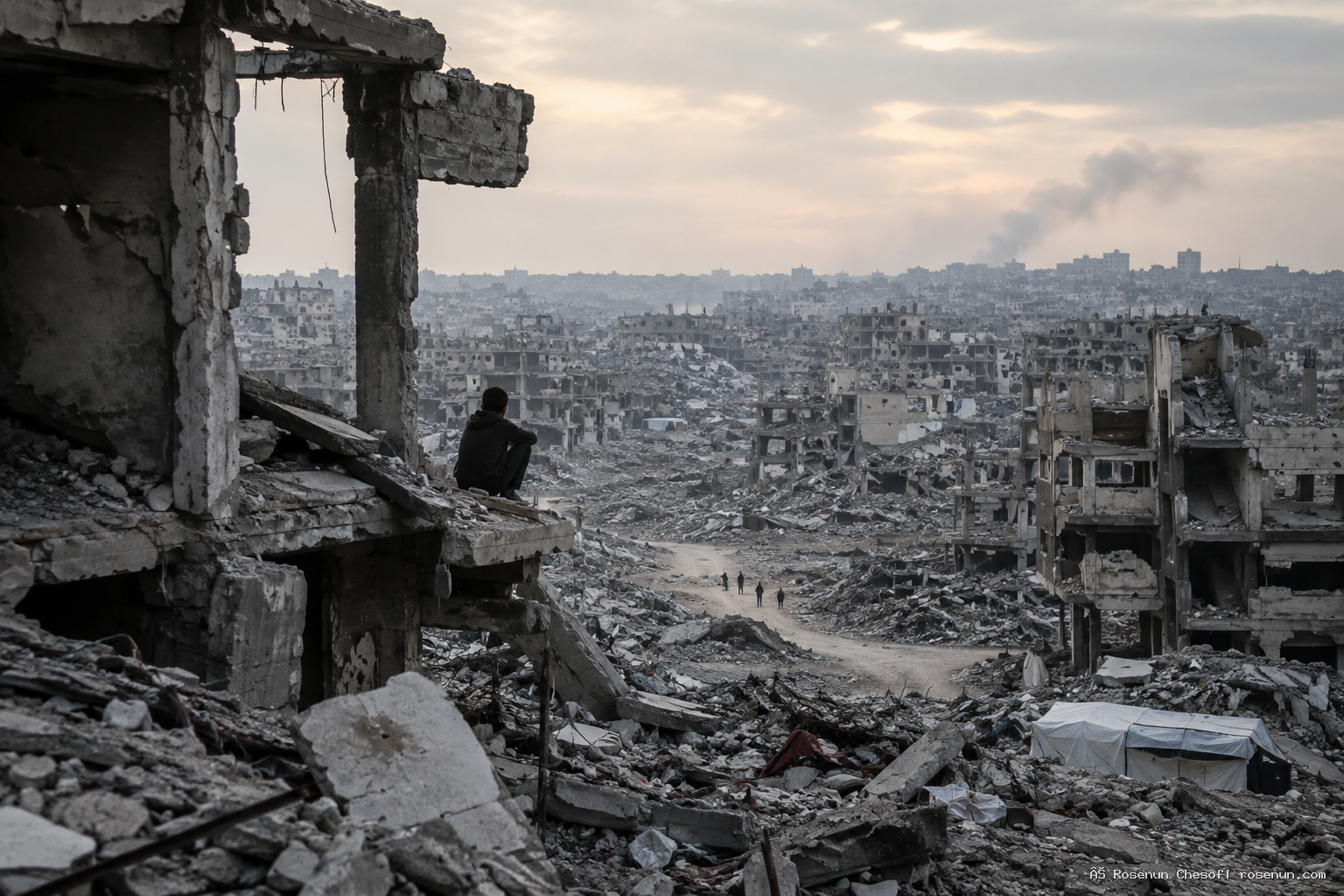
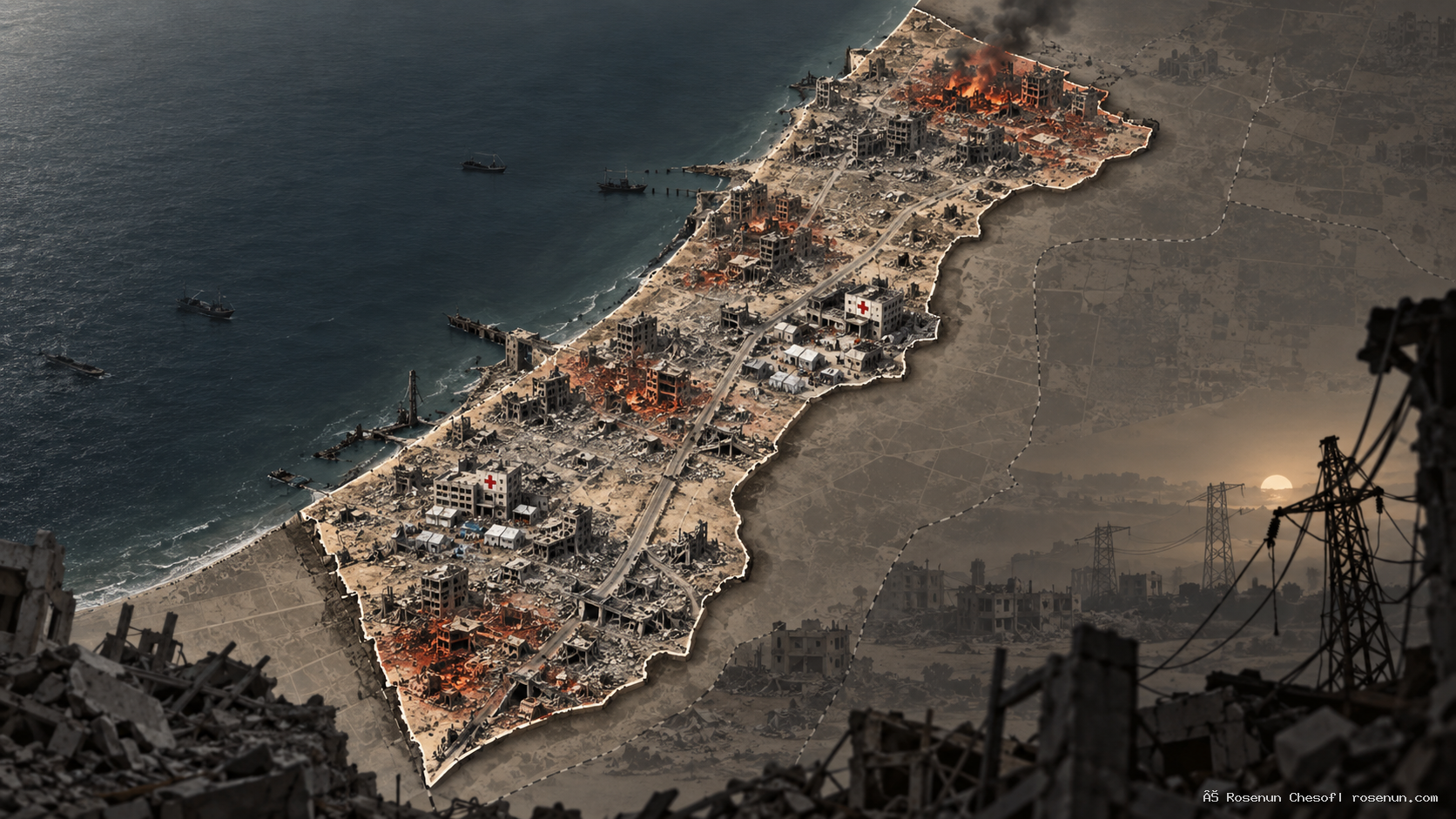
The United Nations estimates that the war since October 2023 has left approximately 61 million tonnes of rubble and debris across the Gaza Strip, and that clearing it could take years.
Palestinian authorities estimate that more than 8,000 people remain missing or buried beneath the ruins, while the death toll reported by Gaza’s Ministry of Health had risen above 73,000 by early September 2026.
The number of people killed in Gaza is therefore unlikely to be final. Bodies are still being recovered from buildings destroyed years ago.
In August, Palestinian rescue teams spent around two weeks searching the remains of a residential area in As Sabra, southern Gaza City, which had been struck in November 2023. According to figures cited by OCHA from the Palestinian Civil Defence, the operation recovered 112 bodies, including 40 children, 38 women and seven people with disabilities. Another 157 people from the same incident were still believed to be missing.
On August 20, another 50 people, including 19 children, were buried after their remains were recovered from beneath collapsed buildings in Gaza City.
The searches have continued into September.
On September 5, Al Jazeera reported that rescue teams in Gaza City recovered the remains of 55 Palestinians from the rubble of homes destroyed nearly three years earlier. Most were members of the Malaka family. The operation was carried out largely by hand because rescuers still lacked heavy machinery capable of lifting concrete slabs and clearing large collapsed structures. Al Jazeera: Gaza teams recover remains of 55 people nearly 3 years after Israeli strike
A day later, around 100 recovered bodies were buried in Gaza City. Many were members of the same family whose remains had been recovered earlier, underlining the fact that bodies from attacks carried out years ago are still being found today. Al Jazeera: Palestinians in Gaza bury remains of 100 people recovered from rubble
As long as homes, schools, roads and apartment blocks remain buried beneath enormous fields of debris, and heavy equipment remains scarce, the number of recovered dead is likely to continue rising.
Israel has rejected Albanese’s criticism in the past and maintains that its military seeks to minimise civilian casualties. It has also accused Hamas of using civilians as human shields, a claim Hamas denies.
Homes May Still Exist on the Map, but People Cannot Return to Them
Beyond the death toll lies the daily reality of the survivors.
OCHA reported in early September that most of Gaza’s roughly 2.1 million residents were entering the rainy season while living in overcrowded shelters, and that 94 per cent of the population required shelter assistance and basic household items.
In Gaza, displacement does not simply mean moving from one home to another.
For many families, it means living under tarpaulins, in tents, in converted schools or in makeshift shelters without adequate drainage, sanitation or privacy.
Humanitarian assessments have documented unsafe toilets, open pits, stagnant wastewater, poor drainage, fire hazards, insects and other health risks. Safe spaces for women and children remain limited.
As winter approaches, the question is no longer only where people will sleep.
It is whether those shelters can withstand rain, flooding, cold weather and the risk of disease.
OCHA warned on September 11 that overcrowding, inadequate shelter, poor access to clean water and weak sanitation were increasing the risk of respiratory disease, acute diarrhoea and jaundice-related illnesses. Preparations for winter have also been constrained by funding shortages and restrictions on the entry of materials into Gaza.
Hospitals Forced to Decide Which Buildings Get Power
Gaza’s energy crisis has become another layer of the humanitarian emergency.
The territory has lacked normal grid electricity since the war began in October 2023. Hospitals, water pumps, sewage systems and many homes have therefore depended heavily on generators.
By September 2026, Reuters reported that hospitals were facing shortages of engine oil, spare parts and fuel, forcing generators to operate beyond recommended maintenance cycles.
At Nasser Hospital, power had to be rotated between buildings simply to keep essential services running.
OCHA, citing the UN 2720 mechanism, reported that since March 1 only 13,445 litres of engine oil had been approved for entry, while more than 92,000 litres remained awaiting approval. The shortages have affected hospitals, water systems, sanitation and waste management.
Israel says it operates inspection mechanisms for humanitarian supplies entering Gaza in order to prevent materials from being diverted for military use by Hamas. Humanitarian organisations, however, say that both the quantity of supplies and the speed at which they enter remain far below what is needed.
There Is a Ceasefire — But Has the War Really Stopped?
This is where Gaza’s situation in 2026 becomes difficult to describe.
The ceasefire agreed in October 2025 sharply reduced the scale of major fighting after two years of war. But it did not stop all attacks.
According to Gaza’s Ministry of Health figures cited by OCHA, from the declaration of the ceasefire on October 10, 2025 to early September 2026, a further 1,358 Palestinians were reported killed and 4,541 wounded, including people killed in new attacks, those who later died from injuries, and bodies recovered from beneath rubble.
Reuters has similarly reported that the ceasefire halted large-scale warfare but did not end Israeli strikes entirely. Since October 2025, more than 1,250 Palestinians had been reported killed, while four Israeli soldiers were killed in attacks by Palestinian forces during the same period.
So the question — when will the war in Gaza actually end? — still has no convincing answer.
A US-backed plan has proposed ending military operations, disarming Hamas, withdrawing Israeli forces and establishing a new Palestinian civilian administration in Gaza.
Hamas has said it could accept such a framework if Israel withdraws its forces and ends its attacks. Israeli Prime Minister Benjamin Netanyahu, however, rejected the latest version of the plan in August, particularly provisions that would restrict attacks against Hamas leaders.
Negotiations involving Egypt, Qatar, Turkey and the United States continue.
The mechanism for ending the war may exist.
A political settlement that all sides accept does not.
And as long as the questions of Israeli withdrawal, Hamas’s weapons, Gaza’s post-war administration and Israel’s security guarantees remain unresolved, the ceasefire remains closer to an uneasy pause than to permanent peace.
Europe Is Beginning to Move Beyond Words
Outside Gaza, another change is becoming increasingly visible: the position of some of Israel’s Western partners.
On September 8, foreign ministers from 12 countries — Canada, Denmark, Finland, France, Iceland, Ireland, Norway, Poland, Portugal, Spain, Sweden and the United Kingdom — announced that they would adopt national measures or support European action restricting trade connected to Israeli settlements in the occupied West Bank. Al Jazeera: UK, France among 12 states backing sanctions on illegal Israeli settlements
Britain went further, announcing a ban on imports from Israeli settlements and measures targeting businesses, organisations and individuals involved in settlement expansion, including sanctions on extremist settlers.
British Foreign Secretary Ed Miliband said Britain could no longer simply point to injustice and suffering; it had to act.
Al Jazeera noted, however, that while the British move carries considerable political significance, its immediate economic impact may be more limited because the measures target goods and activity linked to settlements in occupied territory rather than trade with Israel as a whole. Al Jazeera: UK bans goods from Israeli West Bank settlements — what that really means
France has taken a similar position.
Foreign Minister Jean-Noël Barrot has pointed to rapid settlement expansion, growing violence against Palestinians and the E1 project, which France argues threatens the viability of a future Palestinian state.
Israel responded strongly, announcing the closure of the British consulate in East Jerusalem and reducing British involvement in some Gaza-related coordination mechanisms.
These developments do not yet amount to Europe collectively turning its back on Israel.
But compared with the political atmosphere immediately after October 7, 2023, the shift is increasingly difficult to ignore.
Europe Is Still Divided
The distinction matters.
France, Britain, Spain and several other European countries are adopting a tougher position, but the European Union as a whole has still been unable to agree on how far to go.
The European Commission has proposed suspending some trade preferences under the EU–Israel Association Agreement, but the measure has failed to secure the necessary support among member states.
France has openly acknowledged that efforts to adopt stronger EU-wide measures have been blocked, particularly by opposition from Germany.
Germany remains one of the clearest examples of the divide.
Berlin temporarily suspended some arms exports to Israel in 2025, but later resumed them. In September 2026, Germany also asked the International Court of Justice to dismiss Nicaragua’s case accusing Berlin of violating its obligations under the Genocide Convention through its military support for Israel.
So the idea that “Europe is turning away from Israel” should be understood as an expanding political trend, not a continent-wide shift occurring at the same speed.
Some governments are moving beyond condemnation.
Some remain cautious.
Others continue to place greater emphasis on Israel’s security.
A Ceasefire, but Not an End
Gaza may no longer be experiencing warfare on the same scale as before, but it remains far from peace.
People are still being killed. Families remain displaced. Hospitals continue to operate under severe restrictions. And bodies are still being recovered from beneath buildings destroyed years ago.
For Gaza, the question is no longer whether the world knows what is happening.
The world knows.
The harder question is whether the response so far has been enough.
Enough for families still waiting to bury their dead.
Enough for children growing up among ruins.
Enough for people who still have no home to return to.
And enough while the remains of the missing continue to emerge from beneath the rubble.
Perhaps that is the most difficult question Gaza now puts to the world:
How much longer will the world continue to watch before admitting that what it is doing is still not enough?