Today’s university classroom – one scene has become so common that it is hardly surprising anymore.
An instructor gives students an assignment. Students go home, open ChatGPT or another AI tool, copy and paste a prompt, and within seconds receive hundreds or even thousands of words in response. Some read the answer carefully, verify it and develop it further. Others make only a few changes before submitting the work.
On the other side of the process, instructors are using AI too. It can help prepare lessons, design activities, summarise documents, review assignments, generate feedback and even suggest preliminary grades.
So if students use AI to help produce their work, and instructors use another AI system to help assess it, perhaps the most important question is no longer who is “cheating” or who is “using too much AI".
The more interesting question is this:
In this entire process, who is learning?
That question does not imply that AI is an enemy of education.
Quite the opposite. AI may be one of the most powerful learning tools we have ever had.
The real problem is whether we are trying to use a new technology while keeping the same old model of learning.
When answers arrive in seconds
In the past, when students were given a research assignment, they might begin by looking for books, searching library databases, reading several articles, comparing sources, taking notes and gradually constructing an argument of their own.
All of this took time.
But much of the learning happened along the way.
Students do not learn only from the final answer. They learned from not finding what they were looking for, from struggling with difficult texts, from encountering conflicting evidence, from deciding which sources to trust and from gradually refining an unclear question into a better one.
AI has transformed that process.
What once took several hours may now take only a few minutes. What once required reading across multiple sources can now be summarised quickly with the help of AI.
And that is not necessarily a bad thing.
If a task that used to take two hours can now be completed in twenty minutes, there is little value in forcing students to spend the full two hours simply to preserve an older way of working. Outside the university, the workplace they will eventually enter is already using these tools.
The more important question is:
What happens to the remaining one hour and forty minutes?
If that time is used to read further, ask better questions, verify AI-generated claims, compare interpretations or think more deeply, then AI may genuinely expand learning.
But if the entire process — searching, thinking, organising and concluding — is reduced to typing a prompt and pressing Enter, then time has been saved at the cost of removing much of the learning itself.
The OECD makes a similar distinction in the Digital Education Outlook 2026. Successfully completing a task with Generative AI does not automatically mean that learning has taken place. AI can improve performance, but if it is used without a clear learning purpose, it may simply do the work for the learner without producing deeper understanding (OECD, 2026a).
That is the difference between using AI to learn and using AI to do the learning for us.
A problem for some, an opportunity for others
University instructors do not all see AI in the same way.
One group sees it as a serious problem.
Students may read less, conduct less independent research, submit work they do not fully understand and gradually lose their ability to think, analyse and write on their own.
These concerns are not unfounded.
The Global AI Faculty Survey 2025 by the Digital Education Council surveyed 1,681 faculty members from 52 higher education institutions across 28 countries. It found that 83% were concerned about students’ ability to critically evaluate AI-generated outputs, while 54% believed that current assessment methods were no longer sufficiently suitable for an AI-enabled world (Digital Education Council, 2025).
Yet another group of instructors looks at the same technology and sees opportunity.
If AI can reduce hours of routine work, explain difficult concepts in different ways, support translation, generate questions, provide feedback or offer another perspective, why should educators reject it?
Interestingly, the same survey found that 65% of faculty regarded AI as an opportunity, while 35% saw it as a challenge, and 86% expected to use AI in their teaching in the future (Digital Education Council, 2025).
Those numbers reveal something important.
Educators can be worried about AI and still see its potential at the same time.
The two positions are not mutually exclusive.
That is why the debate over whether AI is “good” or “bad” for education may already be asking the wrong question.
The better question is:
What are we using AI for, and at what point in the learning process are we using it?
Knowledge still matters — because without it, we can’t tell when AI is wrong.
A growing question today is whether students still need to learn factual or disciplinary knowledge when AI can answer almost anything.
The answer is still yes.
Without background knowledge, it becomes extremely difficult to evaluate what AI produces.
If we know nothing about a subject, how can we recognise when an answer is inaccurate, when an important context has been ignored, when evidence is incomplete or when a complicated issue has been oversimplified?
AI does not make knowledge irrelevant.
If anything, knowledge becomes more important in a world where anyone can generate a polished and convincing answer within seconds.
The ability to distinguish between an answer that is useful, one that is wrong and one that is simply incomplete becomes a central intellectual skill.
This is also why “knowing how to ask AI” should not be reduced to writing longer or more sophisticated prompts.
People who know more about a subject can usually ask better follow-up questions.
Instead of simply asking:
“Explain this theory to me."
A student might ask:
What assumptions does this theory depend on?
Who has challenged it?
What evidence supports the opposing position?
Would the theory still work in a different social context?
Questions like these do not come from prompt technique alone.
They come from knowledge and the ability to think.
Or perhaps the assignment itself is the problem.
If an assignment can be copied into an AI system and returned as a finished answer within a minute, we may also need to ask whether the problem lies only with students using AI — or with the way the assignment was designed in the first place.
Consider a prompt such as:
“Explain Theory X in 1,000 words.”
AI can already do this reasonably well.
But consider a different task:
“Here is an AI-generated explanation of Theory X. Identify where the explanation oversimplifies the theory, analyse the assumptions hidden within it, and provide one case that the theory fails to explain.”
The nature of learning has immediately changed.
AI still available.
But it can no longer replace the student’s thinking completely.
An article published on UNESCO IdeasLAB by Hrishikesh Desai makes a similar argument. As AI becomes increasingly capable of producing essays, solving problems and generating polished outputs, assessment should move beyond judging only the final product and place greater emphasis on higher-order thinking, creativity, reasoning and the process by which students arrive at their conclusions (Desai, 2025).
Perhaps, then, the question should no longer be:
“Should students be allowed to use AI?”
It should become:
“What should we ask students to do with AI?”
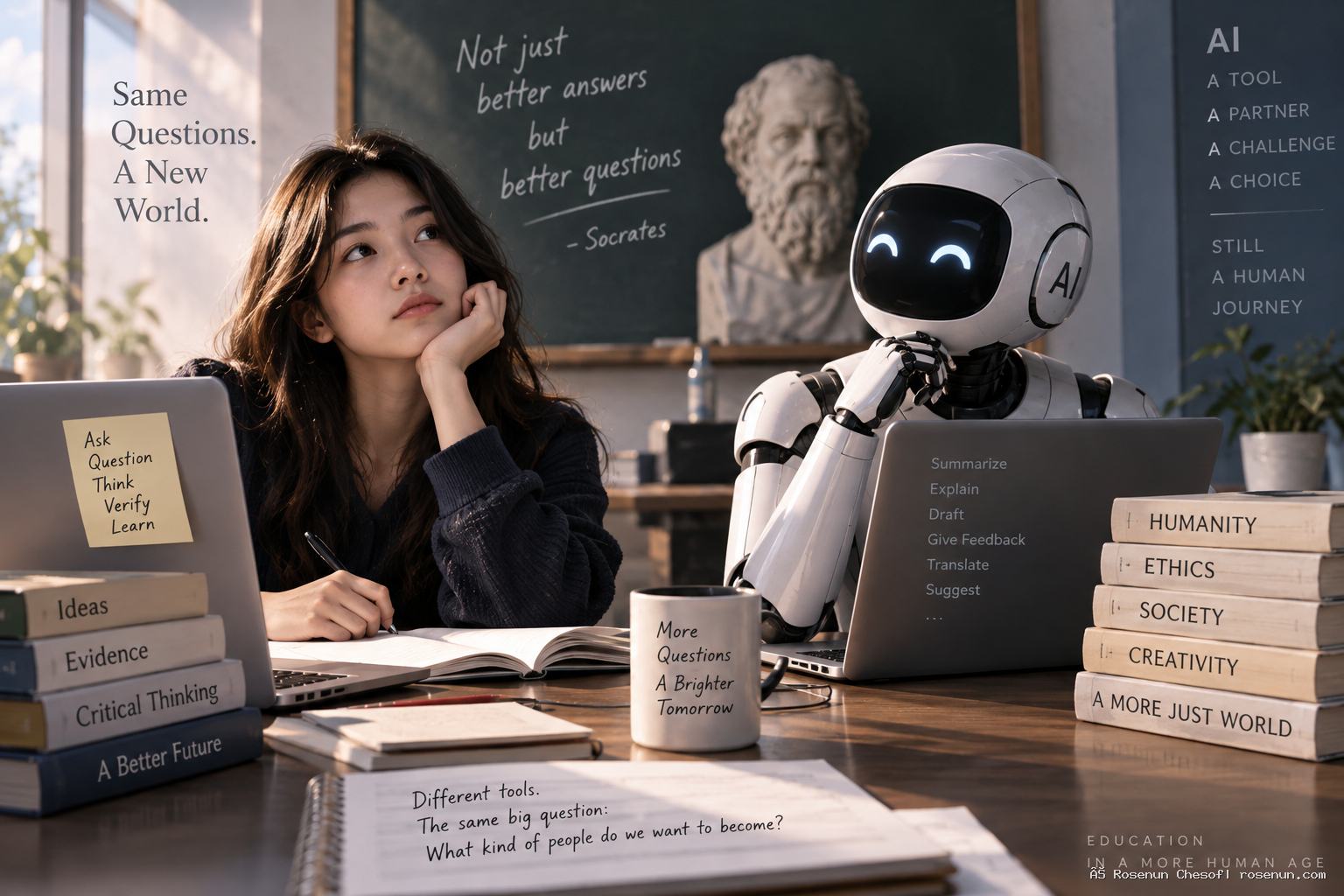
AI may take us back to Socrates.
There is an interesting irony here.
One of the most advanced technologies ever developed may push education back toward one of its oldest approaches to learning:
the Socratic method.
Socrates was not remembered for standing in front of a class and delivering long explanations.
He was remembered for asking questions.
And then asking again.
When someone offered an opinion, he would probe the reasoning behind it, question its assumptions and use further questions to expose contradictions in what the person believed they already understood.
Learning happens through dialogue and dialectic.
Not simply:
teacher, and the student writes notes.
but rather:
In the past, access to answers was difficult.
In the age of AI, we may need to return to Socratic learning for exactly the opposite reason:
Because there are now too many answers.
When answers become easy to obtain, education has to place greater value on the ability to question, challenge, argue and defend a position.
An instructor might ask:
“Why do you believe that?”
“What evidence supports your conclusion?”
“If I disagree, how would you defend your position?”
“If new evidence contradicts your argument, would you change your mind?”
These questions reveal whether students understand what they have submitted, or merely possess an answer.
Future assignments may not need to ban AI at all.
Instead, students could be required to show how they used it: what they asked, where the first answer was weak, how they verified it, what sources they consulted and why they ultimately accepted or rejected the AI’s response.
Instead of assessing only the answer, we begin to assess the thinking process.
Instructors must change too.
The responsibility does not belong to students alone.
If we tell students not to hand over all their thinking to AI, but instructors then hand over the entire task of reading and evaluating student work to another AI system, we are doing essentially the same thing from the other side.
AI can certainly help.
It can check for basic elements, compare work against a rubric, identify patterns, or generate a first draft of feedback.
But there is a difference between helping to assess and making the judgement.
The OECD’s Reimagining Teaching in an Accelerating World addresses this directly. AI can reduce workload and support grading or feedback, but assessment also involves context, creativity, originality and the relationship between teacher and learner — dimensions that an AI system may not fully understand.
The OECD’s principles are straightforward: algorithms may offer suggestions, but teachers must remain responsible for the final judgement; assessment should not simply be outsourced to AI (OECD, 2026b).
The same principle can apply to students:
AI may suggest. Humans must still think and decide.
The role of the instructor does not disappear because AI knows more.
It changes.
“How did you arrive at this answer?”
Education is not becoming meaningless — but the meaning of learning has to change.
AI does not make reading, writing, research or foundational knowledge unnecessary.
They still matter.
But perhaps education should no longer spend most of its time asking students to produce answers that a machine can generate within seconds.
What should become more valuable are understanding, comparison, doubt, evidence, reasoning and the willingness to change one’s mind when the evidence no longer supports it.
AI, then, may not be a crisis for education.
It may be the pressure that finally forces education to confront a question it has avoided for too long:
What do we want students to learn?
In an age when answers are becoming cheap, what becomes valuable is not having the greatest number of answers.
It is knowing what to ask.
Knowing what to doubt.
Knowing which evidence deserves trust.
Knowing when an argument is still insufficient.
And knowing when we must accept that our own position may be wrong.
AI may answer questions faster than any human can.
But that does not mean it can learn on our behalf.
And perhaps, in an age when machines can answer almost everything, the most important role of the teacher will return to something Socrates was doing more than two thousand years ago:
not giving students the answers, but teaching them how to ask better questions.
References
Digital Education Council. (2025). Digital Education Council Global AI Faculty Survey 2025.
Desai, H. (2025). What’s worth measuring? The future of assessment in the AI age. UNESCO IdeasLAB.
OECD. (2026a). OECD Digital Education Outlook 2026: Exploring Effective Uses of Generative AI in Education. OECD Publishing. https://doi.org/10.1787/062a7394-en
OECD. (2026b). Reimagining Teaching in an Accelerating World. OECD Publishing. https://doi.org/10.1787/d0edfe8c-en