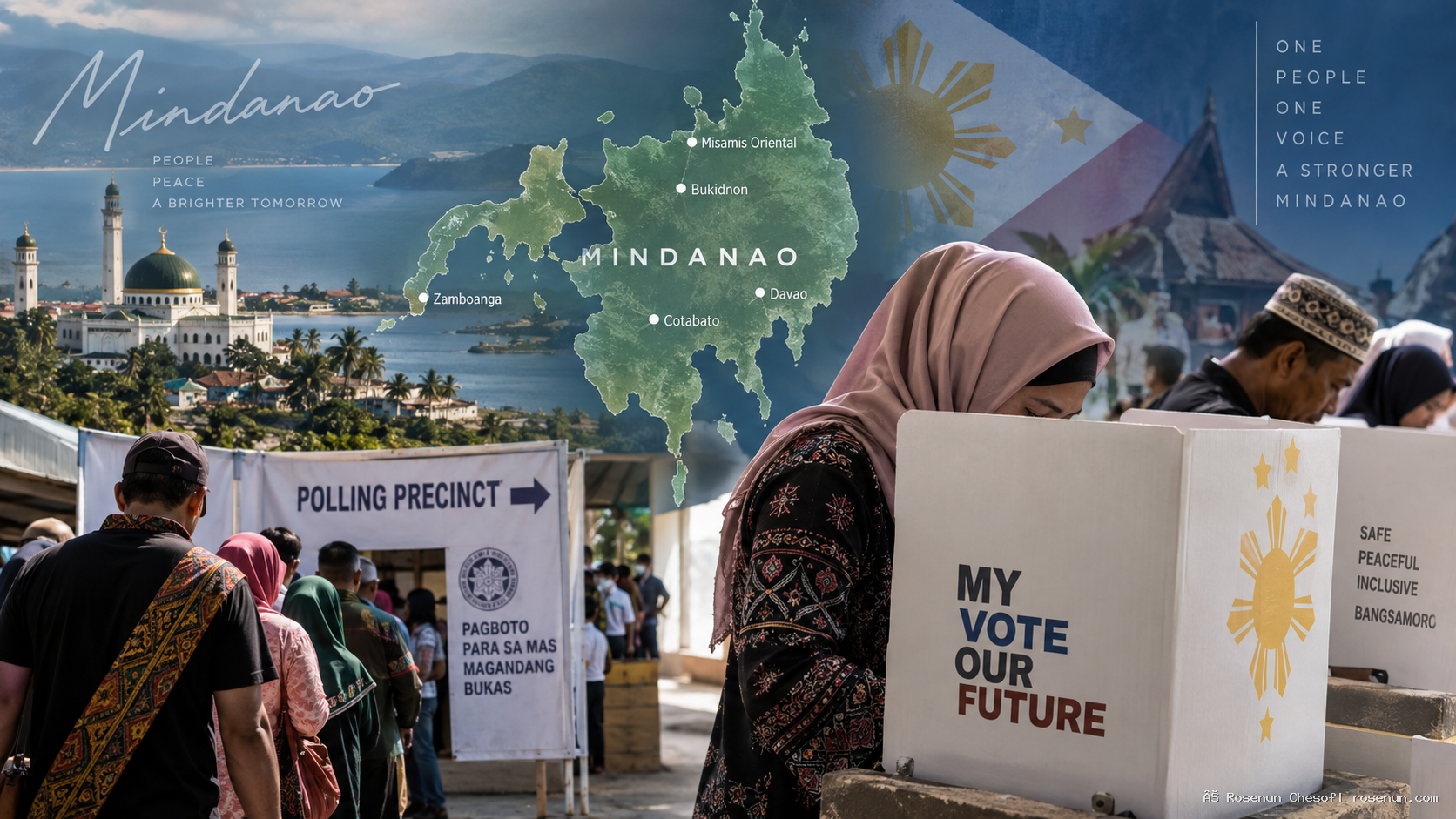
The vote was far more than another local election. It marked another important step in a long transition away from armed struggle and towards representative politics and democratic institutions.
Around 2.393 million voters were eligible to take part in the election for the 80-member Bangsamoro Parliament. Of those seats, 40 are allocated through political parties, 32 are elected from parliamentary districts, and eight represent different sectors of society.
Once the parliament is formed, its members will elect the Chief Minister, who will head the regional government.
For Bangsamoro, this election also marks the transition from the Bangsamoro Transition Authority, which has governed the region since BARMM was established, to a parliament chosen directly by voters for the first time.
For many readers outside the Philippines, however, the name “Bangsamoro” may still be unfamiliar. Behind it lies a history that stretches back centuries and one of the most complex political conflicts in Southeast Asia.
Muslim states existed here before the Philippines
Muslim communities in Mindanao and the Sulu archipelago did not emerge after the creation of the modern Philippine state.
Islam reached the southern islands through regional trade networks long before the Spanish arrived. By the early 15th century, a sultanate had emerged in Sulu, while Islamic political institutions later developed in Mindanao as well.
The Sultanates of Sulu and Maguindanao developed their own systems of governance, laws, trading networks and relationships with other states across the wider Malay world.
When Spain began expanding into the Philippine archipelago in the 16th century, it was therefore not entering an empty political landscape. It encountered established Muslim societies with their own rulers, institutions and regional connections.
It was during this period that the word “Moro” became associated with the region.
Where did the word “Moro” come from?
“Moro” was not originally the name of a single ethnic group.
The Spanish word Moro is related to the English term Moor, historically used by Europeans to describe Muslims from North Africa and the Iberian Peninsula.
When Spanish colonisers encountered Muslim communities in Mindanao and Sulu in the 16th century, they applied the same familiar label to them and began referring to them as “Moros”.
First, it was a name imposed from the outside rather than a shared identity used by all Muslims in the region.
In reality, the Muslim population of the southern Philippines has always been ethnically and linguistically diverse. These include groups such as the Tausug, Maguindanaon, Maranao and Sama, among others.
The Tausug of Sulu, for example, are a distinct ethnic community. They are not synonymous with the wider term Moro.
Over time, however, especially during the political movements of the 20th century, Muslim leaders and organisations began reclaiming the word Moro as a broader collective identity. It helped unite different Muslim communities across Mindanao, Sulu and Palawan under a shared political cause.
The word Bangsamoro combines bangsa — a Malay term broadly meaning “people”, “nation” or “community” — with Moro.
In its modern political sense, Bangsamoro therefore does not refer to a single tribe. It describes a broader collective identity rooted in the historical Muslim communities of Mindanao and the surrounding islands.
The Philippine government itself describes Bangsamoro as an identity rather than a nationality. The term may refer both to the people and to the autonomous political entity that eventually emerged from the peace process.
A conflict with deep historical roots
Spanish efforts to expand control into Mindanao and Sulu were met with sustained resistance from Muslim polities and communities.
The long series of military encounters between Spain and the Muslim south is often grouped under the term Moro Wars.
Although Spain ruled much of the Philippine archipelago for centuries, its control over Muslim societies in Mindanao and Sulu remained far more limited than in many parts of the northern Philippines.
Following the Spanish-American War in 1898, the United States took control of the Philippines, including Mindanao and Sulu.
These territories later became part of the independent Republic of the Philippines when the country gained sovereignty in 1946.
Yet the end of colonial rule did not resolve long-standing questions surrounding land, political representation, identity and self-government in the Muslim south.
The Philippine government itself has acknowledged that grievances accumulated over decades for many reasons, including the loss of ancestral land, migration into Mindanao from other parts of the country, poverty, social marginalisation and a widespread sense that the political rights and historical identity of Muslim communities have not been adequately recognised.
By the late 1960s, these grievances were again becoming increasingly explosive.
From MNLF to MILF
The Jabidah incident of 1968 became one of the events that helped intensify Moro nationalism.
By the early 1970s, the Moro National Liberation Front (MNLF), led by Nur Misuari, had emerged as a major armed movement fighting the government of President Ferdinand Marcos.
Heavy fighting followed.
Eventually, the Philippine government and the MNLF entered negotiations and signed the Tripoli Agreement in Libya on December 23, 1976. The agreement sought to establish autonomous arrangements for Muslim areas in the southern Philippines.
But disagreements over its implementation soon emerged, and armed conflict continued.
At the same time, divisions developed within the MNLF itself.
A group led by Hashim Salamat broke away from the MNLF in 1977 and later formally established the Moro Islamic Liberation Front (MILF) in 1984.
From then on, the Philippine government faced a peace process that increasingly followed more than one track.
In 1989, the government created the Autonomous Region in Muslim Mindanao (ARMM).
In 1996, it signed a Final Peace Agreement with the MNLF in an effort to fully implement the earlier Tripoli Agreement.
But conflict with the MILF continued.
From the battlefield back to the negotiating table
Formal negotiations between the Philippine government and the MILF developed during the 1990s.
The process was uneven. Periods of ceasefire were repeatedly interrupted by renewed fighting, yet both sides continued searching for a political settlement.
Malaysia later became involved as a third-party facilitator, helping to mediate between the Philippine government and the MILF and supporting negotiations that eventually led to several major agreements.
October 2012, the two sides signed the Framework Agreement on the Bangsamoro.
Then, on March 27, 2014, the Philippine government and the MILF signed the Comprehensive Agreement on the Bangsamoro (CAB).
It was a major turning point.
Under the agreement, the MILF abandoned its goal of creating a separate independent state in exchange for a stronger form of self-government within the Philippines.
That agreement laid the foundation for what would later become BARMM.
From peace agreement to BARMM
The 2014 agreement did not immediately create Bangsamoro as it exists today.
The transition took several more years.
In 2018, the Bangsamoro Organic Law was enacted, followed by a plebiscite in 2019.
The result was the creation of the Bangsamoro Autonomous Region in Muslim Mindanao — BARMM, which replaced the former ARMM.
The new autonomous region was granted greater political and fiscal powers than its predecessor and adopted a parliamentary system at the regional level.
Today, BARMM includes Basilan, Lanao del Sur, Maguindanao del Norte, Maguindanao del Sur and Tawi-Tawi, as well as the cities of Cotabato, Marawi and Lamitan and parts of North Cotabato.
Sulu, despite its central place in Moro history, is no longer part of BARMM. In 2024, the Philippine Supreme Court ruled that the province should be excluded from the autonomous region because voters in Sulu had rejected the Bangsamoro Organic Law in the 2019 plebiscite.
Since BARMM was established, the region has been governed by the Bangsamoro Transition Authority, an interim administration that includes many former MILF leaders and members who have moved from the armed struggle into formal politics.
One of the central goals of that transition was to eventually hold elections and allow voters themselves to decide who should govern Bangsamoro.
The election was delayed several times because of legal disputes, redistricting and the consequences of the Supreme Court ruling on Sulu.
At last, September 14, 2026 became the date of BARMM’s first parliamentary election.
The day Bangsamoro went to the polls
The election proceeded across most of the region, although violence and irregularities were reported in several areas.
Associated Press reported deaths linked to election-related violence in Cotabato, while voting in parts of Maluso on Basilan Island had to be postponed after officials discovered ballots that had apparently been pre-shaded.
The Commission on Elections ordered replacement ballots to be printed.
More than 20,000 soldiers and police officers were deployed across the region to provide security.
Despite these incidents, the broader picture on September 14 was strikingly different from much of Bangsamoro’s past.
People living in a region long associated in international headlines with insurgency and armed groups were lining up outside polling stations to choose their representatives.
By September 15, partial and unofficial results had begun to offer the first outline of the new parliament.
According to GMA News at 3:59 p.m., the Bangsamoro Federalist Party (BFP) was leading the party votes with about 35.1%, followed by the United Bangsamoro Justice Party (UBJP) with 32.4% and the BARMM Grand Coalition (BGC) with 20.6%. The Raayat Democratic Party had around 3.6%.
Based on those partial results, BFP was projected to secure at least 15 party-list seats, UBJP 14 and BGC eight.
The figures remained partial and unofficial, while results for district and sectoral representatives were still being finalised.
That means it is still too early to say who will control the parliament or who will eventually become chief minister.
Building a majority and negotiating cooperation among different political groups will be among the next major steps.
Not the end of the conflict, but a chance to begin again
Bangsamoro’s first parliamentary election does not mean that the region’s problems have disappeared.
The decommissioning of former combatants remains incomplete. Political clan rivalries continue. Armed groups outside the peace process still operate in parts of the region, while poverty and development remain serious challenges.
Since the modern phase of the conflict intensified in the 1970s, fighting and political violence in the southern Philippines has killed an estimated 150,000 people, including civilians and combatants, according to the Associated Press.
The conflict has also left the region carrying deep economic and social costs for generations.
September 14, 2026, therefore, cannot yet be described as the day the conflict finally ended.
But it was unquestionably a meaningful day.
From the MNLF to the MILF, from armed struggle to negotiations, from the Tripoli Agreement to the Comprehensive Agreement on the Bangsamoro, from ARMM to BARMM, and finally from a transitional government to a parliament chosen by voters, this journey has taken more than half a century and has come at an enormous human cost.
Bangsamoro’s first election should therefore be seen as an opportunity to begin a different chapter — one in which political disagreements are fought through votes, debate and parliamentary politics rather than through guns.
For the people of Bangsamoro, that alone deserves congratulations.
And perhaps the greatest hope is that one day the name Bangsamoro will no longer be remembered primarily through war, loss and conflict, but as a home where people of different languages, ethnic communities and beliefs can shape their future together in peace.