How large is the halal economy? Why are countries competing for a share of it, and who are the real leaders? Today, success in this market requires more than producing goods that comply with Islamic principles. It also depends on certification, quality assurance, efficient supply chains, and the ability to earn consumer confidence.
A $2.6 Trillion Economy
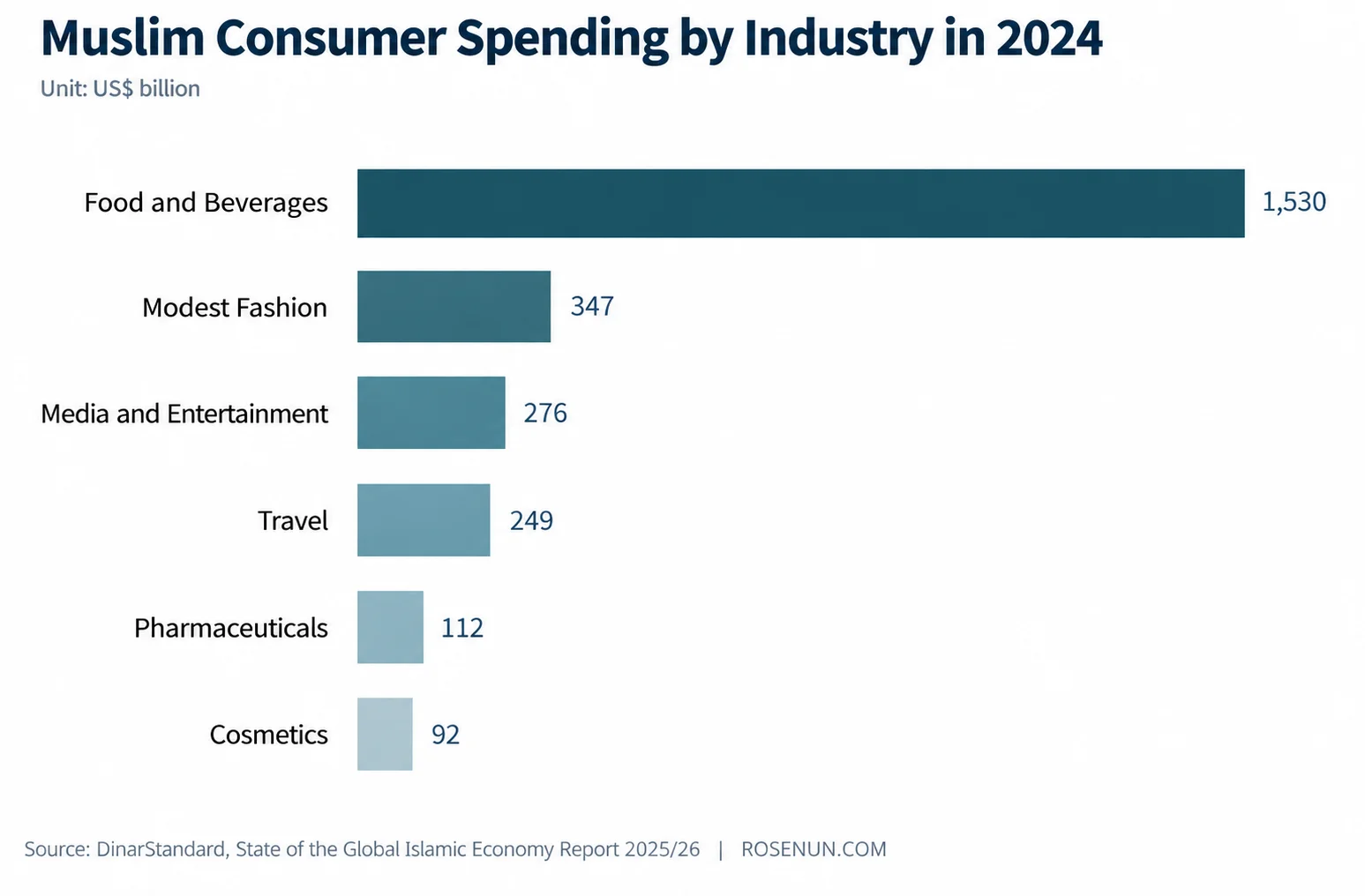
According to the State of the Global Islamic Economy Report 2025/26 by DinarStandard, Muslim consumers worldwide spent an estimated US$2.6 trillion across six sectors of the Islamic economy in 2024. This figure is projected to reach US$3.56 trillion by 2029, representing annual growth of approximately 6.5%.
These sectors include food and beverages, modest fashion, travel, media and entertainment, pharmaceuticals, and cosmetics. Islamic finance assets are measured separately and are not included in this consumer spending figure.
Food and beverages account for the largest share, with spending reaching approximately US$1.53 trillion in 2024, or nearly 60% of the total across the six sectors.
Modest fashion follows at US$347 billion, media and entertainment at US$276 billion, Muslim-friendly travel at US$249 billion, pharmaceuticals at US$112 billion, and cosmetics at US$92 billion.
Although food remains the dominant sector, these figures show that opportunities in the Islamic economy extend well beyond everyday consumer necessities.
From Pharmaceutical Capsules to Hotel Rooms
Halal principles are not limited to food. They also concern the origins of ingredients, manufacturing processes, contamination prevention, and certain types of services.
In the pharmaceutical industry, ingredients such as gelatin used in capsule shells, along with other manufacturing additives, may require verification of their sources. However, religious considerations surrounding medicines also take medical necessity into account. The absence of halal certification does not automatically mean that a medicine is prohibited in every circumstance.
For cosmetics, halal certification involves examining ingredients such as collagen, glycerin, and animal-derived extracts, as well as controlling manufacturing processes. Consumers are also becoming more interested in ingredient transparency. Nevertheless, the terms halal, organic, vegan, and safe refer to different standards or product characteristics and should not be treated as interchangeable.
The modest fashion industry covers clothing designed to provide greater body coverage and accommodate different preferences for modest dress. It is not limited to hijabs or clothing for Muslim women.
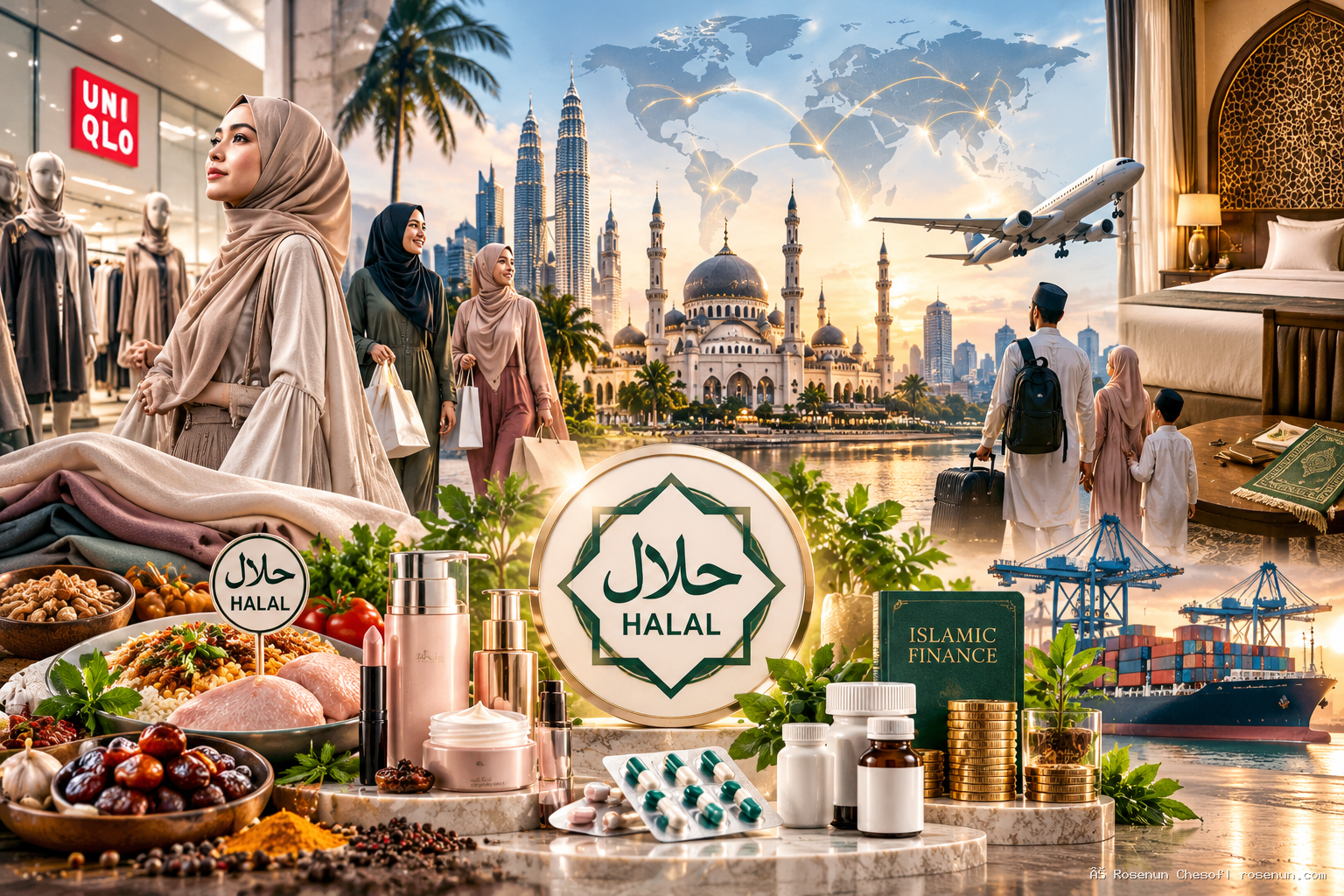
One notable example is UNIQLO, the Japanese clothing retailer that began collaborating with designer Hana Tajima in 2015. Their modest wear collections included hijabs, long-sleeved tops, and loose-fitting dresses. Initially introduced in Southeast Asian markets, the collections later expanded to countries including the United States and the United Kingdom.
UNIQLO has also adapted its designs to different lifestyles and climates, offering comfortable fabrics and sleeves designed to make wudu, the ritual washing performed before Islamic prayers, more convenient.
In August 2026, the company introduced a dedicated hijab collection in Malaysia, featuring the AIRism UV Protection Hijab, Satin Hijab, and Georgette Hijab, with prices starting at RM59.90. The move illustrates how international fashion brands are expanding into modest fashion, appealing not only to Muslim consumers but also to a broader audience that prefers more covered clothing.
Hotels and tourism businesses are responding to Muslim travellers in similar ways. Services may include halal food, prayer facilities, information on the qibla direction, privacy, and family-friendly amenities.
However, providing Muslim-friendly services does not necessarily mean that an entire hotel is halal-certified. Food certification and assessments of Muslim-friendly hospitality operate under different frameworks.
Why Are Non-Muslim-Majority Countries Competing for This Market?
The halal economy offers non-Muslim-majority countries opportunities to expand exports into a large consumer market, provided they have the production capacity and can meet relevant halal requirements.
Brazil is a prominent example. Despite having a relatively small Muslim population, it is the world's largest chicken exporter and ships more than two million tonnes of halal chicken annually, with the Middle East serving as a major destination.
Its success is supported by established production systems, certification arrangements, and international trade networks rather than the size of its domestic Muslim market.
Meanwhile, Japan and South Korea have developed food and tourism services to accommodate Muslim visitors. Thailand also has opportunities to build on its established food industry and tourism infrastructure to serve halal markets.
These examples demonstrate that competitiveness in the halal economy depends less on a country's Muslim population than on its production capabilities, standards, and access to international markets.
Who Leads the Global Halal Economy?
The State of the Global Islamic Economy Report 2025/26 uses the Global Islamic Economy Indicator (GIEI) to assess the strength of countries' Islamic economy ecosystems, including governance, investment, and industry development.
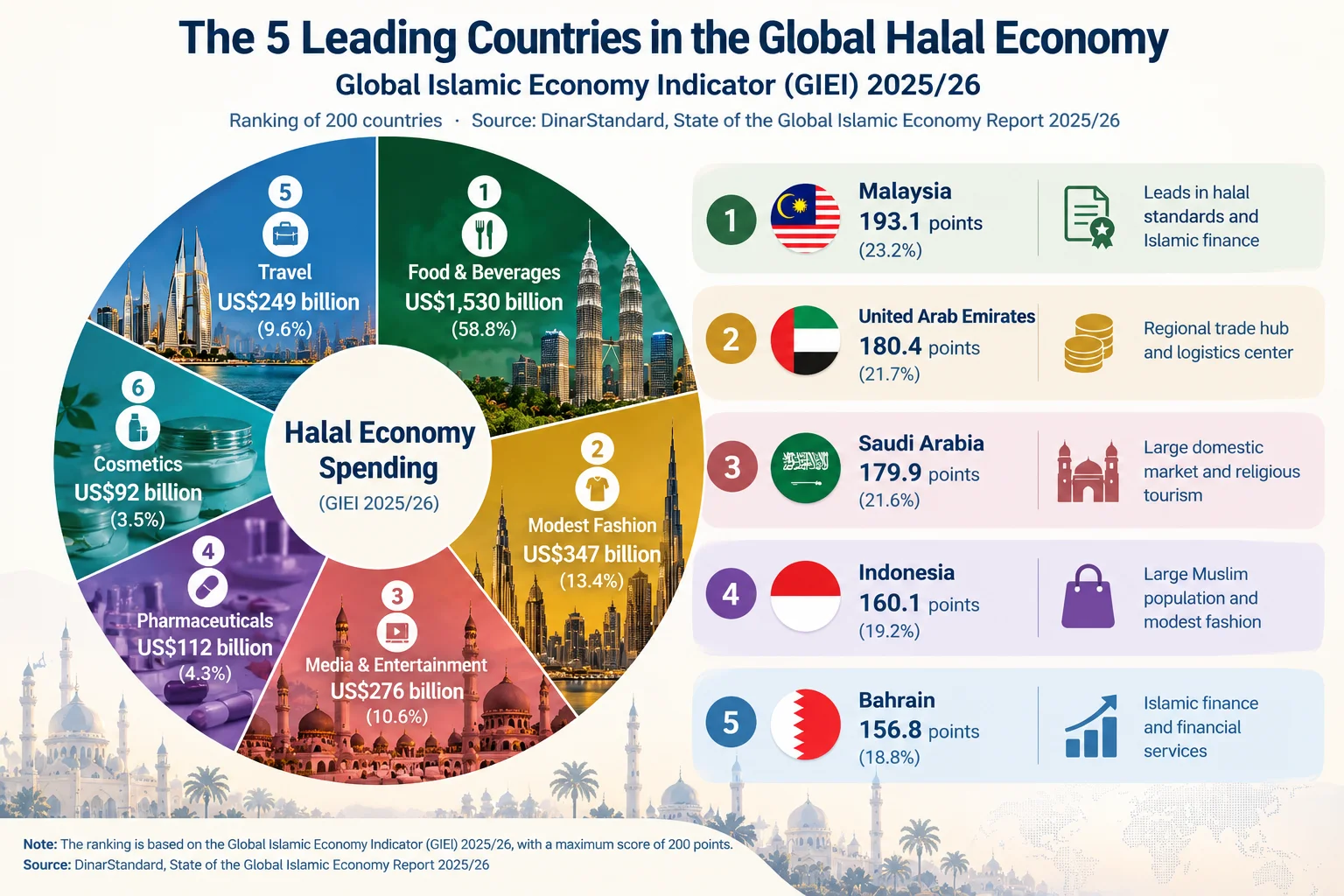
The latest ranking places Malaysia first, followed by the United Arab Emirates, Saudi Arabia, Indonesia, and Bahrain.
Malaysia has maintained the top position for 12 consecutive years, supported by its halal certification system under JAKIM and its well-developed Islamic finance sector.
The United Arab Emirates plays a significant role as an international trade and logistics hub, while Saudi Arabia benefits from a substantial domestic consumer market and economic activities associated with religious travel.
Indonesia has an enormous Muslim consumer base and a strong presence in modest fashion. Bahrain, meanwhile, is particularly established in Islamic finance.
Importantly, the GIEI is not a ranking of halal export values or global market shares. Malaysia's leading position does not mean that it produces or sells the largest volume of every category of halal product.
Instead, the rankings highlight how different countries have developed strengths across different parts of the Islamic economy.
Malaysia: From Halal Certification to Global Competitiveness
Malaysia recognises that halal certification alone does not guarantee commercial success. Products must also compete on price, innovation, quality, and branding.
The Department of Islamic Development Malaysia (JAKIM) plays a central role in halal certification, helping build confidence among consumers and international trading partners.
Meanwhile, the Halal Development Corporation (HDC) supports investment, business development, and the broader halal industry ecosystem.
According to HDC, Malaysia's halal exports reached RM68.52 billion in 2025, an increase of 10.9% from the previous year, accounting for approximately 4.3% of the country's total exports.
These figures demonstrate the industry's tangible contribution to Malaysia's economy.
The next challenge is turning its leadership in halal standards into stronger commercial competitiveness. At the World Halal Business Conference 2026, Malaysia promoted a shift from being merely “halal-certified” to becoming “halal-competitive.”
Halal Certification as a Tool of International Trade
Halal standards do more than strengthen consumer confidence. They also influence access to international markets. Producers must comply with requirements covering ingredients, manufacturing processes, and certification by authorities recognised in destination countries.
However, certification systems differ across countries. Exporters may therefore need additional approvals, increasing compliance costs, particularly for smaller businesses.
Countries whose standards gain wider international recognition may enjoy a competitive advantage. Greater coordination and mutual recognition of certification systems could reduce trade barriers and make global halal markets more accessible.
Technology and Traceability: The Next Competitive Frontier
As halal supply chains become increasingly international, verifying the origins of ingredients, manufacturing processes, and transportation becomes more complex.
Digital technologies can help businesses track products, verify certificates, and use artificial intelligence to identify potential risks.
However, these systems are only as reliable as the information they receive and the inspections supporting them. Countries that establish credible traceability systems may gain a competitive advantage while strengthening trust among international buyers and trading partners.
ASEAN: Cooperation or Competition in the Halal Economy?
For ASEAN, the expanding halal economy creates opportunities for regional economic cooperation. Yet differences in regulations and certification systems remain significant obstacles.
Although member states have different industrial strengths, connecting producers, raw materials, logistics networks, and consumer markets requires closer coordination of standards and cross-border recognition of halal certificates.
The challenge is therefore not simply to increase the number of certified products. It is also to reduce regulatory compliance costs, particularly for small and medium-sized enterprises with limited resources.
If ASEAN can develop mechanisms that facilitate cross-border halal trade, the industry could become another driver of regional economic integration.
Conversely, if certification requirements remain highly fragmented, businesses may continue to face additional costs even when trading within the same region.
Conclusion: When Trust Becomes an Economic Advantage
What distinguishes the halal economy from conventional markets is that consumer confidence depends not only on price and quality but also on compliance with religious principles and the credibility of certification authorities.
This relationship between religion and economics gives halal standards a role beyond product regulation. They can influence investment decisions, market access, and international competition.
Yet the industry's expansion does not guarantee that all businesses will benefit equally. Large companies with greater financial resources and established compliance systems may adapt more easily, while smaller producers face higher certification costs and varying requirements across markets.
The challenge ahead is to develop certification systems that uphold religious principles while remaining transparent, accessible, and free from unnecessary trade barriers.
Ultimately, the success of the halal economy should not be measured by market growth alone. It should also be judged by whether that growth creates opportunities for businesses of different sizes while maintaining the confidence of consumers.
References
DinarStandard. (2026). State of the Global Islamic Economy Report 2025/26. https://www.dinarstandard.com/insights/state-of-the-global-islamic-economy-report-2025-26
Salaam Gateway. (2026, June 28). State of the Global Islamic Economy (SGIE) 2025/26 Report. https://salaamgateway.com/reports/state-of-the-global-islamic-economy-sgie-202526-report
Halal Development Corporation. (2026). About HDC: Malaysia's Halal Ecosystem and Export Performance. https://hdcglobal.com/about-hdc/
Halal Development Corporation. (2026, September 25). Malaysia Calls for Shift from Halal-Certified to Halal-Competitive as ASEAN Targets USD5 Trillion Global Halal Economy. https://hdcglobal.com/2026/09/25/malaysia-calls-for-shift-from-halal-certified-to-halal-competitive-as-asean-targets-usd5-trillion-global-halal-economy/
Associação Brasileira de Proteína Animal. (2025, August 1). Brasil celebra 50 anos do primeiro embarque de carne de frango. https://abpa-br.org/mercados/brasil-celebra-50-anos-do-primeiro-embarque-de-carne-de-frango/
Associação Brasileira de Proteína Animal. (2026, April 28). ABPA lança Relatório Anual 2026 com dados oficiais da avicultura e da suinocultura do Brasil. https://abpa-br.org/noticias/abpa-lanca-relatorio-anual-2026-com-dados-oficiais-da-avicultura-e-da-suinocultura-do-brasil/