A Military Strike Amid Diplomatic Negotiations
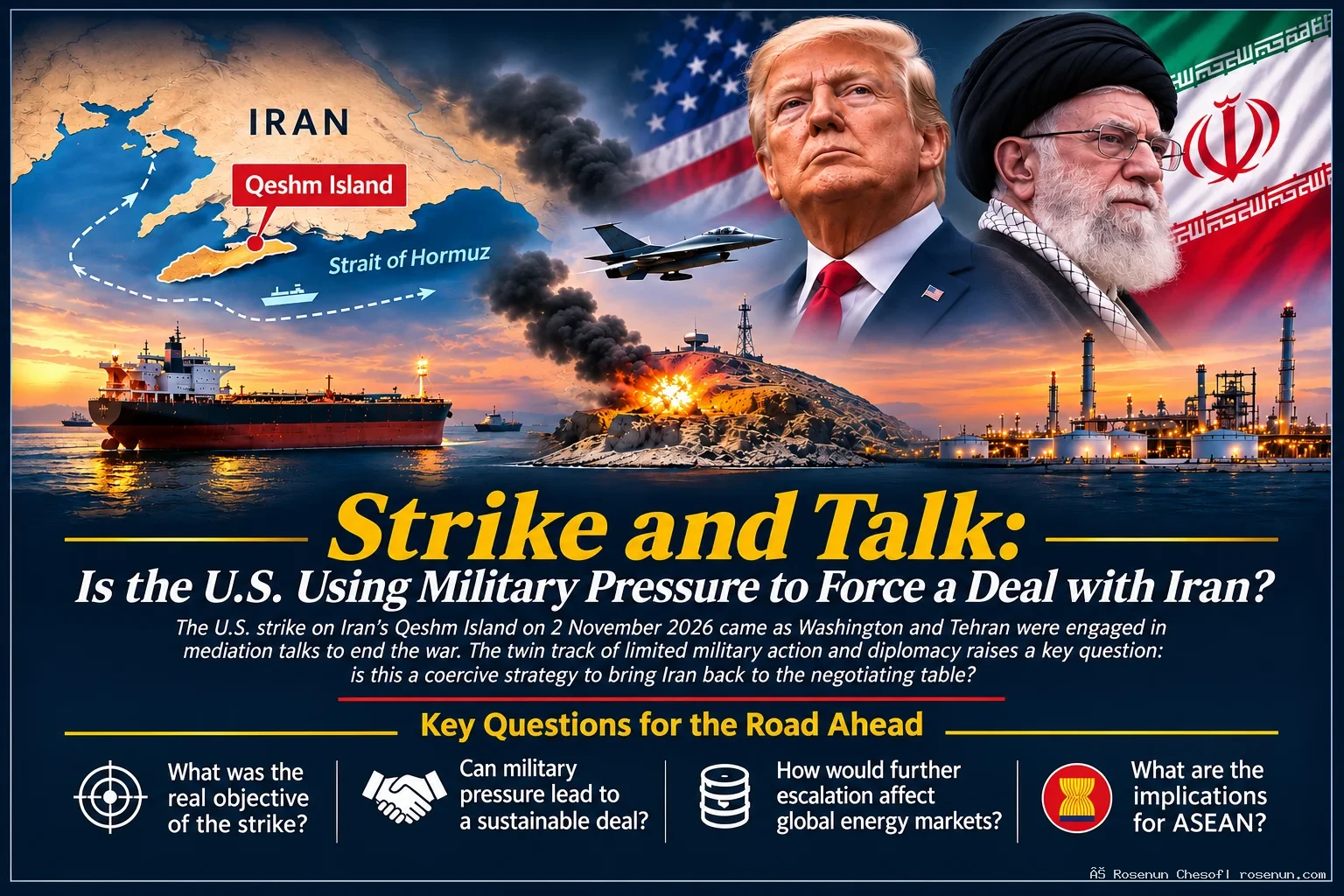
On November 2, 2026, multiple explosions were reported on Qeshm Island, located off Iran’s southern coast near the Strait of Hormuz, one of the world's most strategically important energy corridors.
The Wall Street Journal initially reported, citing U.S. officials, that American forces had conducted strikes on the island. According to the report, the operation formed part of a series of limited military actions undertaken in recent weeks.
Reuters subsequently reported that U.S. officials had characterized the operation as limited rather than a return to large-scale military hostilities. One official described the strikes as a defensive response to threats posed by Iranian surface-to-air missiles against American military assets.
CNN, citing three U.S. officials, further reported that the operation followed Iranian fire directed at U.S. aircraft. According to the network, the administration had deliberately avoided publicizing the strikes to prevent the impression that Washington was initiating another major military campaign.
Meanwhile, Iran’s state news agency IRNA reported several explosions, while Al Jazeera cited reports of blasts near the port city of Bandar Lengeh.
Nevertheless, significant uncertainties remain regarding the precise targets, the extent of the damage, and possible casualties. At the time of the initial reports, U.S. Central Command had not publicly provided a detailed account of the operation.
What makes the incident particularly significant is its timing. On the same day, President Donald Trump indicated that a diplomatic agreement with Tehran remained possible.
This combination of military pressure and diplomatic engagement suggests that Washington may be pursuing a strategy in which force and negotiation operate simultaneously rather than as mutually exclusive alternatives.
Why Qeshm Island Matters
Qeshm Island occupies a strategically sensitive position near the entrance to the Strait of Hormuz, close to the Iranian port of Bandar Abbas.
The strait connects the Persian Gulf with the Gulf of Oman and the wider Indian Ocean. It serves as a vital maritime corridor for energy exports from the Gulf region to international markets, particularly in Asia.
Before the disruptions associated with the 2026 conflict, approximately 20 million barrels of oil passed through the Strait of Hormuz each day. The route was also crucial for liquefied natural gas exports from Gulf producers.
Consequently, the security of the strait extends far beyond the immediate interests of Iran and the United States.
For energy-importing economies, particularly those in Asia, any sustained disruption could increase transportation costs, destabilize energy prices, and intensify inflationary pressures.
From a military perspective, the geographical position of Qeshm Island provides strategic advantages for surveillance, coastal defense, and operations affecting maritime access.
However, a strike against targets on the island does not automatically translate into control over the Strait of Hormuz. Maritime security depends on a complex combination of naval capabilities, missile systems, mines, surveillance infrastructure, and the decisions of multiple regional actors.
The significance of the operation therefore lies not only in its immediate military consequences but also in the broader message it may send to Tehran and international energy markets.
Coercive Diplomacy: Using Force to Strengthen Negotiations?
Washington’s actions can be examined through the concept of coercive diplomacy, a strategy in which military and economic pressure is employed to influence an adversary’s decisions without necessarily seeking its complete military defeat.
Under this approach, the threat or limited application of force may be intended to demonstrate the costs of refusing negotiations or rejecting proposed terms.
Viewed through this framework, the reported strikes on Qeshm Island could serve two overlapping purposes.
The first is operational: reducing perceived threats to American military personnel, aircraft, and maritime assets. This corresponds to the defensive justification attributed to U.S. officials.
The second is diplomatic: maintaining pressure on Tehran while negotiations continue, thereby signaling that Washington retains military options should diplomatic efforts fail.
However, the second interpretation remains an analytical possibility rather than an officially confirmed American objective.
It is important to distinguish between the stated military rationale for the operation and the broader strategic intentions that observers may infer from its timing.
Moreover, coercive diplomacy is inherently uncertain.
Military pressure may encourage concessions when an adversary believes that continued resistance will produce unacceptable costs. Yet the same pressure can also strengthen nationalist sentiment, increase domestic political resistance, and make compromise appear equivalent to surrender.
For Iran, negotiating under military attack may carry significant political consequences, particularly if concessions are interpreted domestically as a loss of sovereignty.
The effectiveness of Washington’s approach therefore depends not merely on the scale of its military capabilities but also on Tehran’s assessment of the political and strategic costs of compromise.
What Does Iran Want from the Negotiations?
Despite continuing tensions, diplomatic contacts between Washington and Tehran have reportedly continued through regional intermediaries, including Qatar and Pakistan.
The Guardian reported on November 1 that indirect negotiations in Doha had focused on reopening the Strait of Hormuz, addressing restrictions on Iranian oil exports, and exploring possible sanctions relief and access to frozen Iranian assets.
According to the report, Iranian negotiators had proposed accelerating the implementation of a potential arrangement if Washington accepted several key conditions, particularly those concerning port restrictions and energy exports.
Iranian Foreign Minister Abbas Araghchi maintained that Tehran remained prepared to pursue diplomacy while preserving its ability to defend itself.
Reuters reported on November 2 that contacts aimed at ending the conflict were continuing, although no breakthrough had been achieved.
A central obstacle concerns the sequence of concessions.
Washington seeks assurances that Iran will not use the Strait of Hormuz to threaten international shipping or regional security.
Tehran, meanwhile, wants tangible relief from economic and military pressure before fully restoring maritime access.
This creates a familiar dilemma in international negotiations: both sides demand credible action from the other before committing themselves.
Without an agreed verification mechanism or a mutually acceptable sequence of implementation, even a limited arrangement may prove difficult to sustain.
Israel and the Gulf States: Different Strategic Priorities
The confrontation between Washington and Tehran cannot be understood solely as a bilateral dispute.
Israel regards Iran’s military capabilities and nuclear program as long-term security threats. Its strategic priorities therefore place considerable emphasis on preventing Tehran from rebuilding capabilities that could threaten Israeli security.
Several Gulf states, however, face a different set of immediate concerns.
Their economic stability depends heavily on secure maritime routes, functioning energy infrastructure, and the avoidance of a prolonged regional conflict.
The Guardian reported that Anwar Gargash, a diplomatic adviser to the president of the United Arab Emirates, had warned against further escalation and emphasized the importance of maintaining relations with Iran.
Qatar’s role as a mediator similarly reflects the interests of Gulf states in preventing additional disruption to regional trade, energy exports, and domestic security.
These differing priorities complicate Washington’s strategic calculations.
The United States must balance Israeli security concerns, its own military objectives, and the interests of Gulf partners that may support containing Iranian capabilities while opposing a wider war.
A strategy that appears militarily effective in the short term may therefore create diplomatic difficulties if it increases the vulnerability of regional allies.
The Economic Consequences for Asia and ASEAN
Even a geographically limited military operation near the Strait of Hormuz can have implications extending far beyond the Middle East.
Global energy markets respond not only to actual disruptions in oil and gas supplies but also to expectations about future risks.
Reports of military strikes, threats to shipping, or progress in diplomatic negotiations can influence crude oil prices, insurance premiums, freight costs, and investment decisions.
For ASEAN economies, the consequences vary according to their energy dependence and economic structures.
Thailand and the Philippines, as major energy-importing economies, are particularly exposed to rising fuel costs and their effects on transportation, production, and consumer prices.
Malaysia and Indonesia occupy more complex positions. Certain energy-producing industries may benefit from higher international prices, while households and energy-consuming businesses may simultaneously face increased costs.
Singapore, as a major regional center for maritime trade, refining, and financial services, is highly sensitive to changes in shipping activity and international energy markets.
Beyond the immediate energy sector, prolonged instability could affect manufacturing competitiveness, trade balances, inflation expectations, and monetary policy across Southeast Asia.
The Strait of Hormuz is therefore not merely a distant geopolitical flashpoint for ASEAN.
Its security remains closely connected to the region’s economic resilience.
Three Possible Scenarios After the Qeshm Strike
The reported attack on Qeshm Island does not necessarily indicate that a wider war is inevitable. Several developments remain possible.
Scenario One: Limited Military Pressure Alongside Negotiations
Washington and Tehran may continue to engage in limited military actions while avoiding a broader confrontation.
Under this scenario, indirect negotiations through Qatar and Pakistan would remain active, with both sides seeking an arrangement to restore maritime access without resolving every underlying dispute.
Such an outcome would resemble a form of managed confrontation in which military pressure and diplomacy coexist.
Its principal weakness would be the continuing possibility of miscalculation.
Scenario Two: A Limited Agreement Before a Comprehensive Peace Settlement
A more constructive outcome would involve an agreement addressing specific issues, such as maritime access, energy exports, or reciprocal confidence-building measures.
This arrangement would not necessarily resolve disputes over Iran’s nuclear program, regional military activities, or the wider security architecture of the Middle East.
Nevertheless, a limited agreement could reduce immediate risks and create conditions for more substantial negotiations.
Its success would depend on credible monitoring arrangements and a mutually accepted timetable for implementation.
Scenario Three: Retaliation and Renewed Escalation
The most dangerous scenario would involve Iranian retaliation followed by additional American strikes.
If either side misinterpreted the other’s actions or attempted to restore deterrence through increasingly forceful responses, a limited confrontation could expand into a broader military campaign.
Such an escalation could threaten commercial shipping, regional energy infrastructure, and the diplomatic channels currently available to both governments.
These scenarios represent possible developments rather than predictions. Their relative likelihood will depend on decisions taken by Washington, Tehran, and regional intermediaries in the coming days.
Conclusion: Can Military Pressure Produce a Sustainable Peace?
The reported U.S. strike on Qeshm Island illustrates a central contradiction in the current confrontation between Washington and Tehran.
Both governments have indicated that diplomatic engagement remains possible, yet neither appears willing to abandon the military and economic instruments that provide leverage over the other.
For Washington, limited military operations may help protect American assets and maintain pressure during negotiations. However, the same actions risk weakening the trust necessary for a durable agreement.
For Tehran, reopening the Strait of Hormuz and reaching an arrangement with the United States could reduce economic pressure. Yet concessions made under military threat may carry substantial domestic political costs.
The broader challenge is therefore not simply whether the United States will conduct additional strikes or whether Iran will retaliate.
It is whether both sides can transform military pressure into a verifiable political arrangement before another confrontation destroys the remaining opportunities for diplomacy.
The ultimate test of Washington’s strategy will not be whether military pressure forces Iran back to the negotiating table, but whether it produces an agreement capable of surviving after the immediate threat of force has diminished.
References
The Wall Street Journal. (2026, November 3). U.S. strikes Iran’s Qeshm Island as Trump talks down war risks. https://www.wsj.com/world/middle-east/u-s-strikes-irans-qeshm-island-as-trump-talks-down-war-risks-79d73d3d
Reuters. (2026, November 3). US carries out ‘defensive’ strikes on Iran’s Qeshm Island, officials say. https://www.reuters.com/world/middle-east/us-struck-irans-qeshm-island-wall-street-journal-reports-2026-11-03/
CNN. (2026, November 2). US military conducts strikes on Iran’s Qeshm Island in defensive operation, officials say. https://keyt.com/politics/cnn-us-politics/2026/11/02/us-carried-out-limited-defensive-strikes-on-irans-qeshm-island-official-says/
Al Jazeera. (2026, November 3). Explosions hit Iran’s Qeshm Island as US media report US strikes in Hormuz. https://www.aljazeera.com/news/2026/11/3/explosions-hit-irans-qeshm-island-as-us-media-report-us-strikes-in-hormuz
The Guardian. (2026, November 1). Negotiators ‘braced for worst’ over US-Iran talks to reopen Strait of Hormuz. https://www.theguardian.com/world/2026/nov/01/negotiators-braced-for-worst-over-us-iran-talks-to-reopen-strait-of-hormuz
Reuters. (2026, November 2). Iran says contacts over ending war continue after talks finish with no breakthrough. https://www.investing.com/news/commodities-news/iranians-have-left-doha-talks-draft-proposal-for-us-deal-being-circulated-official-says-4990460
AFP. (2026, November 3). US strikes Iran’s Qeshm Island: Wall Street Journal. https://www.thedailystar.net/news/world/news/us-strikes-irans-qeshm-island-wall-street-journal-4314216