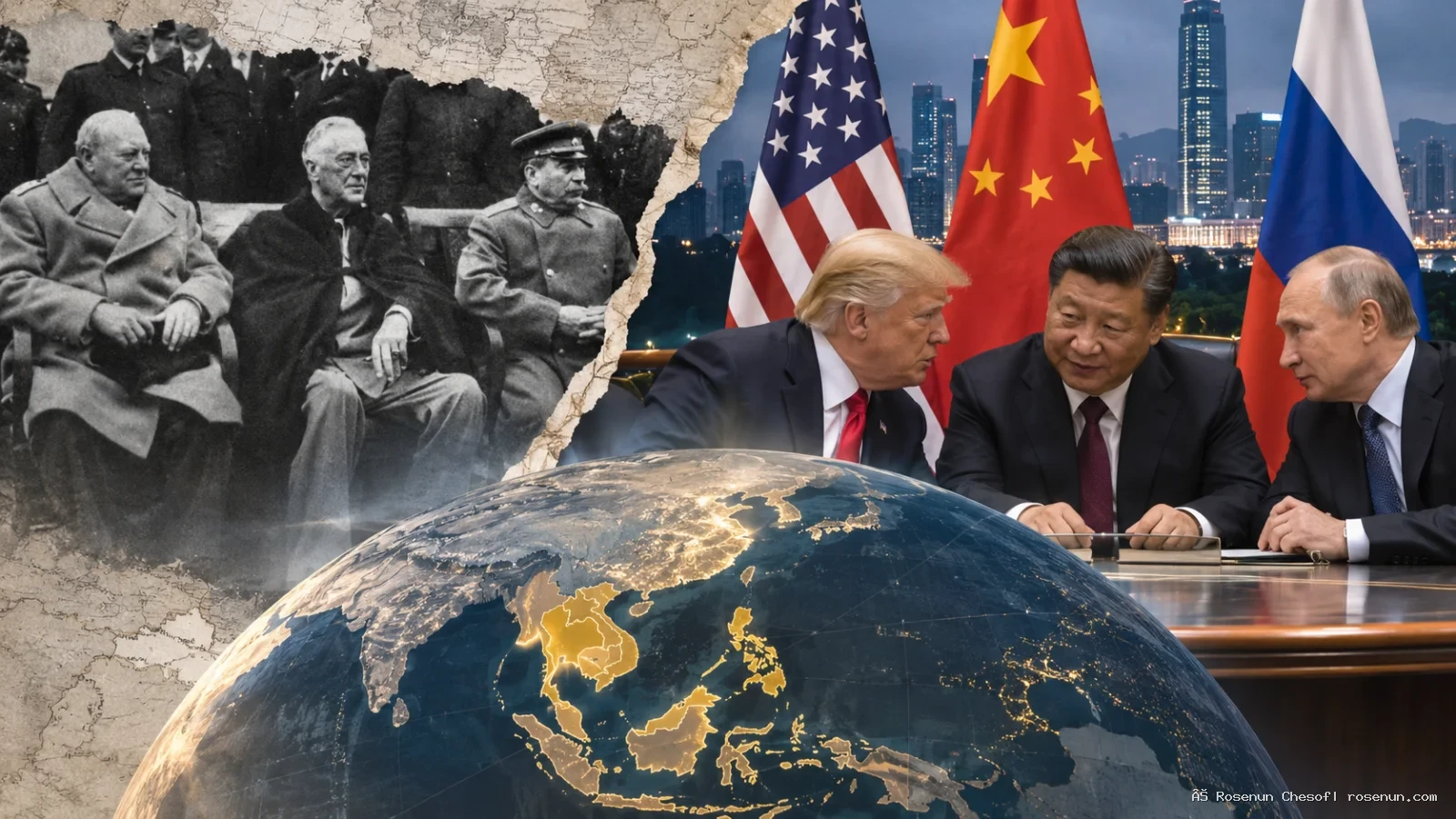
On 19 November 2026, US President Donald Trump, Chinese President Xi Jinping and Russian President Vladimir Putin convened at Kylin Villa in Shenzhen, China, for an unprecedented trilateral summit on the sidelines of the 33rd Asia-Pacific Economic Cooperation (APEC) Economic Leaders’ Meeting.
The gathering marked the first dedicated trilateral summit between the leaders of the three countries. It took place against the backdrop of the war in Ukraine, instability in the Middle East, technological competition between Washington and Beijing, and growing concerns over nuclear security.
Following their discussions, the three leaders issued a four-point Declaration toward Peace, addressing United Nations reform, energy security, the jurisdiction of international courts and the reduction of nuclear risks.
The meeting immediately invited comparisons with the Yalta Conference of 1945, a defining moment in the formation of the post-war international order.
Despite their vastly different historical circumstances, the two gatherings raise a fundamental question: who has the power to determine the rules by which the rest of the world must live?
Yalta 1945 and the Foundations of the Post-war Order
Between 4 and 11 February 1945, as the Second World War approached its final stages, US President Franklin D. Roosevelt, British Prime Minister Winston Churchill and Soviet leader Joseph Stalin met in Yalta on the Crimean Peninsula.
Their discussions focused on the political reconstruction of Europe following the anticipated defeat of Nazi Germany, the occupation and administration of Germany, the future of Poland, the establishment of the United Nations and the Soviet Union’s entry into the war against Japan.
The conference helped lay the foundations of an international order that continues to shape global politics today. Among its most enduring legacies was the institutionalisation of great-power privilege within the United Nations Security Council, where five permanent members were granted veto power.
Yet Yalta also became a symbol of the politics of spheres of influence. The future of several Eastern European countries was negotiated by major powers without the equal participation of the nations directly affected.
Although the division of Europe during the Cold War cannot be attributed to Yalta alone, the conference exposed a fundamental tension in international politics: peace negotiated by great powers does not necessarily guarantee political freedom or self-determination for smaller nations.
Shenzhen 2026: A Changing Landscape of Power
Eighty-one years later, the composition of the negotiating table has changed considerably.
The United States remains a dominant economic and military power. Russia has inherited the Soviet Union’s permanent seat on the UN Security Council, while China has emerged as a major centre of economic, technological and geopolitical influence.
Britain, one of the three principal powers at Yalta, was absent from the Shenzhen talks. So were the European Union and Ukraine, despite the war in Ukraine being among the issues discussed.
This contrast illustrates the growing importance of the Asia-Pacific in global affairs and the changing distribution of international power.
China’s position as host was particularly significant. By bringing the American and Russian presidents together in Shenzhen, Beijing demonstrated its diplomatic reach and its capacity to shape discussions on international security.
The circumstances, however, differ fundamentally from those of 1945. Roosevelt, Churchill and Stalin were wartime allies approaching a shared military victory. Trump, Xi and Putin represent countries whose strategic interests overlap in some areas but remain deeply divided in others.
Shenzhen was a meeting of competitors seeking accommodation rather than allies preparing to construct a shared post-war settlement.
The Shenzhen Declaration
The joint declaration published by the White House and the Chinese government outlined four areas of agreement.
First, the three countries expressed support for reforming the United Nations to improve its ability to address global challenges and fulfil its responsibilities for international peace and security.
Second, they proposed expanding the production and availability of refined petroleum products, emphasising the importance of reliable energy supplies.
Third, the leaders stressed the importance of state consent and legal immunity for government officials, while expressing concern over the exercise of jurisdiction by the International Criminal Court (ICC) and comparable institutions.
Finally, they reaffirmed their opposition to nuclear war and committed themselves to further discussions on nuclear risk reduction and non-proliferation.
These commitments identify areas in which cooperation remains possible despite broader geopolitical tensions.
Nevertheless, the declaration contained no concrete agreement on nuclear disarmament, no roadmap for ending the war in Ukraine and no settlement of the conflict in the Middle East.
The immediate significance of Shenzhen therefore lies in the opening of diplomatic channels rather than the achievement of a comprehensive geopolitical agreement.
The Interests of Washington, Beijing and Moscow
Each participant arrived in Shenzhen with distinct strategic objectives.
For the United States, the summit offered the Trump administration an opportunity to pursue direct, leader-level diplomacy on nuclear security, regional conflicts and economic relations.
Washington nevertheless remains at odds with Beijing over trade, advanced technologies and Taiwan, while its relationship with Moscow continues to be shaped by the war in Ukraine and Western sanctions.
China has a strong interest in maintaining stability among the major powers. Its economic development, energy security and extensive involvement in global supply chains depend heavily on a relatively predictable international environment.
Beijing therefore has reasons to reduce the risks of direct confrontation with Washington, even as strategic competition between the two countries continues.
For Russia, participation in a summit alongside the leaders of the United States and China represented a significant diplomatic opportunity. It reinforced Moscow’s claim to great-power status at a time of sustained pressure from Western governments.
The declaration’s emphasis on the immunity of state officials and the jurisdiction of international courts was particularly relevant to Russia, given the ICC arrest warrant issued against Putin in 2023.
The summit did not invalidate that warrant. Nor did it establish a formal agreement among the three countries to divide the world into separate spheres of influence.
It did, however, provide Moscow with a prominent platform from which to challenge aspects of the international legal order.
Great-power Privilege in the International System
One of the most revealing aspects of the Shenzhen Declaration is its simultaneous call for United Nations reform and its criticism of international judicial authority.
The United States, China and Russia are permanent members of the UN Security Council. Their veto powers are privileges inherited from the international arrangements established after the Second World War.
At the same time, none of the three countries is a state party to the Rome Statute, the treaty establishing the International Criminal Court.
Their position raises questions about the direction of institutional reform. Would a reformed United Nations distribute authority more equitably among its members, or would it reinforce the influence of countries that already occupy privileged positions?
The international system has long been characterised by this contradiction. The UN Charter recognises the sovereign equality of states, yet the institutional structure of the Security Council grants exceptional decision-making powers to a small group of countries.
The Shenzhen summit brings this longstanding imbalance into sharper focus.
For smaller states, international institutions and legal frameworks can provide important safeguards against coercion by more powerful countries. Weakening those safeguards without creating credible alternatives could further widen existing inequalities in the international system.
The Politics of Spheres of Influence
The trilateral meeting also recalls the historical concept of a concert of powers, associated with the Concert of Europe established after the Napoleonic Wars in the early nineteenth century.
Under such arrangements, major powers seek to preserve international stability through negotiation, compromise and the management of competing strategic interests.
This approach can reduce the likelihood of direct confrontation between militarily powerful states. In an era of nuclear weapons, such cooperation has considerable value.
Its limitations, however, become apparent when the interests of smaller nations conflict with those of the dominant powers.
Ukraine offers a particularly relevant example. Discussions concerning its future security carry profound consequences for the country, yet Ukraine was not represented at the Shenzhen negotiating table.
A similar concern extends to other regions where great-power competition intersects with territorial disputes, economic dependence and national security.
The twenty-first century, however, presents a more complex geopolitical environment than that of 1945. Economic interdependence, technological networks, regional organisations and the growing influence of middle powers complicate any attempt to establish clearly defined spheres of influence.
Countries outside the traditional centres of power also possess greater opportunities to diversify their partnerships and exercise diplomatic agency.
The Shenzhen summit may indicate renewed interest in direct great-power diplomacy, but it provides insufficient evidence to conclude that a new system of geopolitical partition has emerged.
ASEAN’s Strategic Space
For Southeast Asia, relations among the United States, China and Russia have direct implications for regional stability and development.
China is a major trading partner of ASEAN, while the United States remains an important source of investment, advanced technology and security cooperation. Russia maintains energy and defence relationships with several Southeast Asian countries.
A reduction in tensions among the major powers could ease some of the pressure on ASEAN members to align themselves with competing geopolitical blocs.
Conversely, direct agreements among major powers on matters affecting Southeast Asia could diminish ASEAN’s influence over regional affairs, particularly if established ASEAN-led mechanisms are bypassed.
The principle of ASEAN centrality depends on the organisation’s ability to convene external powers, facilitate dialogue and shape regional cooperation.
Its effectiveness ultimately rests on the willingness of member states to maintain a degree of collective purpose despite their differing national interests.
Diplomatic flexibility remains valuable, but it must be supported by economic resilience, technological capabilities and stronger regional coordination.
ASEAN’s strategic autonomy will depend on its capacity to negotiate with major powers from a position of collective strength rather than simply maintaining favourable relations with all sides.
Great-power Peace and the Sovereignty of Smaller Nations
Shenzhen cannot yet be described as a new Yalta. The summit produced neither a comprehensive international settlement nor a formal division of geopolitical influence.
Its historical significance lies instead in the renewed prominence of direct negotiations among major powers at a time when multilateral institutions are struggling to manage international conflicts.
Dialogue among nuclear powers is essential to reducing the risks of military escalation. Yet lasting peace requires more than agreement among the strongest states. It also depends on respect for national sovereignty, international law and the right of peoples to determine their own political futures.
Eight decades after Yalta, the world contains more independent nations, more international institutions and deeper connections between societies than ever before. Nevertheless, the distribution of power over global decision-making remains profoundly unequal.
The enduring lesson of Yalta concerns both the capacity of great powers to negotiate peace and the price other nations may pay when their futures are determined without their participation.
If Shenzhen marks the beginning of a new chapter in international politics, its greatest test will be whether cooperation among the major powers can preserve peace without sacrificing the sovereignty of nations that have no seat at their negotiating table.
References
The White House. (2026, November 19). U.S.-Russia-China Heads of State Declaration toward Peace.
https://www.whitehouse.gov/briefings-statements/2026/11/u-s-russia-china-heads-of-state-declaration-toward-peace/The State Council of the People's Republic of China. (2026, November 19). Full text: China-Russia-U.S. Heads of State Declaration toward Peace.
https://english.www.gov.cn/news/202611/19/content_WS6afeda1ac6d00ca5f9a0e790.htmlReuters. (2026, November 19). Putin defends his ‘Yalta’, as 3-way summit draws parallels to post-war carve-up.
https://www.reuters.com/world/china/putin-defends-his-yalta-3-way-summit-draws-parallels-post-war-carve-up-2026-11-19/Associated Press. (2026, November 19). Takeaways from the historic summit between Trump, Xi and Putin.
https://apnews.com/article/25e17ec8d9c55fbff960d5631eaba71dChannel NewsAsia. (2026, November 19). Xi, Trump and Putin begin unprecedented trilateral talks in Shenzhen.
https://www.channelnewsasia.com/east-asia/trump-xi-putin-trilateral-talks-apec-shenzhen-6563591The Guardian. (2026, November 19). Global courts under attack and four more takeaways from the Trump, Xi, Putin meeting.
https://www.theguardian.com/world/2026/nov/19/five-takeaways-from-putin-trump-xi-apec-shenzhen-summitBernama. (2026, November 19). Trump, Putin, Xi Issue Joint Declaration On Peace, Strategic Stability.
https://web26.bernama.com/en/news.php?id=2636841U.S. Department of State, Office of the Historian. The Yalta Conference, 1945.
https://history.state.gov/milestones/1937-1945/yalta-confUnited Nations. Charter of the United Nations.
https://www.un.org/en/about-us/un-charter/full-textInternational Criminal Court. The States Parties to the Rome Statute.
https://asp.icc-cpi.int/states-partiesASEAN. ASEAN Outlook on the Indo-Pacific.
https://asean.org/asean-outlook-on-the-indo-pacific/