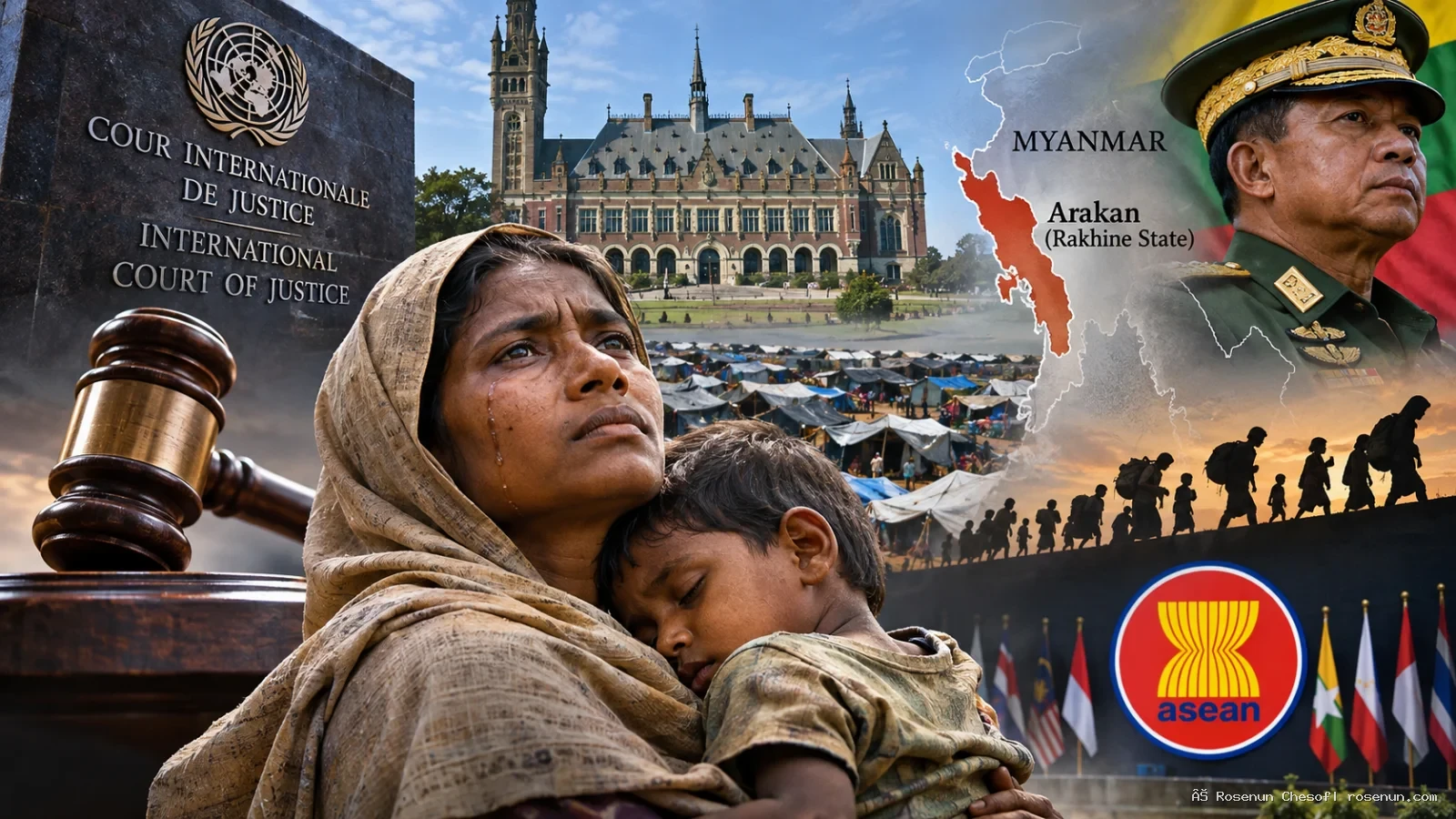
The ruling came nearly a decade after more than 700,000 Rohingya fled their homes and seven years after The Gambia, a small West African nation, brought the case against Myanmar.
Yet the judgment raises questions that extend beyond the courtroom. Will Myanmar provide reparations and restore the rights of Rohingya communities? Can refugees return home safely? And how will ASEAN respond when one of its own member states has been found responsible for genocide?
A Landmark Judgment
In a 9–6 decision, the ICJ found that Myanmar had violated the Genocide Convention through military operations carried out in northern Rakhine State in 2017.
The Court examined evidence of killings, sexual violence, serious physical and psychological harm, and measures intended to prevent births within the Rohingya community. It concluded that the acts demonstrated an intent to destroy a substantial part of the Rohingya population in the affected area.
The judgment also found that Myanmar had failed to prevent and punish genocide and had breached aspects of the provisional measures ordered by the Court in 2020, including obligations relating to the preservation of evidence.
Myanmar was ordered to take measures to prevent further violations, investigate and prosecute those responsible, restore the rights of victims, and facilitate the safe, voluntary and dignified return of displaced Rohingya. The ruling also addressed reparations for the harm suffered, with further proceedings required to determine their scope.
The judgment represents a significant legal victory for Rohingya survivors, although its implementation remains uncertain.
From the 2017 Military Crackdown to the ICJ
In August 2017, Myanmar's military launched operations in northern Rakhine State following attacks on security posts by Rohingya militants.
The military campaign resulted in widespread killings, sexual violence and the destruction of villages. More than 700,000 Rohingya fled across the border into Bangladesh, with many eventually settling in refugee camps around Cox's Bazar.
In November 2019, The Gambia filed a case against Myanmar at the ICJ, accusing it of violating the Convention on the Prevention and Punishment of the Crime of Genocide. The case received support from the Organisation of Islamic Cooperation (OIC).
Aung San Suu Kyi, then Myanmar's civilian leader, travelled to The Hague to defend the country, arguing that the military operations were a response to insurgent attacks and should not automatically be characterised as genocide.
In January 2020, the Court ordered provisional measures requiring Myanmar to prevent acts prohibited under the Genocide Convention and preserve relevant evidence.
Legal proceedings continued for several years before culminating in the November 2026 judgment.
For Rohingya survivors, the decision represents international legal recognition of atrocities they have described and documented for nearly a decade.
ASEAN's Silence Comes at a Moral Cost
The judgment also places ASEAN under renewed scrutiny. Myanmar remains a member of the regional organisation, yet ASEAN has not established a clear collective mechanism to ensure compliance with the ruling.
On 22 November, Malaysia announced that it respected the ICJ judgment and would coordinate with the United Nations, the OIC and ASEAN in seeking a sustainable response to the Rohingya crisis. The positions of other ASEAN members require further examination, rather than assuming that every government has remained silent.
ASEAN has restricted Myanmar's military leadership from participating in certain high-level meetings since the 2021 coup. Nevertheless, diplomatic engagement between Myanmar and individual member states has continued in different forms.
Such engagement may be necessary to facilitate humanitarian assistance and political dialogue. However, maintaining normal relations without clear conditions for accountability risks restoring political legitimacy to military leaders accused of involvement in serious international crimes.
One striking question remains: why was The Gambia, a small country in West Africa, able to pursue this case through the international judicial system while ASEAN, the organisation to which Myanmar belongs, has struggled to establish an effective collective response?
Diplomatic silence does not amount to legal endorsement. But failing to demand accountability carries political and moral consequences, particularly when victims remain displaced and deprived of basic rights.
The ruling challenges ASEAN to reconsider whether its longstanding principle of non-interference can continue to take precedence when a member state has been found responsible for genocide.
A Judgment Is Not the End of Justice
Although ICJ judgments are legally binding on the states involved, the Court has no independent enforcement mechanism. Implementation will depend on Myanmar's actions and sustained international pressure.
It is also important to distinguish between state responsibility and individual criminal accountability. The ICJ determines whether a state has violated international law; it does not prosecute individuals. The judgment therefore does not constitute a criminal conviction of Myanmar's military leader, Min Aung Hlaing, or other commanders.
For Rohingya refugees, international recognition is an important achievement, but justice will remain incomplete without citizenship rights, security, reparations and a genuine opportunity to return home.
The Court has established Myanmar's responsibility. The question now is whether neighbouring countries and the wider international community will translate that judgment into meaningful action or allow diplomatic relations to continue as though nothing has changed.
ASEAN's failure may ultimately be measured not only by its inability to prevent atrocities in the past, but also by its willingness—or unwillingness—to demand accountability after those atrocities have been recognised by international law.
References
International Court of Justice. (2026, November 19). The Gambia v. Myanmar: Judgment and press release.
https://www.refworld.org/sites/default/files/2026-11/178-20261119-pre-01-00-en.pdfIndependent Investigative Mechanism for Myanmar (United Nations). The Gambia v. Myanmar.
https://iimm.un.org/en/icj-gambia-v-myanmarMinistry of Foreign Affairs, Malaysia. (2026, November 22). Malaysia respects the International Court of Justice judgment in The Gambia v. Myanmar.
https://www.kln.gov.my/web/guest/post/malaysia-respects-the-international-court-of-justice-judgment-in-the-gambia-v-myanmarUnited Nations Myanmar. (2026, November 19). Statement attributable to the Secretary-General on the International Court of Justice judgment.
https://myanmar.un.org/en/326406-statement-secretary-general-international-court-justice-judgment-%E2%80%9C-gambia-v-myanmar%E2%80%9DHuman Rights Watch. (2000). Burmese refugees in Bangladesh: Historical background.
https://www.hrw.org/reports/2000/burma/burm005-01.htm