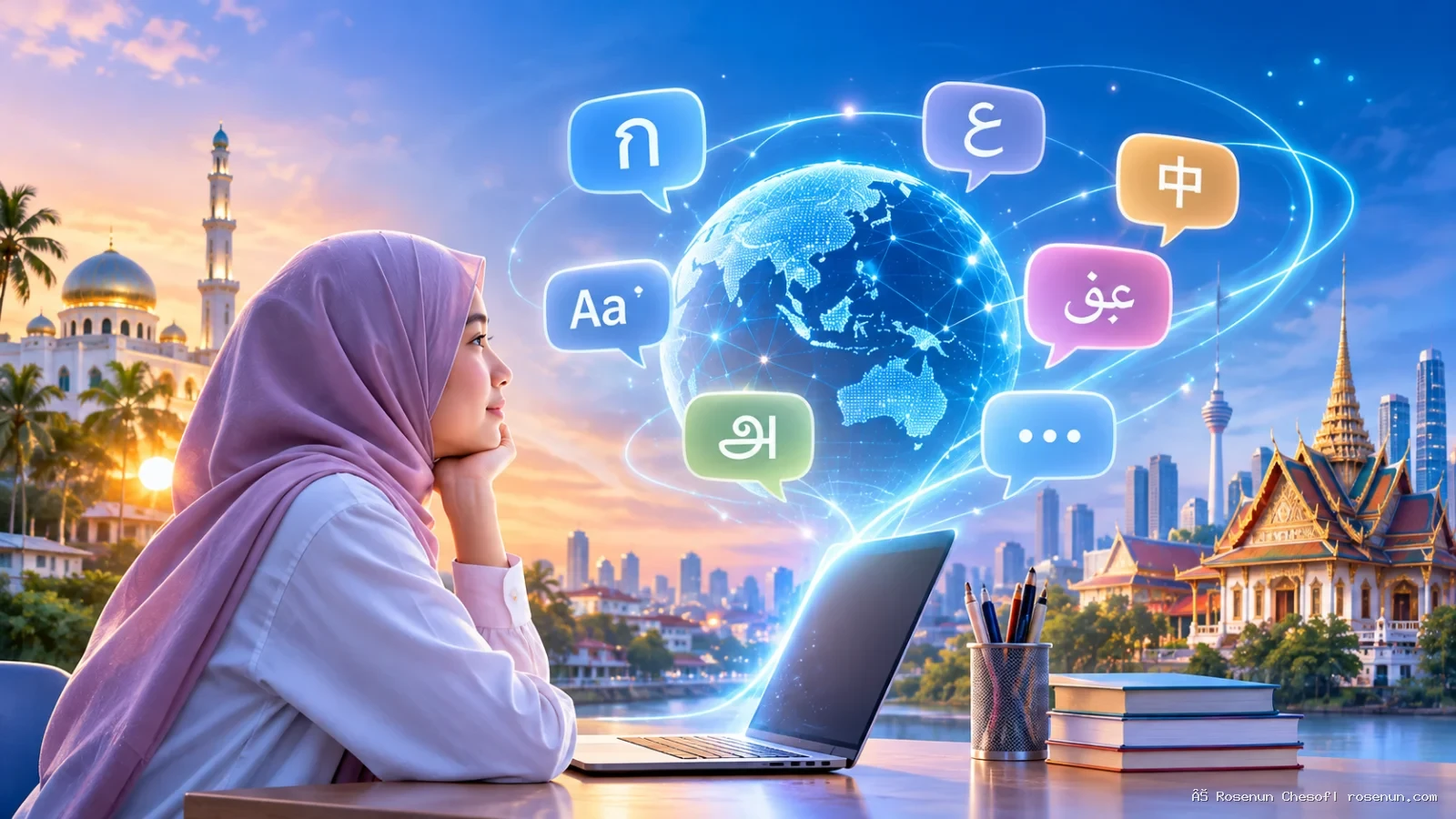
Imagine two children growing up in families that speak different languages. One speaks English, while the other speaks Patani Malay. Both have access to the internet and use the same artificial intelligence (AI) tools. Yet when they ask questions in the languages they are most comfortable with, the first child may receive detailed and natural responses, while the second may have to switch to Thai, Standard Malay or English to make the system understand what they want to communicate.
Although both children have access to the same technology, their opportunities to benefit from it are unequal.
This illustrates another dimension of inequality in the age of artificial intelligence. Beyond disparities in income, education and internet access lies a growing concern: digital linguistic inequality.
As AI becomes an increasingly important tool for accessing knowledge, employment and public services, languages that technology can readily understand have a distinct advantage over those that receive limited support.
More Than 7,000 Languages, but How Many Can AI Understand?
According to UNESCO, 8,324 languages have been documented worldwide. Approximately 7,000 remain in use, yet only around 1,000 are represented online.
Meanwhile, a linguistic diversity initiative by the United Nations Development Programme (UNDP) estimates that fewer than 100 languages are well supported by AI technologies.
These figures illustrate how the presence of a language in the physical world does not necessarily guarantee its equal representation in the digital environment.
A thematic brief on AI capacity-building published in November 2026 by the United Nations Independent International Scientific Panel on Artificial Intelligence also highlights the problem of linguistic exclusion, noting that English and a small number of other major languages receive considerably greater technological support.
These disparities affect the accuracy of AI-generated responses, system safety and the ability of AI to understand users' cultural contexts.
Why AI Understands Some Languages Better Than Others
Large Language Models (LLMs) learn linguistic patterns from vast amounts of data, including websites, books, academic publications, news articles, public documents and specially curated datasets.
Languages with extensive digital content, such as English and Chinese, therefore have an advantage in model training. In contrast, languages with limited digital documents, dictionaries, text corpora and evaluation datasets are often classified as low-resource languages.
The term low-resource does not imply that these languages are linguistically less developed or possess less cultural value. Rather, it refers to the limited availability of resources from which machines can learn.
Some languages may have millions of speakers, extensive literary traditions, rich histories and knowledge transmitted across generations. However, unless these resources are systematically digitised, AI systems may have relatively few opportunities to learn from them.
Linguistic inequality thus begins with the creation of datasets, the allocation of research funding and the decisions made by technology companies about which languages to prioritise.
National Languages Are Supported, but Regional Varieties May Be Overlooked
Southeast Asia provides a particularly compelling illustration of this problem. The region is characterised by considerable linguistic, ethnic and orthographic diversity, with different forms of communication often coexisting within the borders of a single country.
An AI system that claims to support Thai, Malay or Indonesian does not necessarily understand all regional varieties and forms of language use associated with those languages equally well.
In Thailand, support for Standard Thai does not guarantee the same level of proficiency in Isan, Northern Thai (Kham Mueang), Southern Thai or Patani Malay.
Similarly, although AI can communicate in Standard Malay, its ability to understand Kelantan Malay, Terengganu Malay and forms of everyday speech involving English, Chinese and Tamil requires separate evaluation.
The Case of Patani Malay and Kelantan Malay
Patani Malay, spoken in Thailand's southern border provinces, and Kelantan Malay, spoken in northern Malaysia, share close linguistic and historical connections. Both are integral to everyday life and community identity on either side of the border.
Nevertheless, these varieties differ from Standard Malay in vocabulary, pronunciation and certain grammatical features.
For example, the word demo in Kelantan Malay functions as a second-person pronoun, whereas in English, the same word commonly refers to a demonstration or product presentation.
Similarly, kawe, a first-person pronoun in Kelantan Malay, may occur relatively infrequently in Standard Malay text corpora.
An AI model's ability to distinguish these meanings depends on context and the data from which it has learned. If a system is trained primarily on standard language varieties, it may misinterpret regional vocabulary or normalise users' expressions into the standard language, potentially losing some of their social and cultural meanings in the process.
Jawi: Linguistic Inequality at the Level of Writing Systems
Beyond differences between languages, writing systems also influence AI's ability to process linguistic information.
Malay can be written in both Rumi, a Latin-based script, and Jawi, a script derived from Arabic.
Jawi has long played a significant role in education, religion, literature and administration throughout the Malay world. Today, it continues to appear on public signs, religious documents, educational materials and in cultural activities across Malaysia, Brunei and Thailand's southern border provinces.
In contemporary digital spaces, however, Malay written in Rumi is considerably more widespread.
The following example expresses the same meaning through two different writing systems:
Rumi: Bahasa Melayu ialah warisan budaya kita.
Jawi: بهاس ملايو اياله واريسن بوداي کيت
English translation: The Malay language is our cultural heritage.
For people who can read both scripts, the two sentences convey the same meaning. For AI systems, however, the accuracy of processing each version may differ depending on the quantity and quality of the training data available.
Support for Arabic does not automatically guarantee that a system can accurately understand Malay written in Jawi. Although the two share a related writing system, they are distinct languages.
This issue has significant implications for the digitisation of historical documents, the interpretation of old manuscripts, document translation and access to knowledge preserved in traditional writing systems.
From Public Spaces to Digital Linguistic Landscapes
In linguistics, the concept of the linguistic landscape refers to the visible presence of languages in public spaces, including street signs, shopfronts, government buildings and educational institutions. These linguistic representations reflect the status, power and recognition of different languages within society.
Languages displayed prominently, printed in larger type or selected for official signage occupy a different level of visibility from those that appear only marginally or are entirely absent.
In the age of AI, this perspective can be extended to the concept of the digital linguistic landscape. Linguistic visibility is no longer confined to written content on websites and social media. It also encompasses the ability of technology to search for, read, translate and generate content in a particular language.
When a language can be effectively used to retrieve information, produce documents, create educational materials and interact with AI, its domains of use expand.
Conversely, when speakers must switch to a more dominant language to access the same services, the functional space available to their local language in the digital environment may gradually diminish.
AI may therefore emerge as a new mechanism through which linguistic hierarchies are established, even without any explicit prohibition on the use of particular languages.
Implications for Education and Access to Opportunities
The linguistic capabilities of AI are becoming increasingly important as educational institutions and other organisations adopt the technology in their services.
Students with strong English proficiency may be able to access explanations, learning materials, writing assistants and research tools more effectively than children whose mother tongues receive limited technological support.
Similar challenges may affect older people, rural communities and populations whose first language is not the national language, particularly as healthcare, legal, financial and government services begin adopting automated conversational systems.
The digital divide therefore extends beyond access to mobile devices and the internet. It also concerns people's ability to use their own languages to access essential services.
If educational systems adopt AI as a primary learning tool without adequately considering linguistic diversity, a technology with the potential to reduce educational disparities may instead widen existing inequalities.
Southeast Asia's Efforts to Address Linguistic Inequality
Several countries have begun to recognise the limitations of AI models developed predominantly around English and are creating technologies that better reflect their own linguistic and cultural contexts.
One notable example is SEA-LION (Southeast Asian Languages in One Network), developed by AI Singapore to improve the ability of language models to process Southeast Asian languages.
The initiative supports several regional languages, including Thai, Malay, Indonesian, Vietnamese, Burmese, Lao and Khmer. It has also developed an evaluation framework known as SEA-HELM to assess linguistic capabilities and understanding of cultural contexts.
Singapore has another initiative, MERaLiON, developed by the Agency for Science, Technology and Research (A*STAR). It focuses on multilingual language and speech processing, including code-switching within conversations, a common feature of communication in multilingual societies.
In Malaysia, researchers from Universiti Malaya and YTL AI Labs have jointly developed MalayMMLU to address the shortage of tools for evaluating AI proficiency in Malay.
Introduced as the first multitask language understanding benchmark designed specifically for Malay, MalayMMLU consists of 24,213 questions covering 22 subjects from Malaysia's primary and secondary school curricula. It was used to evaluate 44 AI models in terms of linguistic understanding, reasoning and knowledge of Malaysian cultural contexts.
These initiatives demonstrate a growing recognition among Southeast Asian countries of the importance of developing AI technologies that reflect their own languages and cultures.
However, developing models that support national languages is only a starting point. The next challenge is to extend such efforts to regional varieties, minority languages and writing systems that continue to receive limited attention.
Who Should Own Community Language Data?
Incorporating additional languages into AI systems requires substantial amounts of data, including audio recordings, conversations, oral narratives, literary works, dictionaries and cultural documents.
Yet collecting these resources also raises questions about community ownership and control over linguistic data, a concept known as data sovereignty.
If technology companies use a community's linguistic and cultural knowledge to develop commercial products, how should that community participate in decision-making, and how should it benefit from the use of its data?
Who should determine spelling conventions, transcription practices and the interpretation of vocabulary when a language exhibits considerable internal diversity or lacks a commonly accepted writing standard?
The development of AI for local languages should therefore involve collaboration among linguists, universities, technology developers and language communities, with careful consideration of consent, data rights and diversity within communities.
The Future of the Languages AI Leaves Behind
Throughout history, the status of languages has been shaped by government policies, educational systems, mass media and economic structures. In the twenty-first century, artificial intelligence is emerging as another influential factor determining where and how languages can be used.
Languages that receive strong technological support will have greater opportunities to expand into education, employment and the digital economy. Those with limited support, however, may face increasing pressure as their speakers are compelled to use other languages.
For Thailand and ASEAN, investment in AI should therefore encompass the development of local-language corpora, the digitisation of linguistic and cultural knowledge, and the creation of evaluation tools that reflect the region's linguistic diversity.
As access to knowledge becomes increasingly mediated by artificial intelligence, the fundamental question may go beyond how intelligent our technology can become.
It is about who gets to use that technology in their own language.
Sources
UNESCO — Multilingualism and Linguistic Diversity https://www.unesco.org/en/multilingualism-linguistic-diversity
UNESCO — Coalition for Linguistic Diversity in Artificial Intelligence https://www.unesco.org/ethics-ai/en/coalition-linguistic-diversity-artificial-intelligence
UNESCO — Global Roadmap on Multilingualism in the Digital Era https://www.unesco.org/en/articles/unesco-launches-global-roadmap-multilingualism-digital-era
UNDP — Linguistic Inclusion in Artificial Intelligence https://www.undp.org/digital-innovation/elm-the-problem
United Nations — Thematic Brief: AI Capacity-Building, November 2026 https://www.un.org/independent-international-scientific-panel-ai/sites/default/files/2026-11/Thematic%20Brief_AI%20Capacity-Building_22%20Nov%202026.pdf
Ng et al. (2025). SEA-LION: Southeast Asian Languages in One Network. https://aclanthology.org/2025.ijcnlp-long.30/
AI Singapore — Southeast Asian Holistic Evaluation of Language Models (SEA-HELM) https://docs.sea-lion.ai/benchmarks/sea-helm
Poh et al. (2024). MalayMMLU: A Multitask Benchmark for the Low-Resource Malay Language. https://aclanthology.org/2024.findings-emnlp.36.pdf
IMDA Singapore — National Multimodal Large Language Models: MERaLiON and SEA-LION https://www.imda.gov.sg/-/media/imda/files/news-and-events/media-room/media-releases/2026/04/ai-innovation-challenge/annex-b-details-about-singapore-national-mll-models.pdf