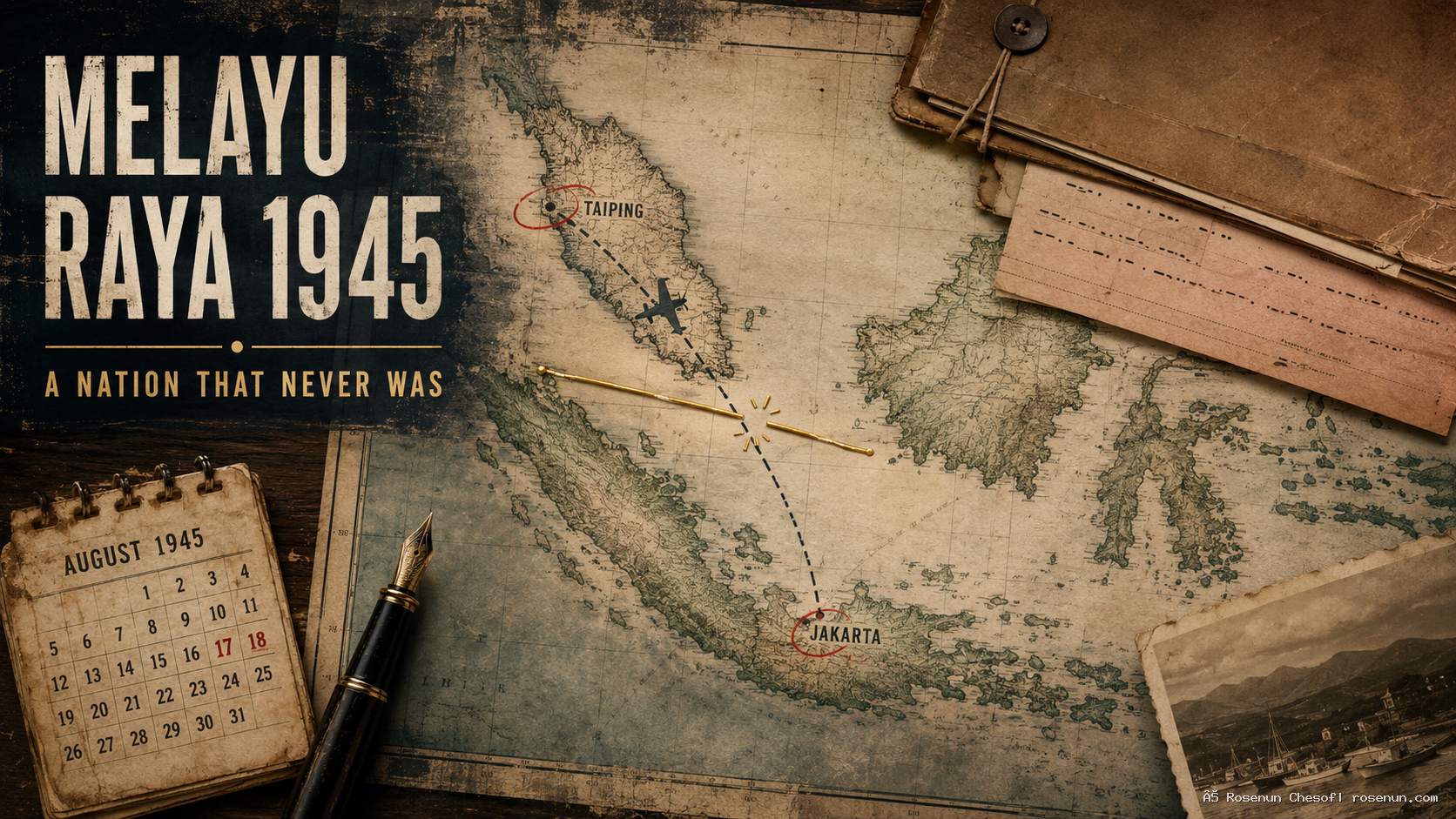
In Taiping, they met Ibrahim Yaakob and Dr. Burhanuddin al-Helmy, Malay nationalist leaders who were seeking a path to free Malaya from British rule.
What they discussed was not merely when Malaya would gain independence, but what kind of country the territories on both sides of the Strait of Malacca should become once colonial rule came to an end.
One possibility placed on the table was to bring Malaya and Indonesia into independence under a single state, under the name "Melayu Raya", or "Indonesia Raya"
Had the plan succeeded, the map of Southeast Asia might look very different today, and 31 August might not carry the same meaning it does for Malaysians today.
Before Borders Divided the Malay World
Today, Malaysia and Indonesia are understood as two countries with clearly separate territories, governments, and national identities. Yet these borders were shaped in part by the expansion of European empires.
The Netherlands controlled the archipelago that would later become Indonesia, while Britain ruled Malaya, Singapore, and parts of Borneo. Colonial political boundaries gradually divided territories that had long been connected through trade, seafaring, language, literature, religion, and kinship.
Before the emergence of the modern nation-state, people in the Malay Peninsula, Sumatra, Java, the Riau Islands, and surrounding areas did not understand their relationships through borders in the same way they are understood today. Books, newspapers, and nationalist ideas from Indonesia circulated in Malaya, while students, teachers, writers, and activists in Malaya closely followed their neighbours’ struggles against colonial rule.
It was in this atmosphere that the idea of Melayu Raya emerged. The concept held that the peoples of the Malay world shared linguistic, cultural, and historical roots and should achieve independence within a larger political community, rather than allowing imperial borders to become permanent divisions.
Melayu Raya, however, was not an idea supported by every group in Malaya, nor did it offer a clear blueprint for the structure of the state, the distribution of political power, or relations among diverse populations. The idea was promoted most strongly by left-wing and anti-colonial Malay nationalists, rather than representing a consensus among all communities.
Ibrahim Yaakob and the Dream of Melayu Raya
One of the central figures behind the idea was Ibrahim Yaakob, leader of "Kesatuan Melayu Muda" or KMM, which emerged in the late 1930s.
Unlike movements that sought to establish Malaya as a separate independent state, Ibrahim believed that the path to freedom might lie in union with Indonesia. Indonesian nationalism possessed a broader mass base and greater political strength, and might therefore help Malaya break free from Britain more quickly.
Dr. Burhanuddin al-Helmy was another figure who supported a vision of the Malay world that extended beyond colonial borders. For him, cultural, linguistic, religious, and historical connections made independence with Indonesia a political possibility, not merely a cultural imagination.
Yet the path chosen by these leaders was complex and remains controversial. They hoped to use Japan’s arrival to displace Western power and cooperated with parts of the Japanese administration in order to create political space for nationalist movements.
This hope rested on Japan’s rhetoric of liberating Asia from Western imperialism. In practice, however, Japan did not arrive as a genuine liberator. Its occupation of Malaya between 1942 and 1945 brought control, exploitation, forced labour, and violence to large numbers of civilians.
Although KMM had cooperated with Japan, the Japanese dissolved the organisation in 1942 when they came to regard its political activities as potentially beyond their control. For some nationalist leaders, cooperation with Japan was therefore both an attempt to seize a political opportunity and a gamble on another empire with its own objectives.
When the Dream Began to Approach Reality
As the Second World War entered its final phase in 1945, Japan’s defeat became increasingly apparent. Japanese leaders began signalling that some territories in Southeast Asia would be allowed to prepare for independence.
In April 1945, representatives from Malaya travelled to meet Indonesian leaders to discuss a joint declaration of independence. Sukarno later raised the question of incorporating Malaya into Indonesia during discussions within Indonesia’s independence-preparatory committee.
A crucial meeting then took place in Taiping between 12 and 13 August. A study by Mohamad Muzammil Mohamad Noor on Dr. Burhanuddin’s political role states that the meeting discussed declaring independence in late August. Malaya would send eight representatives to Jakarta to participate in the declaration of independence and establish a provisional government together with Indonesia.
At that moment, the idea of Indonesia Raya was no longer merely a slogan found in writings or speeches. It had begun to involve travel, meetings, organisational work, and preparations for actual representatives to take part in a declaration of independence. Details of these developments appear in the work of [Cheah Boon Kheng](https://ecommons.cornell.edu/entities/publication/d65fe80b-2d7a-4972-827c-b90362d33413) and in an article on [Dr. Burhanuddin al-Helmy](https://ejournal.um.edu.my/index.php/SEJARAH/article/download/9222/6530/18803) published in the University of Malaya’s historical journal.
Malay leaders also established "Kesatuan Rakyat Indonesia Semenanjung", or KRIS, to advance the project. On 15 August, representatives from Malaya, the Riau–Lingga Islands, and Patani gathered at the Station Hotel in Kuala Lumpur to prepare for the next stage of the movement.
It appeared that the moment they had been waiting for was finally approaching.
But on that very day, a single piece of news changed everything.
Three Days That Changed the Course of Two Countries
On 15 August 1945, Emperor Hirohito announced Japan’s surrender to the Allied powers, following the atomic bombings of Hiroshima and Nagasaki.
Japan’s surrender immediately destroyed the power structure on which KRIS’s plans depended. Japanese leaders were no longer in a position to endorse or manage the transfer of power they had once encouraged. At the same time, Britain was preparing to return to Malaya, while Indonesia faced mounting pressure to declare independence without waiting for Japanese approval.
On 17 August, Sukarno and Hatta proclaimed the independence of the Republic of Indonesia in Jakarta. The declaration did not include Malaya, and the eight Malay representatives did not join the provisional government as previously discussed.
Within only a few days, the possibility of a shared nation had disappeared.
Ibrahim Yaakob travelled to Java on 19 August to avoid arrest by the British as a collaborator with Japan. He spent the rest of his life in Indonesia and never returned to settle in Malaya. Dr. Burhanuddin, meanwhile, remained in Malaya and continued the struggle for independence through post-war political movements
From a Shared Dream to Separate Paths
After 1945, Indonesia fought against the Netherlands’ attempt to restore colonial rule. The revolutionary process and armed conflict lasted for several years before Indonesia’s sovereignty received international recognition.
In Malaya, Britain returned to power. Post-war politics moved in a different direction. Various nationalist movements competed to shape the country’s future, but the constitutional negotiating approach led by UMNO and its Alliance partners gradually became dominant.
Eventually, the Federation of Malaya gained independence from Britain on 31 August 1957—not as part of Indonesia Raya, but as an independent state with its own monarchies, federal system, and political institutions.
Malaysia in its present form did not emerge until 16 September 1963, when Malaya, Sabah, Sarawak, and Singapore joined to form a new country. Singapore later separated from the federation in 1965.
The irony is striking: only eighteen years after the meeting in Taiping, Indonesia under Sukarno opposed the formation of Malaysia, leading to **Konfrontasi** between 1963 and 1966.
The territories that some leaders had once imagined declaring independence together became two states confronting one another along their borders.
An Independence That Might Have Looked Different
We should be cautious about telling the story of Melayu Raya as though the union of Malaya and Indonesia had been a complete agreement that was inevitably about to happen. The idea raised many unresolved questions, including popular acceptance, ethnic diversity, the role of the Malay rulers, the form of government, and the power relationship between Malaya and the much larger Indonesia.
Nevertheless, the events of August 1945 demonstrate that Malaya’s future did not follow a single predetermined path. Independence might have emerged through revolution, union with Indonesia, the return of British rule, or negotiations to create a new state.
What we call a “country” today is therefore not the result of an inevitable historical design. It emerged from human decisions, the timing of war, imperial power, and political opportunities that sometimes opened only briefly before closing forever.
As Malaysia marks 69 years of independence, looking back at the dream of Melayu Raya does not mean that we must wish history had taken another course. Rather, it helps us understand that the Malaysia of today emerged from one of several possible historical outcomes.
31 August is therefore not merely the date on which Malaya gained independence from Britain. It is also a symbol of the path this land chose after once standing near a crossroads that might have led to a very different country—a nation united with Indonesia, which never came into being.