Before Becoming an Official Language, Malay Was a Regional Lingua Franca
Malay did not emerge with the creation of Malaysia. It had been one of the region’s most important indigenous languages for centuries.
The rise of the Malacca Sultanate in the fifteenth century helped establish Malay as a lingua franca—a common language used by traders, seafarers, diplomats, religious teachers and people from different communities.
Its role was therefore never confined to communication among Malays. Malay connected people from China, India, the Arab world and territories across the Southeast Asian archipelago. It was used in trade, government, diplomacy, law, religion and literature long before a country called Malaysia existed.
One Malay Language, Two Writing Systems
Any discussion of the history of Malay must distinguish clearly between a language and the script used to write it.
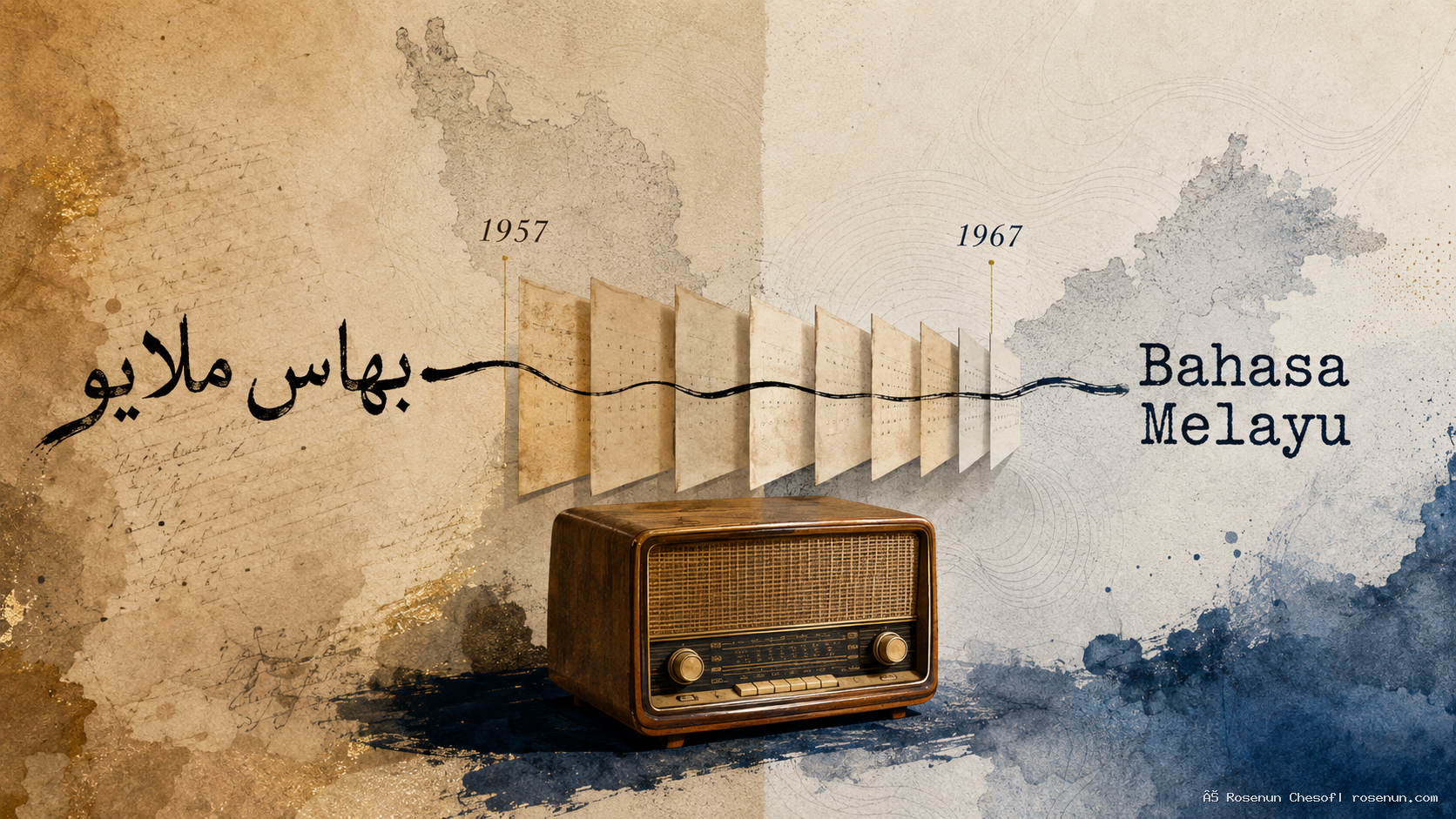
The term Bahasa Melayu can be written in Rumi as Bahasa Melayu and in Jawi as بهاس ملايو. These are not two different languages. They are two writing systems used to represent the same language.
Jawi was adapted from the Arabic script, with several additional letters introduced to represent sounds found in Malay. These include چ (ca), ڠ (nga), ڤ (pa), ݢ (ga), ۏ (va) and ڽ (nya).
The script spread alongside the arrival and development of Islam in the Malay world. It became an important medium for royal correspondence, diplomacy, law, religious texts, medical knowledge and Malay literature.
A substantial part of the Malay world’s intellectual heritage is therefore preserved in Jawi manuscripts. If younger generations can no longer read Jawi, a door leading to part of that historical knowledge may close with it.
Rumi, meanwhile, is the Roman or Latin script used to write Malay today. It gradually became more prominent through colonial administration, printing and formal education before developing into the principal script of schools, government departments, the media and modern communication.
Why Was a Ten-Year Transition Necessary?
Although Article 152 established Malay as the national language in 1957, the Constitution allowed English to continue to be used for ten years in Parliament, the courts, legislation and certain other official matters.
This transitional period gave the government time to develop terminology for law, science and public administration, produce textbooks, train teachers and civil servants, and expand the use of Malay throughout the education system.
The Razak Report of 1956 and the Rahman Talib Report of 1960 played important roles in building a national education system and advancing Malay as a principal medium of instruction.
The ten-year period did not suggest that Malay lacked the capacity to serve the state. It reflected the reality that changing the working language of an entire government could not be accomplished through a proclamation alone.
1 September 1967
In March 1967, Parliament passed national language legislation that provided greater clarity concerning the status and use of Malay for official purposes.
On 1 September that year, the fourth Yang di-Pertuan Agong, Sultan Ismail Nasiruddin Shah, proclaimed Malay the official language of the Federation of Malaysia.
On the same day, the Prime Minister’s Department issued General Circular No. 12 of 1967, directing government bodies to use Malay in their day-to-day administration. The transition that had begun at independence thus entered a new and more formal stage.
Tunku Abdul Rahman, the prime minister at the time, regarded the proclamation as completing the country’s independence. Malaysia now possessed not only its own territory and government, but also its own language through which to administer the country.
Did the State Choose Jawi or Rumi?
Section 9 of the National Language Act 1963/67 establishes Rumi as the script of the national language. The same section, however, makes clear that this provision does not prohibit the use of the Malay script more commonly known as Jawi.
In other words, Rumi became the principal script of public administration and modern communication, but Jawi was neither abolished nor made illegal.
Rumi provided a practical medium for modern administration and education, while the law continued to preserve space for a script that had recorded the history and intellectual traditions of the Malay world for centuries.
What Is the Status of Jawi in Malaysia Today?
Rumi is now the script most Malaysians encounter in schools, government documents, newspapers, websites and everyday communication. Jawi does not hold an equal position as the principal script of national administration.
Nevertheless, Jawi remains visible in religious education, parts of the school curriculum, public signs in certain states such as Kelantan, Terengganu, Perlis and Kedah, royal institutions, historical documents, calligraphy, shop signs and the study of Malay manuscripts. Policies and practices concerning Jawi vary among states and education systems.
The Ministry of Education continues to introduce Jawi in parts of the Malay-language curriculum, while the Department of National Heritage places it within the country’s linguistic and literary heritage to be preserved.
Jawi therefore occupies a position somewhere between a living script and a form of heritage requiring active protection. It has not disappeared, but it is no longer a skill that every Malaysian can read and write as many once could.
Malaysia Remains a Multilingual Society
The coexistence of Rumi and Jawi is only one dimension of Malaysia’s more complex linguistic landscape. Fifty-nine years after the proclamation of 1 September 1967, Malaysia remains a profoundly multilingual society.
Establishing Malay as the official language did not prohibit the use of other languages. Article 152 protects the right to use, teach and learn other languages outside official purposes. It also allows the federal and state governments to preserve and support the study of the languages of Malaysia’s different communities.
Malay serves as the national language, the official language and a shared language connecting people across different states and ethnic communities. At the same time, Mandarin and Chinese varieties such as Hokkien, Cantonese, Hakka and Teochew remain widely used in families, communities, businesses, the media and education.
Tamil and other languages used by South Asian communities—including Punjabi, Telugu, Malayalam and Urdu—continue to play roles in everyday life, religion, culture and education.
Sabah and Sarawak are home to numerous Indigenous languages, including Iban, Bidayuh, Kadazan-Dusun and Bajau. Orang Asli communities in Peninsular Malaysia continue to preserve their languages and bodies of knowledge in different ways. Malaysian Siamese communities, particularly in the northern states, also continue to use Thai within their families and communities.
Language policy has not developed identically throughout the country. Sabah applied the National Language Act through the National Language (Application) Enactment 1973, while Sarawak continues to recognise English as an official language alongside Malay at the state level. These differences reflect the distinctive histories and constitutional arrangements of the two East Malaysian states.
English did not cease to be important after 1967. It remains a second language in the education system and continues to play a significant role in higher education, international business, science, technology, tourism, the media and communication with the wider world.
In everyday life, many Malaysians do not use their languages in isolation. They select and move between languages according to the person with whom they are speaking, the place and the purpose. The same individual may use Malay when dealing with a government department, English at university or in the workplace, and Chinese, Tamil, Thai or an Indigenous language when speaking with family and members of the community.
Such diversity does not diminish the status of Malay. Instead, it demonstrates how different languages can perform different functions within the same society.
Malaysia’s challenge should therefore not be framed as a choice between Malay and English, between Rumi and Jawi, or between the national language and community languages. The challenge is to ensure that Malay remains strong enough to support public administration, education and the production of knowledge, while maintaining proficiency in English and protecting the linguistic diversity that constitutes an important part of the country’s social and cultural capital.
The proclamation of 1 September 1967 was therefore not the birth of the Malay language, nor did it mark the end of other languages. It was the moment when a language that had once connected people in the ports of the Malay world was formally entrusted with connecting the citizens of an independent country.
Malay can provide Malaysia with a shared voice without requiring its other voices to fall silent. Rumi and Jawi likewise demonstrate how one language can carry both the memory of the past and the demands of the modern world.
References
Use of Malay in Government Administration — Public Service Department
Introduction of Jawi in the Malay-Language Curriculum — Ministry of Education Malaysia
Jawi as Part of Malaysia’s Linguistic and Literary Heritage — Department of National Heritage
Malay Manuscripts and Jawi — Department of National Heritage
Federal Constitution of Malaysia — Attorney General’s Chambers