What makes the code remarkable is that it was not created from one language.
Kopi is the Malay word for coffee, with a history linked to the Dutch koffie. The O in kopi O is commonly associated with the Hokkien word for “black”. Kosong, meaning empty or zero, and satu, meaning one, are Malay. Peng, used for an iced drink, comes from a Chinese speech variety, while tapau can be traced to the Cantonese daa baau, meaning to pack or wrap something for takeaway.
That single coffee order contains Malay, Hokkien and Cantonese, together with a distant trace of Dutch colonial history.
Even the Word Kopitiam Is Multilingual
The name of the coffee shop tells a similar story.
Kopitiam combines the Malay word kopi with the Hokkien tiam, meaning shop. The result is a word that literally means coffee shop—but belongs entirely to neither language.
Kopitiams took shape in colonial Malaya as towns expanded and migrants arrived from southern China. Hainanese migrants became particularly closely associated with the business. Many had worked as cooks or waiters in European households, restaurants and other establishments, giving them experience in preparing Western-style food and serving coffee.
They were not the only community involved. Hokkien, Cantonese, Teochew and other groups also contributed to the development of kopitiam culture.
What emerged was not simply a local copy of the European café. Coffee, food and service were adapted to suit local ingredients, local incomes and the everyday routines of urban workers.
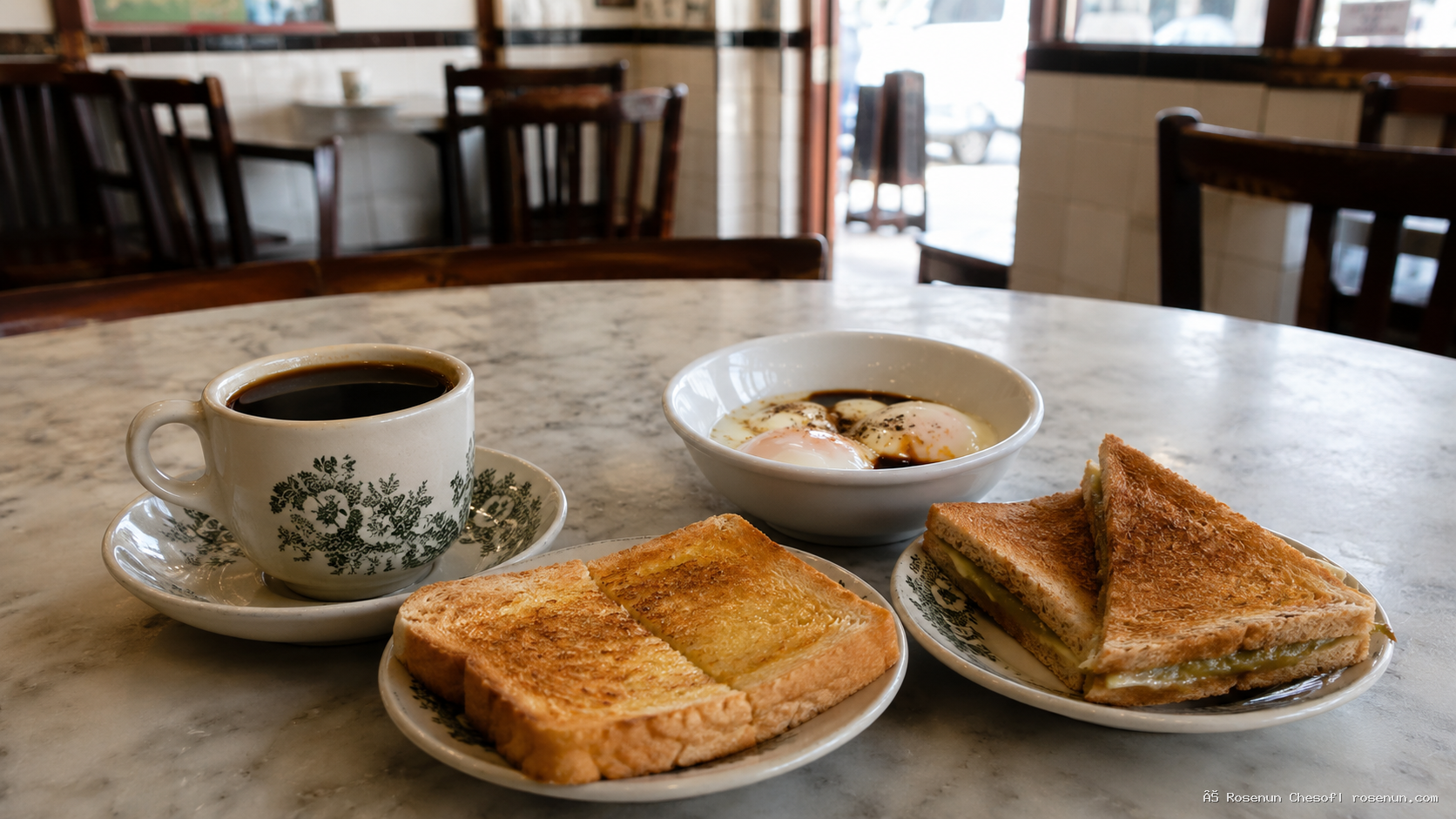
Dark-roasted coffee—sometimes roasted with sugar or margarine—developed a strong flavour that worked well with sweetened condensed milk. It was served with roti bakar, kaya toast, soft-boiled eggs and dishes from different communities.
The menu became as mixed as the society around it.
With marble-topped tables, wooden chairs, affordable food and quick service, the kopitiam grew into one of the most familiar breakfast spaces in Malaysia. It welcomed office workers, labourers, traders, families, retirees and anyone who needed a cup of coffee before beginning the day.
How the Kopitiam Code Works
A kopitiam order usually begins with the name of the drink. Customers then add words to indicate the type of milk, level of sweetness, strength, temperature or serving method.
The most common terms include:
| Term | What it usually means | Language source or association |
|---|---|---|
| Kopi | Coffee with sweetened condensed milk | Malay, historically connected to Dutch |
| O | No milk; black coffee that normally still contains sugar | Commonly associated with the Hokkien word for “black” |
| C | Coffee with evaporated milk and usually sugar | The origin remains disputed |
| Kosong | No sugar | Malay: empty, blank or zero |
| Peng | Iced or served cold | A Chinese speech variety, often associated with Hokkien |
| Gao/Kaw | Stronger, thicker or more concentrated | A Chinese speech variety, adapted locally in spelling and pronunciation |
| Po/Poh | Weaker or more diluted | A Chinese speech variety |
| Cham | Coffee mixed with tea | Associated with the idea of mixing in Chinese varieties |
| Kurang manis | Less sweet | Malay |
| Siew dai | Less sugar | Cantonese; more common in some shops and regions |
| Tarik | Poured repeatedly between containers to create froth | Malay: to pull |
| Tapau/Tapao | Packed to take away | Cantonese in origin; now widely used in Malaysia |
| Minum sini | To drink here | Malay |
| Take away | To take the order away | English |
Order kopi O, for example, and you will receive black coffee without milk—but it will normally still contain sugar. To remove the sugar, add kosong. For an iced version, add peng. In shops where Malay is more commonly used, you may hear ais instead.
Kopi C replaces condensed milk with evaporated milk, although sugar is normally still added. One popular explanation connects the letter C with Carnation evaporated milk, once a familiar product in the region. Another possibility links the term to Hainanese usage. Since no single explanation has been conclusively established, it is better understood as a debated origin rather than a settled fact.
Then there is cham, the drink for people who do not want to choose between coffee and tea. It combines both. The proportions vary, and some kopitiams have developed their own house recipes.
The system may appear standardised, but it is not used in exactly the same way everywhere. A term common in Penang or Kuala Lumpur may be less familiar in another state. Some expressions are more strongly associated with communities that speak particular Chinese varieties, while other customers may prefer Malay terms.
Pronunciation, spelling and word order can also vary according to location, generation and the habits of an individual shop.
There is no official grammar book for ordering kopitiam coffee. The system survives because customers and servers learn it through use.
“Minum Sini” or “Tapau”?
Once the drink has been ordered, the next question may be:
“Minum sini atau tapau?”
In Malay, minum means to drink and sini means here. Minum sini therefore means that the customer will stay and drink at the shop.
In some kopitiams, the server may shorten the question to a single word:
“Minum?”
The rest does not need to be said. Both sides already understand the situation.
If the customer wants the order to go, the answer may simply be:
“Tapau.”
The word comes from the Cantonese 打包 (daa baau), meaning to pack or wrap something. Yet tapau is no longer used only by Cantonese speakers. It has become part of everyday Malaysian speech and appears naturally in both Malay and English conversations.
A customer might say:
“Nasi lemak satu, kopi O kosong peng satu—semua tapau.”
The order is for one nasi lemak and one iced black coffee without sugar, with everything packed to take away.
There are other ways to say the same thing. The Malay word bungkus also means to wrap or pack, while people in urban or more modern shops may simply use the English expression take away.
A conversation can therefore move easily across languages:
The customer begins with a combination of Malay and a Chinese-derived coffee term, receives a question in Malay and answers in English. No translation is requested. No one stops to ask which language is being spoken. The conversation works because both sides share the same everyday vocabulary.
From the Kopitiam to the Oxford English Dictionary
The journey of tapau did not end at the coffee-shop counter.
In March 2025, the word was added to the Oxford English Dictionary, with the meaning of taking prepared food or drink away from a restaurant or shop to be consumed elsewhere.
A Cantonese expression that became part of everyday life in Malaysia and Singapore had travelled far enough to be recognised as part of English.
This challenges the idea that borrowed words move only from globally powerful languages into smaller or local ones. Language also travels in the opposite direction. A word shaped by the daily life of Southeast Asia can enter English because people use it often enough, widely enough and for long enough.
Why Do So Many Languages Fit into One Sentence?
Language education often teaches us to keep languages separate. Malay belongs in one lesson, English in another, while Hokkien or Cantonese may be treated as entirely different systems.
Everyday multilingual life is much less orderly.
People do not always select words according to the official identity of a language. They choose the expression that works best in the situation and that other people are most likely to understand.
A person who orders kopi O kosong does not need to speak Hokkien. Someone who asks for kurang manis does not need to be Malay. A customer who says tapau may have no idea that the word came from Cantonese.
Knowing the entire language is not necessary. What matters is knowing what the word does at the counter.
Through thousands of ordinary exchanges, words move beyond the communities in which they began. They are repeated by customers, workers, neighbours and friends until they become part of a shared Malaysian vocabulary.
The mixture found in a kopitiam order is therefore not careless or incorrect language. It is a highly efficient way of communicating.
With only a few words, a customer can specify the drink, the milk, the sweetness, the strength, the temperature, the number of cups and whether the order is for here or to go.
No institution designed this system. It developed because people needed it, used it and passed it on.
When Kopitiam Language Becomes a Brand
The Malaysian food-and-beverage brand Bungkus Kaw Kaw offers a modern example of how this mixed vocabulary has moved beyond the traditional coffee shop.
Its name combines the Malay bungkus, meaning to wrap or pack, with kaw, a Hokkien-derived term for a strong or concentrated drink. Repeating the word as kaw kaw intensifies the meaning: not merely strong, but very strong.
The name immediately sounds familiar to people who know kopitiam culture. It suggests a rich local drink prepared to be taken away.
It also shows how the language of the old coffee shop has entered shopping centres, digital menus, food-delivery applications and contemporary branding.
More Than a Place to Drink Coffee
A kopitiam has never been only about coffee.
It is a place where office workers, traders, retirees, neighbours and customers from different communities meet. Scholar Gaik Cheng Khoo has written about the kopitiam as a cosmopolitan everyday space—one in which differences of ethnicity, class and generation are brought together and negotiated through ordinary encounters.
In the morning, one customer may sit quietly with a newspaper while people at the next table discuss work, food prices, politics or neighbourhood news. Some customers remain for hours. Others collect a drink and leave within minutes.
They may come from different backgrounds, but they share the tables, the sounds of the shop and the familiar code of the menu.
The kopitiam functions as a restaurant, a neighbourhood living room and a small public forum at the same time.
In 2024, UNESCO inscribed Breakfast Culture in Malaysia on the Representative List of the Intangible Cultural Heritage of Humanity. The recognition highlighted the importance of eating breakfast together in Malaysia’s multi-ethnic society.
Kopitiams preserve more than recipes for coffee, toast and eggs. They also preserve ways of meeting, speaking and living together.
So, How Many Languages Are in One Cup of Coffee?
The answer may be two, three, four or more. It depends on the order and on how far back we trace the history of each word.
But counting the languages is not really the most important point.
What matters is how expressions that began in different communities became part of a vocabulary that many Malaysians now share. No single group needs to own these words completely for everyone to understand and use them.
The history of a multilingual society is not found only in constitutions, museums and archives. Sometimes it survives in a short order spoken across a coffee-shop counter.
We lift the cup to drink, or carry it away tapau, without noticing that a small part of Malaysia’s history is travelling with us.
References
UNESCO — Breakfast Culture in Malaysia
Gaik Cheng Khoo — Kopitiam: Discursive Cosmopolitan Spaces and National Identity
South China Morning Post — Coffee Names and Multicultural History