This knowledge is largely built from material that has left a digital trace: books, websites, research papers, news reports, databases, online discussions, and other forms of recorded information. Before knowledge can become available to an AI system, it usually has to be written down, digitized, published, and made accessible in a form that machines can process.
This leaves an enormous part of human knowledge beyond its reach. What happens to languages with little digital presence, histories passed down orally, practices learned through observation, and memories preserved within families and communities? Where do they belong in a future in which people increasingly turn to AI for information and guidance?
When AI Moves from Answering to Acting
This question is becoming more urgent as artificial intelligence develops from systems that generate content into systems that can also take action.
Generative AI responds to prompts by producing text, images, audio, code, or other content. Agentic AI can go further. It may plan a task, search for information, select sources, use digital tools, evaluate alternatives, and carry out a sequence of actions with a degree of autonomy.
The issue, therefore, is no longer confined to what AI says. It also concerns what AI decides is relevant, which sources it considers reliable, what options it prioritizes, and how it acts upon the information available to it.
As AI agents enter education, employment, public services, creative industries, and other consequential areas of life, the boundaries of their knowledge begin to matter in new ways. What a system knows—and what it does not know—may influence not only the answers people receive but also the recommendations made, opportunities presented, and decisions carried out on their behalf.
A system trained predominantly on the knowledge of certain languages, institutions, and societies may reproduce those perspectives even when operating in a very different cultural environment. The answer may be grammatically correct and technically competent while remaining detached from the people whose lives it is supposed to represent.
There Is More Than One Way of Knowing
This concern was at the center of a UNESCO roundtable held on 2 September 2026 under the title “Plural Intelligences: Designing Agentic AI that Respects Cultural and Epistemic Diversity.” The discussion was framed around a fundamental challenge: how can increasingly autonomous AI systems reflect different languages, worldviews, and traditions of knowledge without quietly turning one dominant perspective into a universal standard?
In this context, plural intelligences does not refer to Howard Gardner’s theory of multiple intelligences. It refers instead to the plurality of ways in which human beings create, validate, preserve, and use knowledge.
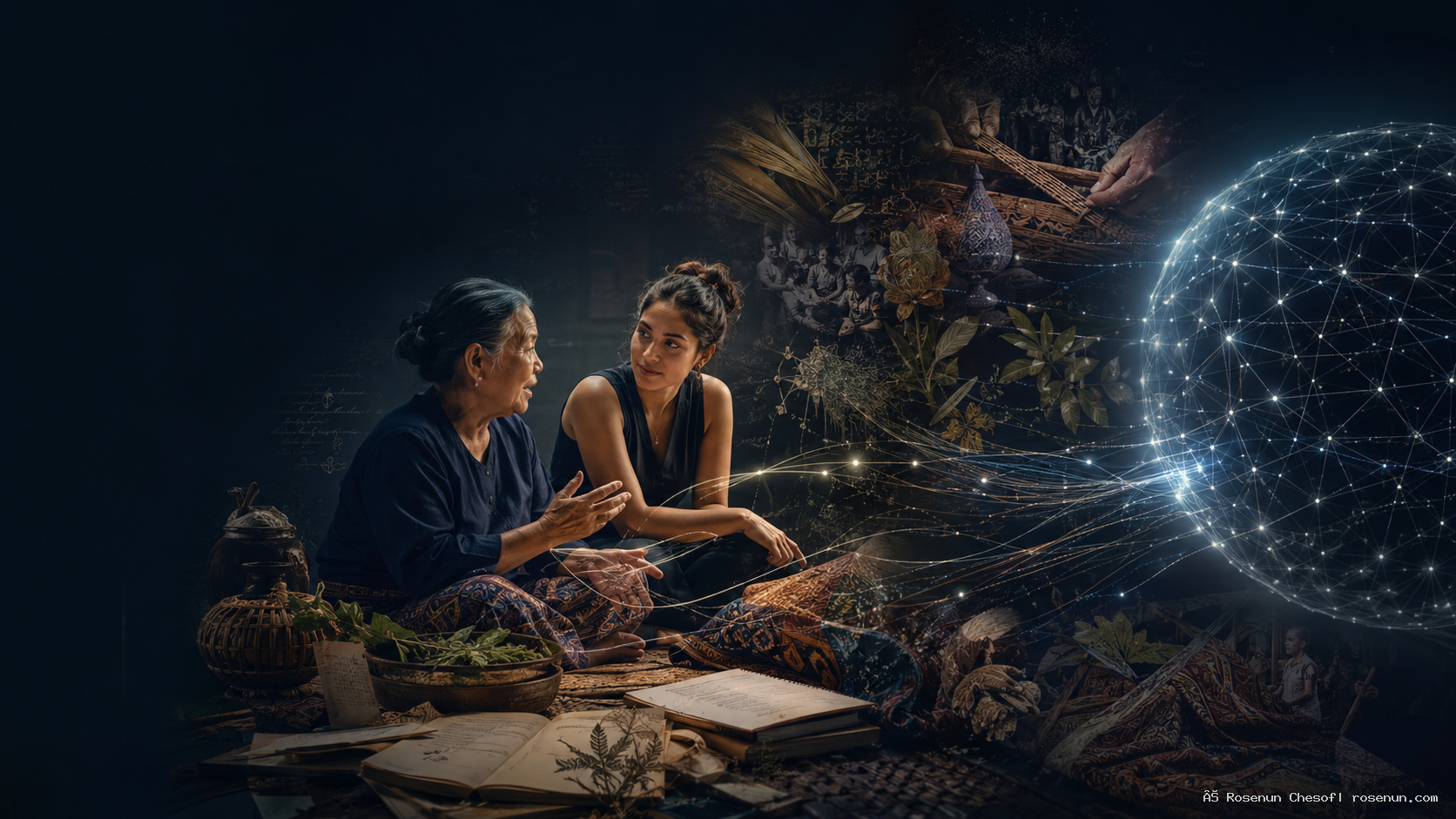
Some knowledge is produced through formal research and documented in scholarly publications. Other knowledge develops through sustained experience of a particular place. It may be carried through oral histories, spiritual traditions, songs, agricultural practices, craftsmanship, family relationships, or close observation of the natural world.
These different forms of knowledge do not always use the same methods to establish authority or credibility. Nor can they all be removed from their social settings and treated as interchangeable pieces of information.
The questions raised by UNESCO are therefore larger than how to place more data inside AI systems. It is about whether those systems can engage with cultural and epistemic diversity without flattening it. It asks whether AI can serve as a broker of knowledge without quietly making knowledge more uniform. UNESCO
The Internet Is Not the Whole World
The internet contains an extraordinary amount of information, but that information is not an equal representation of humanity.
Languages spoken by large populations or supported by powerful economies tend to have extensive digital resources. They appear in books, media archives, government records, research databases, and millions of webpages. Smaller languages, regional varieties, and languages sustained primarily through speech may have only a limited online presence.
The imbalance is not simply a matter of quantity. It also matters who has been able to record and publish the information that exists.
A community may be visible online mainly through the writing of tourists, government agencies, researchers, or journalists from outside it. These sources can be useful, but they do not necessarily express how members of the community understand their own lives.
An outsider might describe a ceremony as a colorful cultural performance. For those who practice it, however, the same ceremony may carry religious meaning, family memory, moral responsibility, and relationships extending across generations. Both accounts may refer to the same event, yet they do not contain the same knowledge.
Information about a community should not be mistaken for knowledge produced by that community.
This distinction becomes particularly important when AI combines many sources into a single, seamless answer. The smoothness of the final response can conceal whose interpretation has been preserved, whose has been translated into unfamiliar categories, and whose has disappeared altogether.
Something does not cease to exist just because a search engine cannot find it. Nor does knowledge lose its value merely because it was never included in a dataset.
Speaking a Language Is Not the Same as Knowing Its World
Language does more than carry information. It also reflects how people organize relationships, express respect, understand responsibility, and interpret experience.
Some words are inseparable from local histories, religious traditions, or social relationships. Their meanings may shift according to who speaks, to whom, in what situation, and with what intention. A direct equivalent in another language may capture the basic definition while losing much of the social meaning.
An AI system may be able to generate fluent sentences in a language without having substantial access to knowledge created in that language. When local digital resources are limited, the system may rely on explanations written in English or another dominant language and then reproduce those ideas in the user’s language.
The result may sound local while carrying an imported frame of reference.
This is why the ability of AI to speak our language does not necessarily mean that our voices are present in its knowledge. A language can appear in the output while the experiences, assumptions, and ways of seeing embedded within that language remain absent.
The distinction is subtle but important. Representation is not achieved simply because a system can translate its answer.
When the Most Available Answer Becomes the Standard Answer
If millions of people ask AI similar questions and receive responses assembled from the same dominant sources, certain explanations may gradually acquire the status of standard knowledge.
No deliberate campaign to erase cultural differences is required. Dominant accounts are simply easier to find. They are better documented, more frequently cited, and more compatible with the categories used by major institutions and digital platforms. Local meanings may be shortened for convenience, translated into broader terms, or omitted because the system lacks sufficient material to represent them confidently.
Over time, people may begin to assume that what AI does not mention is unimportant or that knowledge without an accessible online reference is less credible than information produced instantly on a screen.
There is also a more personal risk. Younger generations may increasingly consult AI before turning to elders, religious scholars, craftspeople, farmers, or others whose expertise has grown through lived experience. AI is immediate, patient, and easy to access. Community knowledge often requires relationships, time, and a willingness to listen.
At first, AI may merely reflect existing inequalities in the digital record. But as their answers are repeated in classrooms, articles, reports, and newly generated online content, they can also reinforce them. Highly visible knowledge becomes more visible, while poorly represented knowledge is pushed further towards the margins.
The problem, then, is not only that AI sometimes provides incorrect information. It is also that its answers can prevent us from noticing the knowledge that was never represented in the first place.
Putting Everything Online Is Not the Solution
A seemingly obvious response would be to digitize more local knowledge, document smaller languages, and place community histories online. Such efforts can be valuable, particularly when they are led by the communities concerned. But digitization alone does not resolve the ethical problem.
Knowledge is not a freely available resource simply because someone has the technical ability to record it.
Some forms of knowledge belong collectively to a community. Some are connected to sacred practices or restricted ceremonies. Others may be shared only with particular relationships, at particular times, or with people entrusted to receive them. Removing such knowledge from its context and placing it in a dataset may expose it to misuse, commercial exploitation, or serious misinterpretation.
Before asking how community knowledge can be added to AI, we must ask who has the authority to share it. Did the community consent to its use? Can it decide how the material is interpreted? Can it correct errors or withdraw access? If a company uses that knowledge to develop a profitable product, will the people from whom it originated receive recognition or benefit?
Respecting epistemic diversity cannot mean collecting as much information as possible and moving it into a central technological system. It must also include the right of communities to determine what may be recorded, who may access it, and how it may be used.
In some cases, respecting knowledge means accepting that it should not be available to everyone. An ethical AI system must not only recognize that it cannot know everything; it must also understand that it is not entitled to know everything.
AI Should Know the Limits of Its Knowledge
An AI system that respects cultural and epistemic diversity does not need to provide an answer to every question. More important is its ability to recognize the limits of the information on which its answer is based.
When evidence about a language, tradition, or community is limited, the system should be able to say so. It should distinguish between accounts written by outsiders and knowledge articulated by members of the community itself. Where appropriate, it should present more than one interpretation rather than converting a contested issue into a single authoritative statement.
Sources and context should remain visible. Communities should have meaningful opportunities to challenge, correct, and contribute to the ways in which they are represented. Sensitive knowledge should not be absorbed into AI systems merely because it can be technically obtained.
For questions that depend deeply on local experience, the most responsible response may not be an elaborate display of machine-like confidence. It may be an acknowledgement that the question should be taken to someone who knows the language, place, or tradition from within.
Such an approach reflects the principles of inclusion, cultural diversity, and respect for different knowledge systems set out in the UNESCO Recommendation on the Ethics of Artificial Intelligence.
What AI Does Not Know Is Still Knowledge
Artificial intelligence could play a valuable role in translating, documenting, and preserving forms of knowledge that have previously struggled to travel beyond their communities. Designed and governed responsibly, it may help smaller languages survive, connect dispersed communities, and make overlooked perspectives more visible.
But this possibility depends on our willingness to distinguish between the knowledge available to AI and the full range of human knowledge.
The internet is not the entire world. Digital archives are not the whole of human memory. An AI-generated answer is not a complete account of everything humanity has learned.
Beyond the data are languages spoken by relatively few people, skills held in the hands of craftspeople, memories carried by elders, stories shared within families, and forms of understanding that have never been written down.
In the future, knowledge may not disappear because no one remembers it. It may disappear because people stop asking those who still remember—and turn instead to systems that never encountered that knowledge at all.