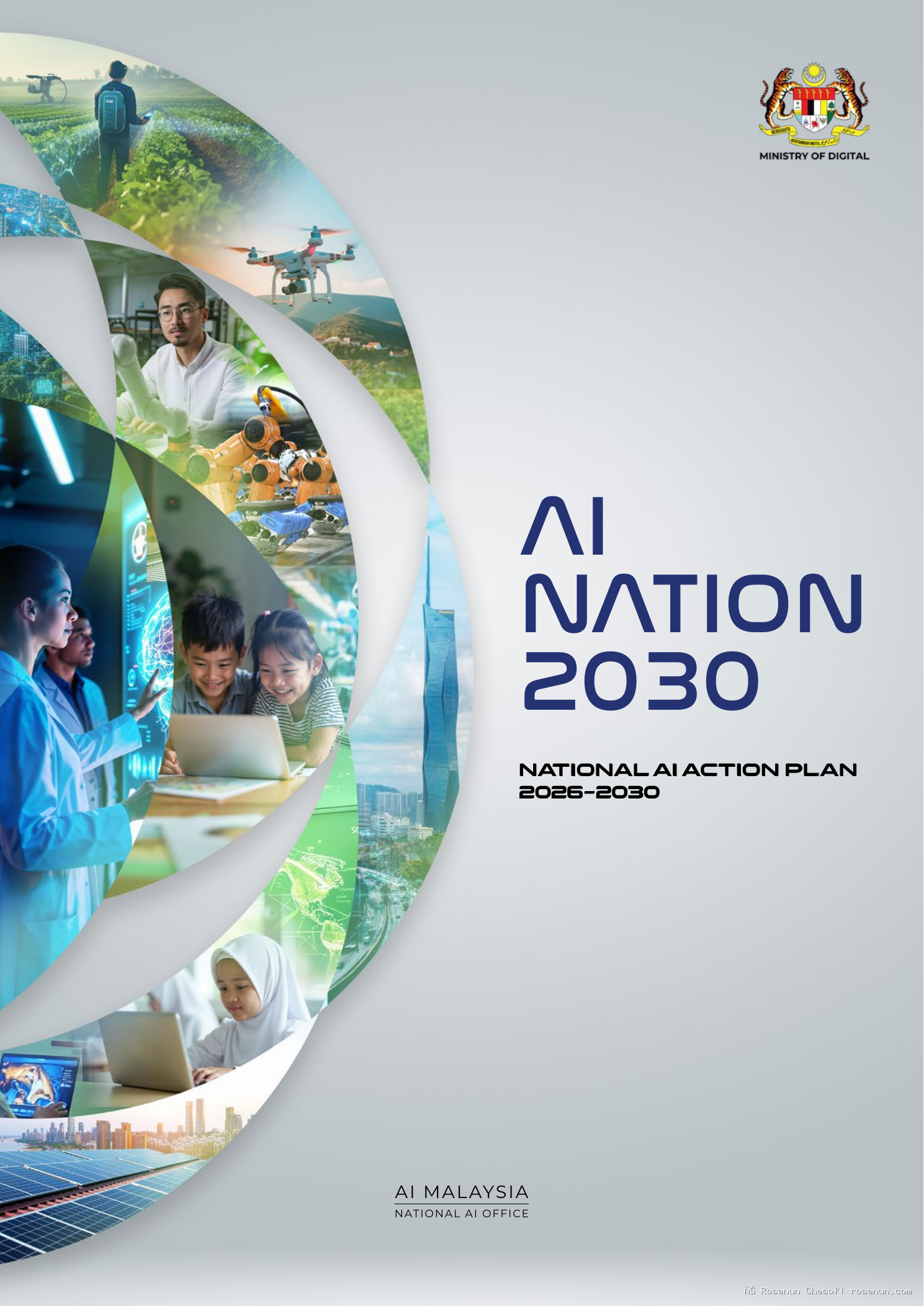
That ambition is set out in the National AI Action Plan 2026–2030, known as AI Nation 2030, prepared by the Ministry of Digital and AI Malaysia, or the National AI Office.
Running to more than 100 pages, the document is not merely a catalogue of technology projects. It attempts to bring the economy, labour market, education system, public administration and national data infrastructure into a single framework for AI-driven development.
The plan is organised into five parts, moving from an assessment of Malaysia’s present position to the question of how its ambitions will be governed and delivered.
| Part | Main focus |
|---|---|
| Part 1 | Malaysia’s starting point, lessons from its earlier AI roadmap and alignment with national policy |
| Part 2 | The vision, targets and strategic framework for 2030 |
| Part 3 | Fourteen sectoral Impact Engines |
| Part 4 | Fourteen Foundational Enablers supporting the wider AI ecosystem |
| Part 5 | Governance, accountability and implementation |
Taken together, the five parts show that AI Nation 2030 is not simply a plan to promote a new technology. It is an attempt to reorganise how government, business, universities, workers and citizens participate in an economy increasingly shaped by AI.
Part 1: Where Is Malaysia Starting From?
The first part, The National AI Strategic Context, assesses Malaysia’s position before it begins the next phase of its AI agenda.
Malaysia is not starting from scratch. The country’s National AI Roadmap 2021–2025 established an initial framework covering governance, research, digital infrastructure, talent development, public awareness and ecosystem activation.
According to the new plan, these efforts improved Malaysia’s preparedness for AI and helped the country perform ahead of many of its ASEAN peers in government AI readiness. Yet the document also acknowledges that Malaysia has not achieved large-scale AI deployment across multiple sectors.
Shortages remain in advanced expertise, private investment and the pathways needed to turn research into commercially viable products. Many projects are still isolated pilots rather than systems capable of being expanded across institutions, industries or the country as a whole.
The lesson from the earlier roadmap is therefore not simply that Malaysia needs an AI policy. Policy design, coordination and execution matter as much as the technology itself. A country can launch numerous programmes and build an appearance of readiness without producing meaningful economic or social results.
AI Nation 2030 is intended to move Malaysia from preparedness to delivery. It is aligned with existing national frameworks, particularly the Thirteenth Malaysia Plan, the National Fourth Industrial Revolution Policy and the Malaysia Digital Economy Blueprint.
Part 1 therefore establishes the case for a new plan: Malaysia does not lack ambition, but it still needs a mechanism capable of turning that ambition into measurable outcomes.
Part 2: What Kind of AI Nation Does Malaysia Want to Become?
Part 2, The Action Plan Framework, sets out the plan’s vision, mission, targets and overall architecture.
An AI Nation is defined as one in which AI is integrated across socioeconomic development, public administration and the daily lives of citizens.
In other words, AI is not understood merely as a chatbot or an application that individuals may choose to use. It includes the systems operating behind hospitals, universities, factories, farms, power grids, financial institutions, cities and government agencies.
By 2030, Malaysia intends to become a regional digital technology hub, a producer of globally competitive Made by Malaysia AI products and services, and an inclusive and sustainable AI Nation.
The plan sets three headline national targets.
| Target for 2030 | Intended outcome |
|---|---|
| International AI position | A place among the top 10 in recognised global AI indices |
| Economic impact | Up to 1.2 percentage points of additional GDP growth attributable to AI |
| Employment impact | Up to 300,000 jobs attributable to AI |
The GDP target refers to an increase in the rate of growth, not a 1.2 per cent increase on the original figure. If the economy were otherwise expected to grow by 4 per cent, for example, an additional 1.2 percentage points would raise that rate to 5.2 per cent.
The phrase “up to” is important. Both the GDP and employment figures are intended outcomes, not guaranteed results.
What Should AI Deliver for Government, Business and the Rakyat?
The plan divides its mission among three groups.
For government, AI is expected to improve public administration, policymaking and service delivery. For business, it should provide a platform from which Malaysian firms can grow, compete internationally and enter higher-value segments of the AI economy. For the Rakyat, it should improve access to services, quality of life and socioeconomic opportunity.
AI Nation 2030 also describes its approach as human-centred. Drawing on Malaysia’s National Guidelines on AI Governance and Ethics, it argues that technological progress must be balanced with safety, fairness, accountability and public trust.
The plan has two main operational layers. The first consists of Impact Engines, which apply AI to selected sectors. The second consists of Foundational Enablers, which provide the talent, data, computing capacity, governance and financing required to sustain those applications.
Part 3: Fourteen Engines for Sectoral Transformation
Part 3, Impact Engines: Driving Sectoral Transformation, provides the clearest picture of where Malaysians may encounter AI in practice.
The fourteen Impact Engines are divided into three delivery models.
| Delivery model | Sectors |
|---|---|
| Government-initiated | Healthcare, AI Cities, public services, the public sector, higher education, agrofood, and a secure and localised AI ecosystem |
| Public–private partnerships | Manufacturing, plantations and MSMEs |
| Industry champion-led | Power utilities, oil and gas, financial services and telecommunications |
The central principle is that projects should begin with a sectoral problem, rather than with a technology in search of somewhere to be deployed.
The plan calls this process the AI Adoption Closed Loop. It begins with the creation of high-quality datasets. These datasets are used to develop and deploy AI systems, which are expected to deliver benefits to users. The results and newly generated data then feed into the next cycle of infrastructure, talent and technology development.
Healthcare, Cities and Citizen Services
In healthcare, Malaysia plans to use national health data to support disease prevention, diagnosis, chronic-disease management and clinical research. The document estimates that AI could improve radiologist productivity by between 16 and 40 per cent while increasing diagnostic accuracy by more than 10 per cent.
AI Cities would add an intelligence layer to existing smart-city infrastructure. The first applications would connect transport and mobility data, allowing authorities to manage traffic and plan more proactively. The same infrastructure could later extend to public safety, energy and environmental management.
Public services would be brought together through an AI interface connecting MyGOV Malaysia with MyDigital ID. In time, citizens could use one AI assistant to obtain information, submit applications and complete transactions involving several government agencies.
The plan anticipates that this could reduce service-delivery costs by 20 to 30 per cent and increase citizen satisfaction by as much as 45 per cent.
Public Administration and Education
Within government, AI adoption would begin with everyday tasks such as producing meeting notes, preparing presentations and drafting emails. It could later expand into procurement, grants management, parliamentary responses and policy simulation.
The stated objective is not simply to remove civil servants from administrative work. It is to release time for functions that require human judgement, strategy and accountability.
In higher education, AI would support teaching-material development, assessment, learning analytics and personalised academic guidance. Students’ performance, interests and skills could be used to recommend learning and career pathways.
These possibilities also raise difficult questions. How much control will students retain over their data? How much authority should an automated system have when suggesting which subject, occupation or life path might suit a particular person?
Agriculture, Manufacturing and Smaller Businesses
The agrofood initiative centres on an Agristack bringing together information about soil, crops, weather, pests, irrigation and fertiliser. The aim is to enable precision agriculture, improve yield forecasting and strengthen food security.
In the plantation sector, a shared AI platform would give smallholders access to tools for disease detection, fertiliser management, drone operations and harvest planning. The plan intends to serve more than 300,000 smallholders and narrow the technological gap between them and large estates.
Manufacturing would receive an AI Hub for the Manufacturing Ecosystem, beginning with semiconductors before expanding into sectors such as automotive production, chemicals and medical devices.
The broader objective is to move Malaysia beyond its established role in production, assembly and testing and towards higher-value activities involving advanced technology and intellectual property.
For micro, small and medium enterprises, the plan proposes affordable, pre-vetted and modular AI tools that can be integrated into platforms businesses already use. The intended reach is 1.5 million MSMEs.
Energy, Finance and Telecommunications
In the power sector, AI would help manage electricity networks, forecast renewable-energy production and balance clean-energy expansion with system reliability.
Oil and gas companies would use AI to improve productivity and modernise the domestic oil and gas services and equipment ecosystem.
Financial institutions would apply AI to widen access to financing, particularly for MSMEs and start-ups, while strengthening fraud detection, cybersecurity, regulatory compliance and risk management.
Telecommunications is treated as part of the national AI backbone. AI applications cannot operate at scale without fast networks, secure data transmission, reliable data centres and sufficient computing capacity.
Part 4: Building the Foundations of an AI Nation
Part 4, Foundational Enablers: Anchoring System-Wide AI Adoption, addresses what Malaysia must build before sectoral projects can expand beyond isolated pilots.
The document identifies fourteen Foundational Enablers across five broad pillars.
| Foundation | Main initiatives |
|---|---|
| Globally competitive human capital | A global AI talent network, large-scale workforce development, AI-centred higher education, AI-fluent students and an AI-competent civil service |
| Market-driven innovation and adoption | A Research Foundry, AI Growth Zones and programmes to build public trust |
| Data and compute infrastructure | An AI-ready data ecosystem and accessible high-performance computing |
| Trust through responsible governance | National and sectoral governance, an AI Trust Function, national AI classification and AI-aware corporate stewardship |
| Sustainable funding and investment | Coordinated public, private and capital-market financing across the AI lifecycle |
One notable feature is that the document presents sustainable funding and investment as its fifth foundational pillar, although the fourteen numbered initiatives, E1 to E14, sit under the other four pillars. Financing operates across the entire plan rather than appearing as a separate numbered programme.
Building Talent from School to the Workplace
Malaysia’s talent strategy extends well beyond training more software engineers.
Primary and secondary students are expected to learn how to use AI effectively, safely and ethically. Teachers would receive training in both teaching about AI and using it as an educational tool. The plan also acknowledges that rural and underserved schools could be left further behind if access to devices, connectivity and trained educators is not addressed.
Universities, colleges and TVET institutions would be expected to update curricula more quickly, introduce AI learning across disciplines and expand industry placements.
Workers whose jobs are vulnerable to automation could receive AI-skilling credits, occupational-risk assessments and clearer pathways into new roles. Civil servants may eventually be required to complete AI training before they are permitted to approve, deploy or oversee government AI systems.
The plan also proposes attracting both international experts and Malaysians living abroad. Participation would not necessarily require permanent relocation; specialists could contribute remotely as well as on site.
Moving Research out of the Laboratory
The proposed Research Foundry is intended to address a persistent problem: research frequently fails to make the journey from university laboratories to the market.
It would connect industry problems, public funding, academic expertise, intellectual-property protection, prototype development, licensing and the creation of new companies within a single commercialisation pathway.
The plan also proposes regional AI Growth Zones based on the economic strengths of different parts of Malaysia.
The Northern Corridor would focus on high-value manufacturing and modern agriculture. Greater Klang Valley would concentrate on advanced manufacturing and financial services. Iskandar Malaysia would develop AI applications for logistics, ports, petrochemicals and oleochemicals. Sarawak would connect AI with renewable energy, smart cities and port management.
These zones would provide more than physical locations for companies. They are intended to offer computing access, embedded specialists, datasets, technical resources, incentives and a single channel for dealing with government agencies.
Data as a National Resource
Malaysia already holds enormous quantities of information in hospitals, universities, government departments, cities, farms and factories. Much of it, however, remains fragmented, stored under incompatible standards or difficult to access.
AI Nation 2030 proposes a catalogue of 100 priority national datasets and a formal Right-to-Data channel through which non-sensitive or anonymised public-sector data could be requested.
A National Data Exchange would allow organisations to discover, license, share or purchase datasets under clearer and more transparent terms.
Private companies contributing high-quality data could receive incentives, faster regulatory approval or recognition as an “AI Data Champion”. Malaysian language and cultural datasets would be developed in collaboration with Dewan Bahasa dan Pustaka and the National Archives.
Yet easier data movement must be accompanied by stronger protection of individual rights. Removing names from a dataset does not always make re-identification impossible, particularly when several datasets can be combined.
Who Will Control the Computing Power?
Developing AI domestically requires high-performance computing, which is expensive and largely controlled by major technology companies.
The plan proposes aggregating demand from government agencies, universities, start-ups and MSMEs into longer-term purchasing arrangements. GPU-hour credits could widen access for smaller organisations that would otherwise be unable to afford the necessary computing capacity.
The government may also negotiate reciprocal arrangements with cloud providers and hyperscalers, exchanging incentives for dedicated access to computing resources for Malaysian users.
Other proposals include a government-owned National Supercomputing Centre and a National Virtual AI Lab serving public agencies, universities, the central bank and smaller businesses.
Investment could be supported through Digital Infrastructure Sukuk, Green Sukuk, credit guarantees, accelerated depreciation and tax allowances.
These measures demonstrate that an AI Nation cannot be built through software alone. It depends on data centres, telecommunications networks, energy, land, finance and extensive physical infrastructure.
Trust, Regulation and Corporate Responsibility
Malaysia plans to adopt a hybrid governance system combining a national framework with the authority of sector-specific regulators. AI applications would be classified according to their level of risk and impact, allowing high-risk systems to face stronger requirements than routine or low-risk uses.
The proposed AI Trust Function would evaluate and test systems, maintain an incident registry, investigate emerging threats and coordinate with cybersecurity, communications, financial and law-enforcement agencies.
Large listed companies would also be encouraged to disclose how they govern AI risks, maintain inventories of the systems they use and strengthen AI expertise at board level.
The target is for 30 per cent of large listed companies to adopt emerging-technology governance practices by 2028, rising to 50 per cent by 2030.
Part 5: Who Will Turn the Plan into Reality?
The final part, Governance and Implementation, sets out who will coordinate the programme and who will be accountable for its results.
AI Nation 2030 adopts what it calls a Whole-of-Nation Execution Model. Oversight will sit with the National Digital Economy and 4IR Council, chaired by the Prime Minister.
Below it, a steering committee will coordinate the action plan, while AI Malaysia, or the National AI Office, will serve as the central secretariat linking ministries, agencies and other stakeholders.
Two advisory bodies are also proposed. The AI Strategic Advisory Council would provide national-level direction and help resolve systemic obstacles. The AI Implementation Advisory Council would maintain industry and academic participation in delivery, feedback and continuous improvement.
Each initiative is assigned to a lead ministry or agency. This is intended to reduce duplication and make responsibility easier to trace when a project is delayed or fails to deliver.
The plan also promises a shift from measuring inputs—such as the number of programmes, training sessions or ringgit spent—to measuring outcomes experienced by citizens, businesses and the economy.
Six Initiatives Will Move First
Although AI Nation 2030 contains fourteen Impact Engines and fourteen Foundational Enablers, six have been selected as Catalytic Initiatives for early implementation.
Three apply AI directly to healthcare, cities and citizen services. The remaining three establish a global talent network, AI Growth Zones, and a national and sectoral governance framework.
These projects were chosen because they are expected to benefit broad sections of society, produce measurable results within approximately two years and rely on data or infrastructure over which the public sector has a relatively high degree of control.
They are intended to serve as early demonstrations. The data, experience and confidence they generate can then support wider adoption elsewhere.
From a Five-Part Plan to Measurable Change
Read as a whole, the five parts form a clear sequence.
Part 1 explains what Malaysia has already built and where the gaps remain. Part 2 defines where the country wants to go. Part 3 identifies the sectors in which AI should produce visible results. Part 4 provides the people, data, infrastructure, investment and rules needed to sustain those efforts. Part 5 assigns responsibility for turning the plan into action.
A coherent structure, however, does not guarantee successful implementation.
The document sets ambitious national goals without providing a detailed overall budget or a complete project-by-project breakdown of expenditure. Some targets lack clear baselines, while the methods for calculating AI’s contribution to GDP and employment will require further explanation.
The employment target is particularly complex. Creating 300,000 AI-attributable jobs would be significant, but that figure must eventually be considered alongside the jobs that automation may reduce, reshape or displace.
It will also matter who receives the new opportunities. A genuinely inclusive AI Nation must account for workers outside major cities, lower-income households, older people, rural schools and those without reliable access to devices or high-quality connectivity.
Malaysia’s aspiration to create Made by Malaysia AI presents another challenge. Much of the global supply of advanced chips, cloud infrastructure, foundation models and computing capacity remains controlled by multinational companies.
Success should therefore not be measured only by the amount of foreign investment Malaysia attracts. It should also be judged by whether Malaysian companies, researchers and workers gain greater ownership of knowledge, intellectual property and the higher-value parts of the AI economy.
Ultimately, Malaysia’s progress towards becoming an AI Nation cannot be measured solely by international rankings, the number of data centres it builds or the frequency with which AI appears in government policy.
The real test is whether patients receive better care, whether students in different parts of the country gain comparable opportunities, whether farmers and small businesses can genuinely use the technology, and whether workers can move into new forms of employment.
It will also depend on whether citizens retain the right to know, question and challenge the use of AI when automated systems begin to influence decisions about their lives.
A country does not become an AI Nation on the day it launches a national plan. It becomes one when the technology produces benefits that people can recognise in their everyday lives—without leaving others to bear the cost of progress.
Reference
Ministry of Digital Malaysia — AI Nation 2030: National AI Action Plan 2026–2030