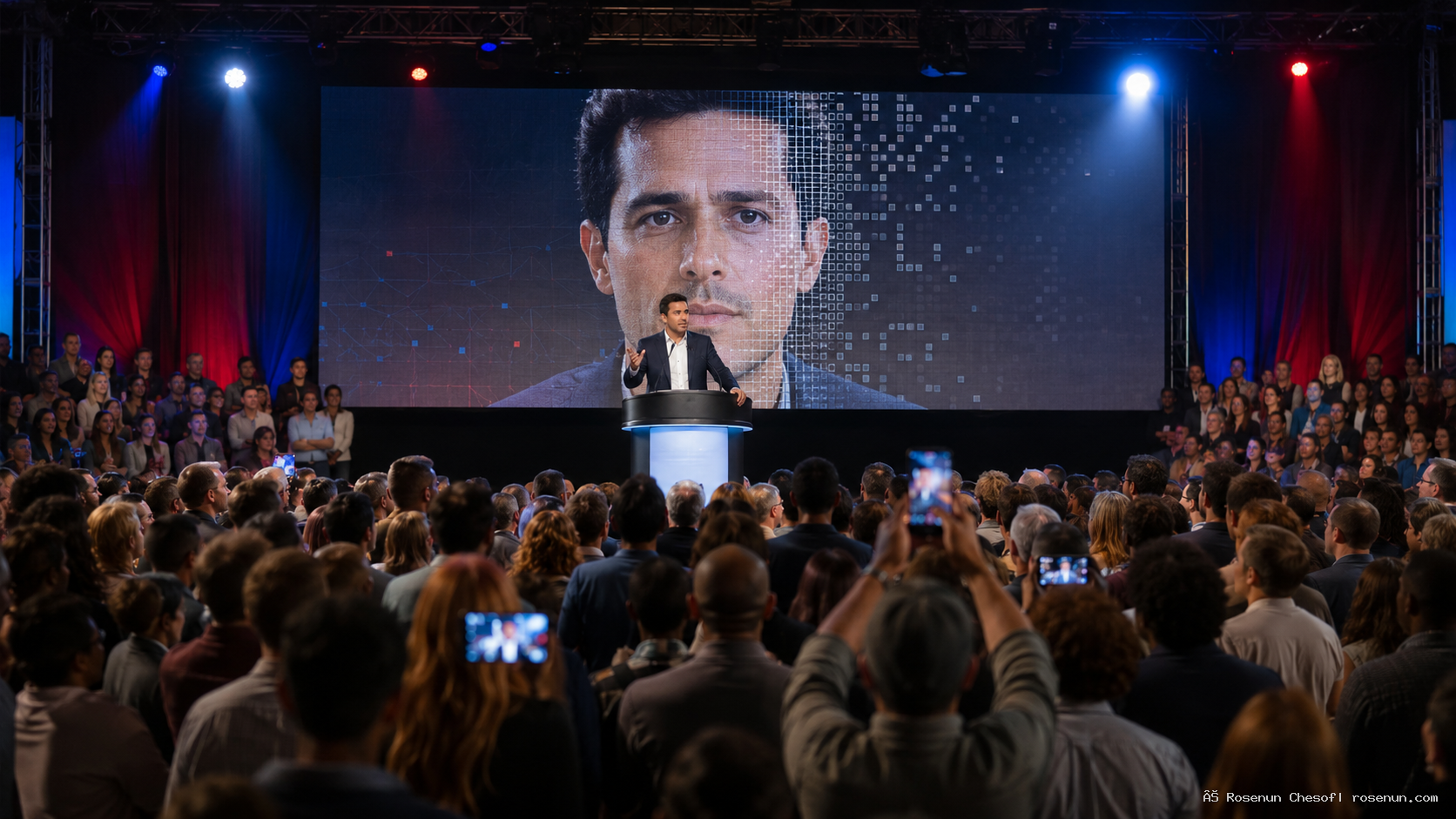
In late July 2026, delegates attending Brazil’s Liberal Party convention watched a video in which former president Jair Bolsonaro appeared to endorse the presidential candidacy of his son, Senator Flávio Bolsonaro.
The figure on screen looked like Jair Bolsonaro. The voice sounded like his. But the video was not a recording of an actual speech. His appearance and voice have been recreated using artificial intelligence.
The video soon became the subject of an important electoral case. Brazil has already prohibited deepfakes in election advertising, and the parties challenging the video argued that it had used AI to manufacture an endorsement and promote Flávio Bolsonaro before formal campaigning was permitted.
On 1 September, Brazil’s Superior Electoral Court, known as the TSE, used the case to establish a clearer legal definition of a political deepfake for the country’s 2026 election.
By a vote of five to two, the court defined a deepfake as synthetic content produced or manipulated using AI or similar technology that is sufficiently realistic to create, reproduce, or alter the image, voice, or expression of a person—whether living, deceased, or fictional.
In a separate four-to-three decision, however, the court declined to penalize Flávio Bolsonaro. It concluded that the video had been shown at what it regarded as an internal party event before his candidacy was formally announced and that it had not explicitly asked anyone to vote for him. On those grounds, it did not constitute premature election advertising.
The decision did not give Brazilian politicians unrestricted permission to use deepfakes. On the contrary, it gave the courts a broader definition to apply in future cases. Yet it also revealed how difficult it has become to draw a legal boundary around synthetic political content.
If viewers are told that a video was created using AI, is it still deceptive? If it does not directly ask for votes but is designed to demonstrate political support, has campaigning already begun? And if an endorsement is delivered by a digital reconstruction rather than the person concerned, who is speaking?
AI in Politics Is About More Than Fake News
Discussions of AI and elections tend to focus on deepfakes—fabricated videos that make politicians appear to say or do things that never happened. In practice, however, AI is entering political campaigns at almost every level.
Campaign teams can use it to analyze public reactions on social media, draft speeches, create images and videos, translate campaign messages, reproduce a candidate’s voice, operate chatbots and produce different advertisements for voters according to their age, location, language or interests.
Some of these uses may reduce campaign costs and help candidates with limited resources reach a larger audience. AI-assisted translation can make political information available to voters who speak different languages. The technology may also help candidates who have disabilities or cannot travel to every constituency.
The relevant question, therefore, is not simply whether a politician uses AI. What matters is how it is used, how clearly that use is disclosed, and who is held responsible when synthetic content misleads the public.
Campaigning Without a Candidate
Before the recent case in Brazil, Pakistan had already shown how AI could allow a politician to campaign without being physically present.
During Pakistan’s 2024 election, former prime minister Imran Khan was in prison and unable to appear at public rallies. His party, Pakistan Tehreek-e-Insaf, took statements he had communicated through his lawyers and used AI to recreate his voice. The recordings were then combined with animated images of Khan and broadcast during online rallies.
Supporters could once again see and hear “Imran Khan” address them, even though he had not personally recorded the speeches. Some of the online events attracted hundreds of thousands of viewers, while one AI-generated address received more than 1.4 million views on YouTube.
From one perspective, the technology gave a political figure who could not appear in public a way to continue communicating with his supporters. On another, it demonstrated that a politician’s face and voice could remain politically active even in the absence of the person himself.
The issue is no longer limited to whether an artificial voice sounds convincing. Voters must also know who wrote the message, who approved it and whether the owner of the face and voice consented to the particular use of that digital identity.
From Military Strongman to Affectionate Grandfather
AI can also help politicians reshape their public image far more quickly than traditional political branding once allowed.
During Indonesia’s 2024 presidential election, Prabowo Subianto’s campaign used an AI-generated cartoon avatar to recast the former general and hard-line political figure as a cheerful, approachable grandfather. Online, his round-cheeked avatar made Korean-style finger hearts and appeared with his beloved cat.
The gemoy image—an Indonesian term associated with being cute and endearing—proved especially appealing to younger voters. Nearly half of Indonesia’s approximately 205 million voters are under the age of 40.
The cartoon was not presented as a real photograph, and most viewers could clearly recognize it as an illustration. Yet AI helped determine which version of Prabowo the public encountered most frequently. Repeated often enough, the new persona began to compete with, and sometimes displace, older memories of his political and military career.
This illustrates why AI’s influence does not always depend on a demonstrably false claim. It can work by creating an emotional impression: making a candidate appear warmer, stronger, younger, more modern, or more relatable than before.
Political image-making existed long before generative AI. Campaigns have always used carefully selected clothes, photographs, slogans, settings, and television appearances. What AI adds is speed, scale, and the ability to produce almost unlimited variations for different audiences.
The Same Tool Can Create Heroes and Villains
During Argentina’s 2023 presidential election, supporters of both Sergio Massa and Javier Milei used AI-generated material as part of the political contest.
Some images portrayed their preferred candidate as a powerful leader or national hero. Others placed their opponent in unsettling film scenes or imaginary situations that made him appear unstable, dangerous, or unfit to govern.
This is one of AI’s greatest political advantages. The same system that constructs a heroic image of one candidate can turn an opponent into a villain within minutes. A campaign no longer needs to wait for its rival to make a damaging statement or an embarrassing mistake. It can manufacture a scene that never occurred.
Even when viewers recognize that an image is fictional, its emotional effect may remain. Fear, anger, and admiration often register before careful reasoning has time to ask whether the event was real.
AI-generated political content can therefore influence voters without persuading them that every detail is literally true. Sometimes it only needs to reinforce what they already hope or fear about a candidate.
When Celebrities Are Made to Take Sides
During India’s 2024 general election, deepfake videos of Bollywood actors Aamir Khan and Ranveer Singh circulated widely on social media. The videos falsely made it appear that the actors were criticizing Prime Minister Narendra Modi and supporting the opposition Congress party.
Both men denied making the statements. Aamir Khan filed a police complaint, while Ranveer Singh warned his followers about the danger of deepfakes.
The case exposed another dimension of synthetic political campaigning. The creators had not merely fabricated a politician’s words. They have appropriated the visibility and credibility of well-known public figures and used their faces and voices to suggest political endorsements that had never been given.
Once such a video has reached hundreds of thousands of people, a later denial may never travel as far as the original fabrication. The correction and the falsehood rarely reach exactly the same audience.
When AI Does More Than Attack a Candidate
An incident before the 2024 New Hampshire presidential primary in the United States showed that electoral manipulation can go beyond damaging a politician’s reputation.
Voters received automated telephone calls featuring an AI-generated imitation of President Joe Biden’s voice. The message encouraged them not to participate in the approaching primary.
Its purpose was not simply to make one candidate more attractive than another. It attempted to discourage citizens from exercising their right to vote.
The US Federal Communications Commission subsequently confirmed that AI-generated voices fall within existing restrictions on artificial or prerecorded robocalls. It also proposed a fine of US$6 million against the political consultant accused of arranging the calls.
The incident demonstrated that a sophisticated video is not always necessary. A short audio message delivered at a strategically chosen moment may be enough to create confusion or interfere with voter participation.
Governments Are Drawing Different Lines
Countries increasingly recognize that traditional election laws may not be adequate for synthetic media. Yet they disagree sharply over what should be prohibited.
Brazil bans deepfakes in election advertising, requires disclosure when AI is used, and restricts automated systems that could make voters believe they are communicating directly with a candidate. The Flávio Bolsonaro decision nevertheless shows that enforcement may still depend on context, timing, audience, and whether the content explicitly asks for votes.
South Korea has adopted a stricter approach. It prohibits the production and distribution of election-related deepfake images, audio, and video during the 90 days before polling. AI-generated campaign content used before that period must be clearly labelled. Violations may result in fines or imprisonment.
Singapore makes it a criminal offense, from the issuance of the election writs until the close of polling, to publish online election advertisements containing a realistic but false representation of a candidate saying or doing something that never occurred. Election officials may direct publishers and platforms to remove the material or block access to it.
India has placed greater emphasis on transparency. The Election Commission has instructed political parties, candidates and prominent campaigners to label synthetic material clearly with descriptions such as "AI-Generated," “Digitally Enhanced," or “Synthetic Content." It has also told parties to avoid AI-generated misinformation and manipulated material that could undermine a fair contest.
The European Union does not prohibit all political deepfakes. Since 2 August 2026, however, Article 50 of the AI Act has required certain AI-generated material to be machine-readable and identifiable, while deepfake images, audio and video must be visibly disclosed as artificially generated or manipulated.
The United States still has no single federal law governing any use of AI in political campaigning. The result is a patchwork of state laws. Some require disclaimers on manipulated political content, while others allow candidates to sue over digital impersonation. Several measures have also faced constitutional challenges over freedom of expression.
Behind these different approaches lies the same unresolved question: should deceptive synthetic media be prohibited outright, or should it remain permissible when clearly labelled? Any answer must also preserve space for satire, parody, art and legitimate political criticism.
Is an “AI-Generated” Label Enough?
Requiring disclosure is a reasonable starting point, but a label alone does not eliminate the problem.
Viewers may fail to notice a small disclaimer or one that appears briefly at the beginning of a video. A screenshot may circulate after the label has been cropped out. Even when people know an image is artificial, the emotional impression it creates can survive.
The growing presence of deepfakes also gives politicians a new defense against genuine evidence. If an authentic recording is politically damaging, the person involved can simply claim that it was created by AI.
The danger, then, works in both directions. AI can make fabricated evidence appear genuine while also making genuine evidence easier to dismiss as fabricated.
Over time, the greatest damage may not come from convincing everyone to believe a particular fake. It may come from creating an information environment in which people no longer believe that anything can be verified.
Politics Has Always Been About Image-Making
Politicians were constructing public personas long before AI arrived. They have always selected their clothes, settings, photographs, music, and language to emphasize the qualities they want voters to see. Attack advertisements, misleading edits, and propaganda are hardly new inventions.
AI did not create political manipulation.
What has changed is the speed, cost, realism, and scale at which that manipulation can be produced. Synthetic media can be generated in enormous quantities, adapted to different languages, and designed around the fears, hopes, and identities of particular groups of voters.
Future elections may not be disrupted by one notorious fake video seen by an entire country. Instead, thousands of different videos may be telling different stories to different voters, with no one outside the campaign able to see the full picture.
Democracy does not require politicians to stop using AI altogether. It does, however, require voters to know who is speaking, who created the message, and who will be held accountable when the content is false.
Because once politicians can manufacture versions of themselves that never existed—and versions of their opponents based on events that never occurred—the defining question of an election may no longer be what a candidate said.
The question may be whether those words were ever spoken at all.
References
Tribunal Superior Eleitoral — TSE Establishes Criteria for Deepfakes in Brazil’s 2026 Elections
Associated Press — Brazil’s Electoral Court Sets New Standards for AI Deepfakes
Reuters — How Imran Khan Campaigned from Prison Using AI and Online Rallies
Reuters — Generative AI Faces a Major Test in Indonesia’s Presidential Election
Reuters — Deepfakes of Bollywood Stars Raise Concerns During India’s Election
Federal Communications Commission — AI-Generated Voices in Robocalls
Elections Department Singapore — Rules on AI in Election Campaigning
Election Commission of India — Labelling Synthetic and AI-Generated Campaign Content
European Commission — Transparency Obligations under Article 50 of the AI Act
Fulcrum — Regulating AI-Assisted Campaigning Before Malaysia’s GE16