A doctrine of permanent confrontation
Harel begins with what he sees as a significant shift in Netanyahu’s security thinking.
The lesson Netanyahu has drawn from the Hamas attack of October 7 is that Israel should no longer wait for threats to become immediate. Instead, it should be prepared to use military force preemptively against potential dangers, even when doing so carries substantial political, economic, and diplomatic costs.
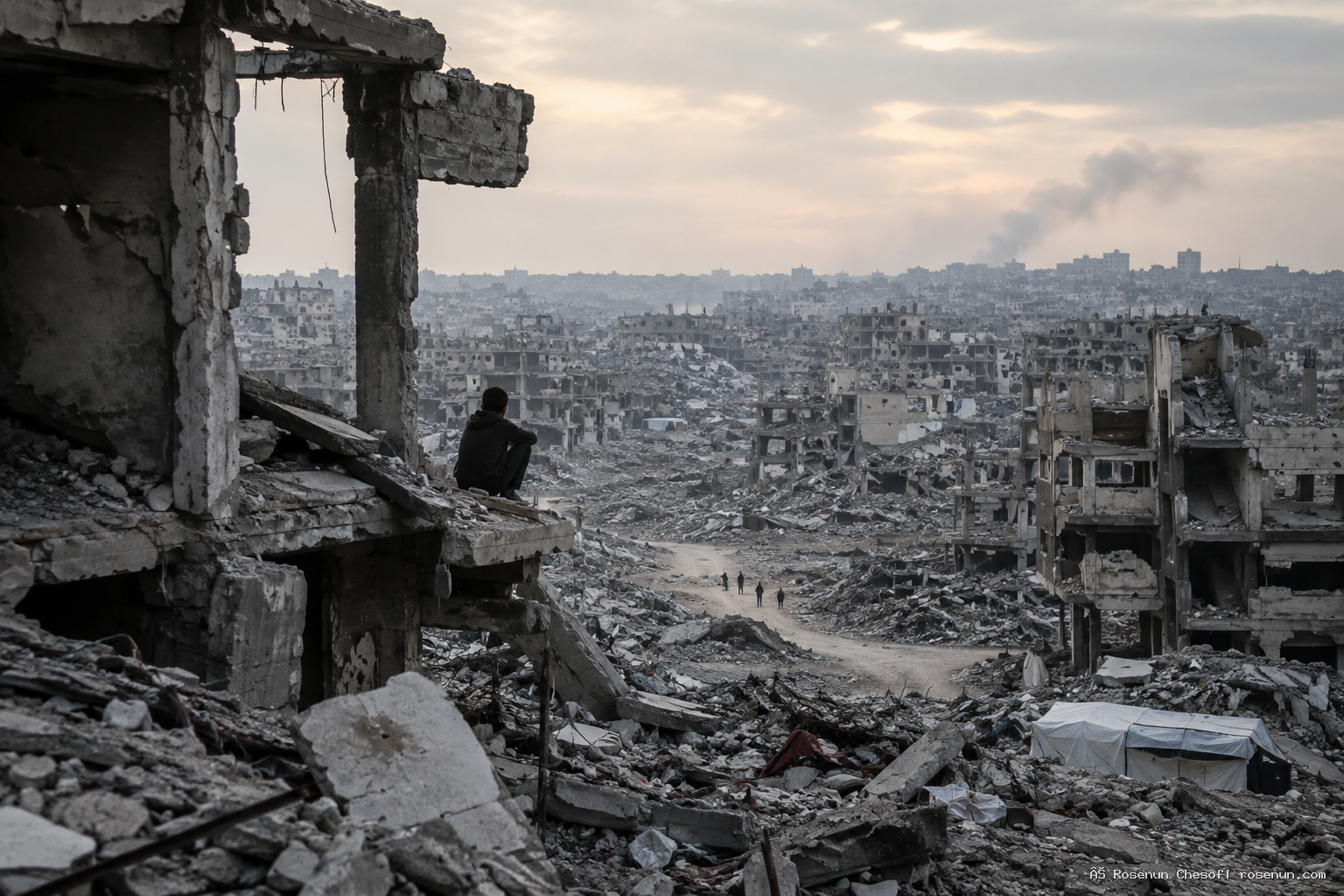
This approach can already be seen across several fronts. Israel has maintained or expanded military control in areas of Gaza, southern Lebanon, and Syria, treating some of them as security zones that may remain under Israeli control for years.
The result, Harel argues, is a strategy in which military confrontation risks becoming not an exceptional response to a crisis but a continuing condition of Israeli security.
And that strategy has been expensive.
Israeli reservists have spent extraordinary amounts of time on military duty. Normal IDF training has been disrupted. The economic cost of the wars since 2023 is estimated at around $142 billion, while Israel has also suffered serious damage to its international standing.
Yet Netanyahu continues to present offensive military action as essential to preventing another October 7.
Would Eisenkot really change Israel's course?
This is where Harel introduces Gadi Eisenkot, the former IDF chief of staff who has emerged as Netanyahu’s most serious political challenger.
At first glance, an Eisenkot victory might appear to promise a major change. Eisenkot has sharply criticized Netanyahu’s management of the war, particularly his handling of negotiations over Israeli hostages. He has also rejected Netanyahu’s repeated promise of achieving “total victory” over Hamas.
But Harel cautions against assuming that a change of prime minister would produce a fundamental change in Israeli security policy.
Eisenkot himself remains hawkish on several important issues. He opposes the establishment of a Palestinian state under present conditions and would almost certainly refuse to tolerate a continuing Hamas military presence in Gaza.
More importantly, the Israeli electorate has changed.
Since October 7, Israeli Jewish public opinion has moved significantly to the right. Distrust of Palestinians has deepened, support for a Palestinian state has declined, and there is broader acceptance of the idea that Israel must act offensively to prevent future threats.
This leads to one of the most important observations in Harel’s analysis:
Netanyahu’s problem may not be that Israelis have rejected his security worldview. They may simply no longer believe that Netanyahu is the right person to carry it out.
If that is true, replacing Netanyahu would not necessarily mean replacing the doctrine that developed under him.
The West Bank may be where change matters most.
Harel sees the West Bank as one area where a new government could make a meaningful difference.
Under Netanyahu, far-right Finance Minister Bezalel Smotrich has acquired extraordinary influence over civilian affairs in the territory. Since 2023, more than 200 settlements and outposts have either been established or begun construction.
At the same time, violence by extremist settlers against Palestinians has increased. Harel is unusually direct on this point. He argues that the issue should not be viewed merely as a public relations problem for Israel.
For him, settler violence represents a moral injustice, and in its most extreme form the effort to seize land and remove Palestinians can amount to localized ethnic cleansing.
There is also a security problem for Israel itself.
Harel warns that the growing power of armed settler groups, combined with their increasing influence over the military administration of the West Bank, could eventually undermine the IDF’s centralized authority.
An Eisenkot government would probably not dismantle the settlement system altogether. Reversing decades of settlement expansion would be politically and institutionally extremely difficult.
But it could restrain violent extremists, investigate attacks more seriously, restore state authority, and halt further expansion.
In other words, the difference between Netanyahu and Eisenkot might not be revolutionary—but in the West Bank, even incremental change could matter.
Gaza: an end to the war, but not a complete withdrawal
Gaza presents a similar dilemma.
Eisenkot has never embraced Netanyahu’s rhetoric of “total victory,” which could give him greater freedom to negotiate an end to the war. Harel also believes he may be more open to allowing the Palestinian Authority to play a role in Gaza’s future administration.
But this should not be mistaken for a dramatic reversal of Israeli policy.
Eisenkot would almost certainly demand the removal of Hamas’s military capability. And like almost any Israeli leader after October 7, he would find it politically difficult to support a complete withdrawal that left Israeli communities near Gaza vulnerable to another cross-border attack.
Harel therefore considers a more limited outcome more plausible: Israel reducing, rather than completely abandoning, its military zone of control while gradually allowing some form of internationally supervised Palestinian Authority administration elsewhere in Gaza.
That would be a change from Netanyahu’s approach—but not a return to the pre-October 7 status quo.
Opportunities in Syria and Lebanon
Harel sees somewhat greater diplomatic room in Syria and Lebanon.
Eisenkot would still insist on strong security guarantees and would demand Hezbollah’s disarmament. The difference is that he appears more willing than Netanyahu to regard ending a military confrontation as a strategic achievement in itself rather than keeping fronts indefinitely open.
Syria could offer a particularly interesting opportunity.
According to Harel, Syrian President Ahmed al-Shara has shown interest in a security arrangement involving an Israeli withdrawal from Syrian territory captured in 2024 in exchange for a degree of normalization.
Such an agreement could appeal to an Eisenkot government because it would reduce one active front without requiring Israel to make what it considers an unacceptable security concession.
A change of government might also affect relations with Saudi Arabia. Crown Prince Mohammed bin Salman could see a post-Netanyahu government as an opportunity to reopen discussions about normalization.
But none of these possibilities depends on Israel alone.
Then there is Trump.
The United States remains the other major variable in Harel’s analysis.
Donald Trump once enjoyed an exceptionally close relationship with Netanyahu, but that relationship has become more complicated. The United States is now involved in a prolonged war with Iran, while Trump has also sought diplomatic successes elsewhere in the Middle East.
This could give Washington an incentive to press Israel toward agreements in Gaza or Lebanon.
For Netanyahu, American pressure to withdraw from territory or wind down military operations could be politically damaging because it would expose the limits of his promise of “total victory.”
For Eisenkot, the same pressure might be useful.
A new Israeli prime minister could use American demands as political cover for ending some military fronts, particularly if the resulting agreement also protected core Israeli security interests.
Yet Harel identifies another uncertainty: Eisenkot is not Netanyahu.
He has far less diplomatic experience, little history with senior foreign leaders, and none of Netanyahu’s fluency in American politics. Whether he could establish an effective relationship with Trump would therefore matter greatly.
Netanyahu may leave. His doctrine may not.
This is ultimately what makes Harel’s argument more complicated than a simple story about an election.
There are meaningful differences between Netanyahu and Eisenkot. A different government could restrain settler violence, give the Palestinian Authority a greater role in Gaza, pursue arrangements with Syria and Lebanon, and perhaps bring some of Israel’s military fronts to an end.
But the political environment in which the next government would operate has already changed.
October 7 transformed Israeli attitudes toward security, Palestinians, and the risks the country is willing to tolerate. A large part of Israeli society now accepts the principle that threats should be confronted before they have the opportunity to develop.
That means Israel's coming election may determine who governs the country without necessarily settling the deeper question of how the country understands security.
Netanyahu may eventually leave office.
The security doctrine shaped during his era may prove much harder to leave behind.
This article summarizes the main arguments presented by Amos Harel in “Can Israel End Its Forever Wars? The Netanyahu Doctrine Could Outlast Netanyahu,” published in Foreign Affairs. Readers interested in Harel’s complete analysis, evidence, and original argument can read the full article at Foreign Affairs.
https://www.foreignaffairs.com/israel/can-israel-end-its-forever-wars