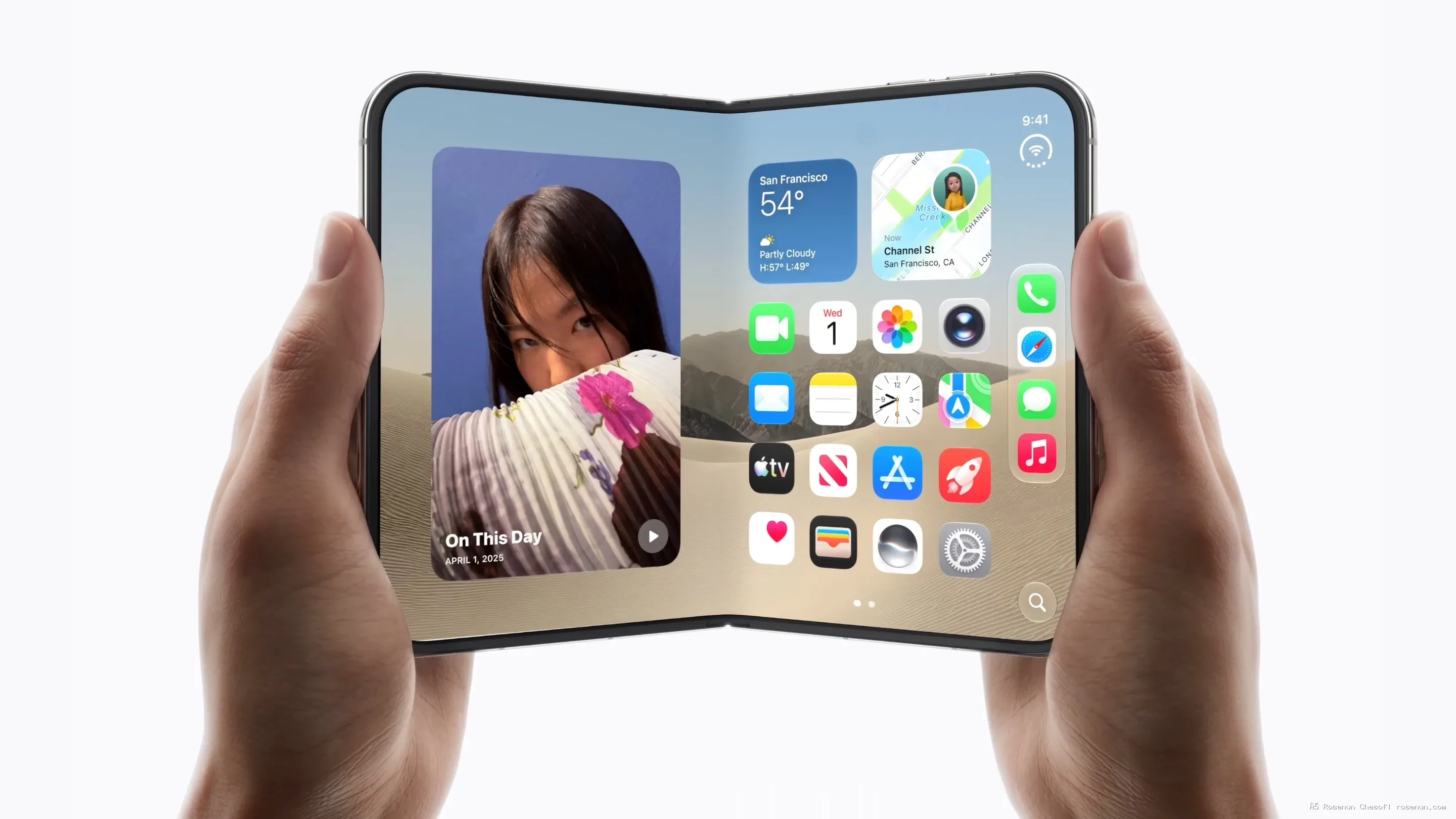
Apple, then, is not arriving with a breakthrough that no one has seen before. Almost everything about the iPhone Duo—from its book-style design to its tablet-like inner screen—will already feel familiar to anyone who has followed the Android market.
Yet the moment Apple unveiled its first foldable iPhone on September 9, the technology suddenly became interesting again. A category that had begun to lose some of its novelty was back at the centre of the technology conversation.
That may be Apple’s most distinctive talent. It can arrive years late and still make an established idea look as though it has just returned from the future.
Arriving After the Difficult Work Is Done
The iPhone Duo resembles a passport when closed. Its 5.4-inch outer display works like a conventional smartphone, while opening the device reveals a 7.6-inch screen—the largest ever fitted to an iPhone.
It runs on Apple’s A20 Pro chip and introduces software designed for the larger display, including the ability to use two applications side by side. Pre-orders begin on October 16, with sales starting on October 23. Apple
None of this will sound especially revolutionary to Samsung users. They have already lived through the awkward early years of foldable technology: fragile screens, unreliable hinges, thick bodies, visible creases and the lingering question of whether anyone truly needed a phone that had to be unfolded before its most useful screen could be reached.
The companies that entered the market first had to test unfinished ideas in public. Every faulty screen and poorly designed hinge became a lesson learned at considerable expense.
Apple avoided that phase. It watched from the sidelines while other companies discovered what users liked, what they rejected and which technical problems had to be solved before a foldable phone could feel dependable.
Samsung’s mildly sarcastic welcome to Apple was therefore understandable. The Korean company was quick to remind the public that it had been developing foldable phones since 2019 and was already eight generations into the process. Reuters
Samsung may have done much of the difficult work, but arriving first does not always mean controlling what happens next.
Apple Does Not Sell Novelty. It Sells Readiness.
Apple has rarely been in a hurry to enter a new product category. It tends to wait until the technology is sufficiently mature, manufacturing has become more reliable and consumers have begun to understand how the product might fit into their lives.
The company did not invent the personal computer, smartphone, tablet, smartwatch or wireless earbud. In several cases, however, it was Apple that turned an existing device into something a much larger group of consumers wanted to use.
Its advantage lies less in possessing technology that no one else can build than in bringing hardware, software, applications and services into a system that feels coherent.
Other foldable phones can already open into larger screens. Apple’s task is to make the iPhone Duo feel like a natural extension of a familiar world that includes the Mac, iPad, Apple Watch and the company’s wider ecosystem of services.
For existing iPhone users, adopting the Duo would not mean moving into an unfamiliar technological environment. It would simply add another doorway into the Apple world.
What the company is selling, therefore, is not merely a hinge. It is the assurance that foldable technology has left its experimental phase and is finally ready for ordinary use.
Exactly who conducted most of that experiment is a detail Apple may prefer not to emphasise.
Late to the Market, but Not Priced Like a Latecomer
Apple’s patience has not produced a modest price.
The iPhone Duo starts at $1,999, placing it in the same price range as a powerful computer and well above a conventional iPhone. Reuters
At that price, consumers must decide more than whether they would like a new phone. They must also decide whether a screen that unfolds into a small tablet will make enough difference to justify the additional cost.
A larger display is clearly useful for reading, watching video, working with documents or running two applications at once. But usefulness is not the same as necessity—particularly when the device costs enough to buy a separate phone and tablet.
This has always been the unresolved problem facing foldable phones. Many consumers can see why they are interesting. Far fewer are convinced that they need one.
Apple is betting that the iPhone name and the strength of its ecosystem can close the gap between curiosity and purchase. It is an expensive bet, especially for the people being asked to place it.
Bringing Excitement Back to a Boring Market
The iPhone Duo is attracting attention partly because conventional smartphones have become rather predictable.
Every generation is faster. Cameras improve, displays become brighter and batteries last longer. Yet the basic experience has changed very little. The smartphone remains a rectangular sheet of glass that people tap and scroll through every day.
Product launches now arrive with an abundance of larger numbers and a diminishing sense of excitement.
The iPhone Duo offers a visible change. It asks users to reconsider the physical form of the smartphone, even if the wider industry began asking the same question years ago.
For the technology business, foldable screens are no longer new. For iPhone users, however, this is a form factor they have never previously been offered. Much of the excitement comes not from Apple producing something the world has never seen, but from bringing an established idea into an ecosystem used by hundreds of millions of people.
Apple’s arrival may also encourage application developers, accessory makers and service providers to take foldable devices more seriously. What was once largely an experimental corner of the Android market could gain enough weight to influence the direction of the entire smartphone industry.
The irony is that the companies responsible for keeping foldable technology alive may not be the ones ultimately credited with making it mainstream.
The Latecomer May Still Change the Market
The iPhone Duo still has much to prove. Durability, battery life and everyday usefulness will matter far more than the excitement of its launch. At nearly $2,000, it could remain an expensive curiosity for a relatively small group of consumers. It could also become the device that moves foldable phones beyond their current niche.
Apple has not made foldable phones possible. Other manufacturers settled that question years ago. What Apple is trying to establish is whether foldable phones can become normal.
In technology, early arrivals carry the burden of proving that a new idea can be built. Latecomers sometimes receive the easier—and more profitable—opportunity to persuade people that the idea is finally worth buying.
If the iPhone Duo succeeds, Apple will once again have followed a familiar formula: arrive late, charge a premium and make a technology that has existed for years seem complete only after an Apple logo appears on it.