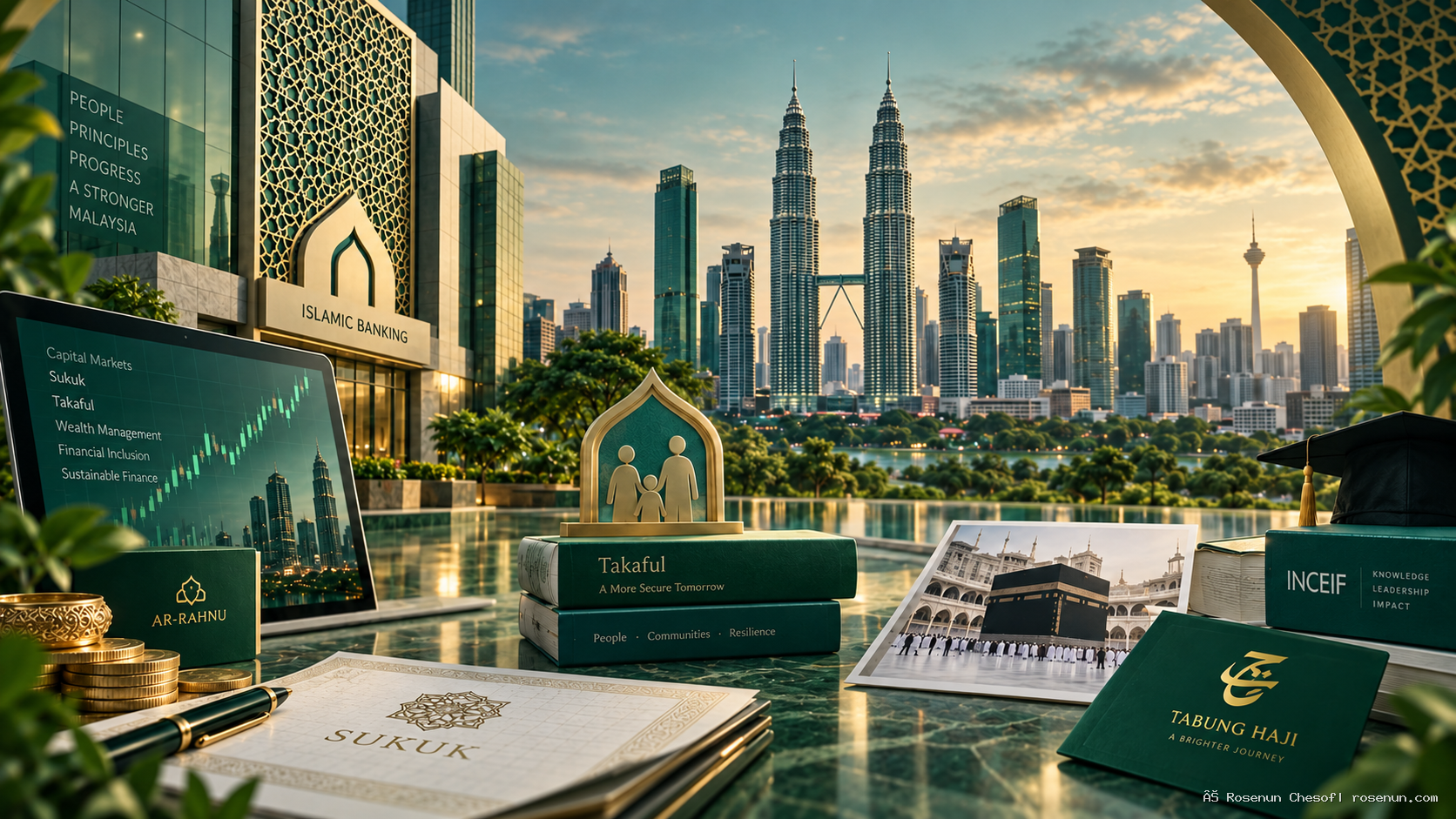
Walk into a major bank in Malaysia and you may find something that is still unusual in many parts of the world.
Customers can open accounts, finance a home or a car, invest, take out insurance and manage their savings through conventional financial products. At the same time, they can choose from another set of products designed to serve many of the same purposes while complying with Shariah principles.
Malaysia calls this a dual financial system.
Conventional and Islamic finance are not designed to replace one another. They operate side by side, compete for customers and share the same broader economy, while being governed by different legal and Shariah frameworks under Bank Negara Malaysia and other regulators.
The system did not appear overnight.
A major turning point came with the Islamic Banking Act 1983 and the establishment of Bank Islam Malaysia in the same year. Malaysia later allowed conventional banks to offer Islamic banking services in 1993, followed by the creation of the Islamic Interbank Money Market in 1994, giving Islamic financial institutions a mechanism to manage liquidity within a Shariah-compliant framework.
More than four decades later, Islamic finance is no longer a niche alternative aimed primarily at Muslim consumers.
Malaysia ranked first among 140 countries in the Islamic Finance Development Indicator 2025, ahead of Saudi Arabia and the United Arab Emirates. The ranking looks beyond the size of Islamic financial assets alone, assessing areas including financial performance, governance, knowledge, sustainability and public awareness.
That distinction matters.
Malaysia’s position at the top does not mean it has the largest Islamic financial assets in every category. Rather, it reflects the depth and breadth of an ecosystem that has been built across banking, capital markets, insurance, investment, regulation, education and social finance.
What exactly is Islamic finance?
Islamic finance is sometimes reduced to the idea of “banking without interest”, but that description misses much of what distinguishes the system.
At its core, financial transactions must comply with Shariah principles. This means avoiding riba, commonly associated with interest; maisir, or gambling; and gharar, which refers to excessive uncertainty or ambiguity in contracts.
Many Islamic financial structures also require transactions to be linked to identifiable assets, services or genuine economic activity.
This does not mean Islamic banks provide money without seeking a return.
They still operate as commercial institutions. The difference lies in how transactions and profits are structured.
Instead of defining the relationship entirely as an interest-bearing loan, Islamic finance may use contracts based on sale, lease, partnership or investment. Terms such as Murabahah, Tawarruq, Ijarah, Musharakah and Mudarabah therefore appear frequently in Islamic financial products.
For consumers, the terminology may sound specialised. The products themselves, however, are often very familiar.
There are savings and deposit accounts, home financing, personal financing, payment cards and even car financing.
Buying a car through Islamic financing
Vehicle financing provides one of the clearest examples of how Islamic finance functions in everyday life.
A Malaysian buying a car can typically choose between conventional hire purchase and an Islamic financing product such as Vehicle Financing-i or Hire Purchase-i.
One structure that has long been used is Al-Ijarah Thumma Al-Bai', or AITAB, which can broadly be understood as “lease followed by sale”.
Under this arrangement, the financial institution initially owns the asset. The customer leases the vehicle for an agreed period, after which ownership is transferred through a separate sale once the contractual conditions have been fulfilled.
This is not a specialist product available only through a handful of institutions. Major Malaysian banks offer Islamic vehicle financing for new, used and reconditioned cars, with financing and tenure broadly comparable to conventional alternatives.
That is significant because it shows how deeply Islamic finance has entered ordinary middle-class life.
It is not confined to religious theory or high-level investment. It is present in decisions about homes, cars, savings, family protection and household finances.
Much more than banking
Malaysia’s real achievement lies in the fact that it did not stop at Islamic banking.
Over time, it built an Islamic financial ecosystem covering almost every major part of modern finance:
Islamic banking
Islamic money markets
Islamic capital markets
Sukuk
Shariah-compliant equities
Islamic funds
Takaful
Ar-Rahnu
Retirement and investment products
Islamic social finance
The scale of the system is now substantial.
Bank Negara Malaysia reported that in 2025, Islamic financing accounted for around 48% of total financing in the banking system, while takaful represented 24.5% of the protection market.
Put simply, for every RM100 of financing in Malaysia’s banking system, almost half now comes through Islamic finance.
Sukuk: Malaysia’s global capital-market success
One of Malaysia’s most visible contributions to global Islamic finance is the development of the sukuk market.
Sukuk are often described as “Islamic bonds” because they serve a similar economic function: raising funds from investors.
But legally and structurally, they are not simply conventional bonds without interest. Sukuk returns are structured around assets, usufruct, investment arrangements or other Shariah-compliant mechanisms rather than conventional interest-bearing debt.
Malaysia has become one of the world’s leading sukuk centres.
Bank Negara Malaysia reported in 2025 that Malaysia accounted for about 37% of global sukuk outstanding.
Within Malaysia, sukuk are no longer a minor alternative to conventional bonds. By the end of 2025, outstanding sukuk stood at approximately RM1.43 trillion, representing close to 64% of Malaysia’s combined bond and sukuk market.
Government agencies, corporations, infrastructure projects and other major issuers now routinely use sukuk as part of their financing strategies.
The Mahathir era: from sovereign sukuk to the Gold Dinar
The early 2000s marked another important phase in Malaysia’s ambition to develop Islamic finance beyond domestic banking.
In 2002, Malaysia issued a US$600 million Global Sovereign Sukuk, which Bank Negara Malaysia has described as the world’s first global sovereign sukuk.
The issuance became an important benchmark for governments and institutions seeking to enter the international sukuk market.
Around the same period, then-prime minister Mahathir Mohamad was promoting another idea: the Gold Dinar as a unit for settling international trade, particularly among Muslim-majority countries.
Mahathir was not proposing the abolition of the ringgit, nor was he suggesting that ordinary Malaysians should begin buying groceries with gold coins.
His proposal was aimed at cross-border settlement.
Countries could value their imports and exports in terms of gold and settle only the net balance between them through their central banks.
Mahathir once illustrated the idea by suggesting that if Malaysia exported RM-equivalent goods worth 100 million dinars to another country but imported oil worth 110 million dinars in return, only the 10 million dinar difference would need to be settled.
The Gold Dinar proposal was therefore not a “gold bond”.
It was an attempt to reduce exposure to exchange-rate volatility and lessen dependence on dominant international currencies in cross-border trade.
The idea never developed into a widely adopted international settlement system. Yet when viewed alongside Malaysia’s pioneering sovereign sukuk issuance in the same period, it reveals something important about the country’s ambitions at the time.
Islamic finance was being imagined not simply as a domestic banking alternative, but as a framework capable of extending into capital markets, sovereign financing and even international monetary arrangements.
A Shariah-compliant stock market
Islamic finance in Malaysia also extends deep into the equity market.
On Bursa Malaysia, investors can choose to invest only in companies classified as Shariah-compliant.
The Securities Commission Malaysia, through its Shariah Advisory Council, determines the relevant criteria, examining both the nature of a company’s business activities and its financial ratios.
By the end of 2025, 867 listed securities — around 80% of all securities on Bursa Malaysia — were classified as Shariah-compliant, representing a market capitalisation of more than RM1.31 trillion.
That gives Shariah-conscious investors a remarkably broad investment universe.
They are not confined to a small number of explicitly Islamic companies. Shariah-compliant portfolios can include businesses in technology, construction, healthcare, telecommunications, property, manufacturing and energy.
Malaysia also has Islamic unit trusts, wholesale funds, ETFs, REITs and other investment vehicles.
By the end of 2025, assets under Islamic fund management had reached approximately RM274 billion.
Takaful: insurance through an Islamic framework
Another pillar of the system is takaful, the Islamic alternative to conventional insurance.
At its core is the idea of participants contributing to a common pool that helps members collectively manage risk within a Shariah-compliant structure.
Malaysia has both Family Takaful, covering areas such as life, health and long-term family protection, and General Takaful, which includes vehicles, homes, property and business risks.
Takaful helps make the broader Islamic financial ecosystem more complete.
Someone who finances a house or car through Islamic financing can also choose protection products structured according to the same Shariah principles.
Ar-Rahnu: Islamic finance at community level
At the other end of the financial spectrum from trillion-ringgit capital markets is Ar-Rahnu, Malaysia’s Shariah-compliant pawnbroking system.
Customers typically pledge gold as collateral in exchange for short-term financing. Instead of relying on conventional interest-based pawnbroking arrangements, Ar-Rahnu uses fee and financing structures designed to comply with Shariah.
It has become particularly useful for households and small entrepreneurs who need temporary liquidity without entering into a full conventional bank loan.
Ar-Rahnu demonstrates just how wide Malaysia’s Islamic finance ecosystem has become.
It stretches from international capital markets all the way down to community-level financial services.
Tabung Haji: from Hajj savings to a major financial institution
No account of Malaysia’s Islamic financial development would be complete without Lembaga Tabung Haji.
Its origins predate Bank Islam.
The idea was developed to help Malaysian Muslims gradually save for the pilgrimage to Mecca without placing their money in arrangements they considered inconsistent with Islamic principles.
Its predecessor began accepting deposits from prospective pilgrims in 1963, eventually evolving into Tabung Haji.
But Tabung Haji is far more than a savings scheme for Hajj.
Deposits are invested through Shariah-compliant channels to generate returns, part of which are distributed back to depositors. At the same time, the institution manages much of the logistical and financial organisation of the Hajj for Malaysian pilgrims.
It is also important to distinguish Tabung Haji from a sovereign wealth fund such as Khazanah Nasional.
Tabung Haji is a savings and investment institution with a specific mandate linked to Hajj and Muslim depositors.
Its scale is considerable.
For the 2025 financial year, Tabung Haji reported more than 9.7 million depositors, investment assets of approximately RM96.37 billion, investment income of RM4.64 billion and a profit distribution of 3.50%, amounting to RM3.22 billion.
Tabung Haji is therefore a remarkable example of how religion, savings, investment and social policy can be brought together within a single institution.
What began with a relatively simple objective — helping people save for Hajj — has grown into an institution managing tens of billions of ringgit in assets.
From zakat and waqf to Islamic social finance
Malaysia’s Islamic financial system also extends beyond commercial banking and investment.
The growing field of Islamic social finance brings tools such as zakat, waqf and charitable funds into broader economic-development strategies.
Rather than relying solely on direct assistance, some programmes combine social funds with financing, training and business development to help lower-income groups and micro-entrepreneurs build sustainable livelihoods.
This marks an important evolution in the way Islamic finance is understood.
The question is no longer simply:
“Is this transaction Shariah-compliant?”
It increasingly also asks:
“Can this financial system generate broader economic and social value?”
None of this happened by accident
One of the main reasons Malaysia emerged as a global Islamic finance centre is that successive governments built the supporting infrastructure deliberately and over a long period.
The progression is striking:
The Central Bank of Malaysia Act 2009 later strengthened the role of Bank Negara Malaysia’s Shariah Advisory Council, making it the highest authority on Shariah matters for Islamic banking and takaful under the central bank’s jurisdiction.
Questions involving Shariah that arise in courts or arbitration can also be referred to the council.
Then came the Islamic Financial Services Act 2013, creating a dedicated legal framework for Islamic financial institutions covering licensing, supervision, financial stability and Shariah compliance.
The Securities Commission Malaysia operates its own Shariah Advisory Council for the Islamic capital market, covering sukuk, Shariah-compliant securities and other capital-market products.
Malaysia therefore developed a multi-layered governance system.
At the national level are specialist Shariah authorities.
At the institutional level, Islamic banks and financial institutions are required to maintain their own Shariah governance arrangements.
Laws are not enough without people who understand the system
Malaysia also invested in something that is sometimes overlooked: human capital.
Islamic finance requires more than conventional banking expertise.
The industry needs professionals who understand finance, economics, accounting, risk management and law alongside Shariah principles.
A number of Malaysian universities now offer Islamic banking and finance programmes.
But the most distinctive institution is INCEIF University.
INCEIF was established by Bank Negara Malaysia in 2005 and received university status the following year, with a specific mandate to develop expertise, research and professional knowledge for the Islamic finance industry.
Today, it offers master's and doctoral programmes alongside professional training, research and consultancy linking academia directly with banks, regulators and industry.
INCEIF describes itself as the world’s only university dedicated specifically to Islamic finance, and in 2025 it marked its 20th anniversary.
This educational infrastructure matters.
A sophisticated financial market cannot be sustained by regulation alone. It needs people who know how to structure products, assess Shariah compliance, manage risk, audit financial institutions and design appropriate regulatory frameworks.
Education allows that expertise to accumulate and pass from one generation of professionals to the next.
Why Malaysia ranks first
Once all these elements are viewed together, Malaysia’s position becomes easier to understand.
Its Islamic financial system includes:
By the end of 2025, Malaysia’s Islamic capital market was worth approximately RM2.7 trillion, out of a total capital market of around RM4.3 trillion.
At the same time, Islamic financing accounted for almost half of total financing in the banking system.
Those numbers tell an important story.
Islamic finance in Malaysia is no longer a specialised market operating at the margins.
It has become one of the main pillars of the national financial system.
Built for the long term, not for spectacle
Islamic finance is not inherently immune to financial crises.
It would therefore be too simplistic to say that Malaysia’s Islamic financial system is stable simply because it is Islamic.
Its resilience has much more to do with the infrastructure built around it.
From Tabung Haji in the 1960s, to Bank Islam in 1983, the dual banking system of the 1990s, the Islamic money market, the sukuk market, Shariah Advisory Councils, the Islamic Financial Services Act and eventually INCEIF and other institutions developing specialist expertise, Malaysia has spent decades building the foundations needed for the system to function.
There is one other important point.
Islamic finance in Malaysia is not reserved for Muslims.
Customers of any religion can open Islamic banking accounts, use Shariah-compliant financing to buy homes or cars, invest in Islamic funds and Shariah-compliant equities, or purchase takaful products, subject to the normal requirements of the institution concerned.
Some non-Muslim customers choose these products not for religious reasons but because of pricing, contractual terms, risk structures or simply because they compare Islamic and conventional products before deciding which suits them better.
That is why Islamic finance in Malaysia should not be understood simply as a financial system for one religious community.
It is part of the national marketplace, competing directly with conventional finance.
Malaysia never attempted to dismantle the conventional financial system and replace it with an Islamic one.
Instead, it built a second system capable of operating alongside it.
Today, Malaysians can choose between conventional and Islamic home financing, hire purchase and Hire Purchase-i, conventional insurance and takaful, ordinary equities and Shariah-compliant investments.
Both systems compete within the same economy, under regulatory frameworks designed to protect financial stability.
That may ultimately be the most important explanation for Malaysia’s global standing in Islamic finance.
Not because it created the most spectacular financial product.
But because, over several decades, it built an entire system capable of working in practice — and of lasting.

References
Bank Negara Malaysia. Annual Report 2025: Promoting a Progressive & Inclusive Islamic Financial System.
Bank Negara Malaysia. Significant Milestones in the Malaysian Money Market.
LSEG & Islamic Corporation for the Development of the Private Sector. Islamic Finance Development Report 2025.
Securities Commission Malaysia. Annual Report 2025 – Islamic Capital Market Statistics.
Securities Commission Malaysia. Shariah-Compliant Securities.
Bank Negara Malaysia. Shariah Advisory Council.
Bank Negara Malaysia. Islamic Financial Services Act 2013.
Lembaga Tabung Haji. Annual Reports, Statistics and 2025 Performance.
INCEIF University. About INCEIF University.
Maybank Islamic. Al-Ijarah Thumma Al-Bai' Vehicle Financing.