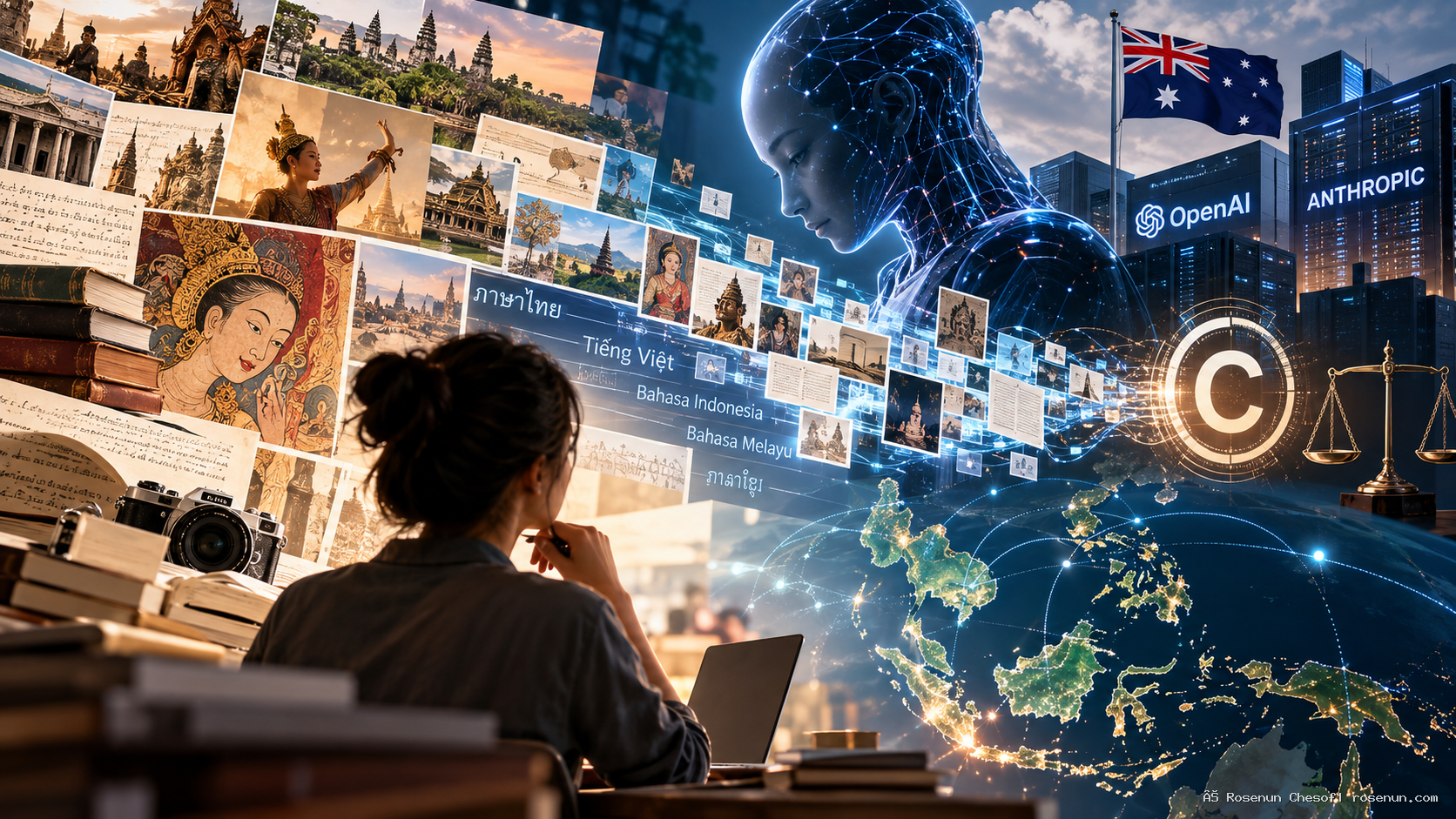
The question growing louder is no longer just how smart AI can become, but what AI has the right to learn from, and who gets to decide that.
This question is now front and center in Australia, where the government is trying to strike a balance between attracting investment from the world's leading AI companies and protecting writers, artists, musicians, media producers, and copyright holders. What's unfolding there may offer an early lesson for Southeast Asia in the near future.
When AI wants to "study" in Australia
The Australian government is trying to shift the country from being merely a user of AI technology to becoming one of the places where advanced AI models are developed and trained. A government discussion paper titled "AI on Australian Terms" leaked in September 2026 shows Australia wants to attract investment in large-scale data centers and AI training infrastructure, viewing the technology as tied to economic productivity, national security, research, innovation, and the country's technological competitiveness.
ABC Australia revealed a confidential document from the Attorney-General's department's copyright consultation, which proposed a default opt-out system: rights holders would have to actively signal they don't want their work used, reversing the current principle where companies must ask permission first.
This is no longer a routine copyright debate. On one side sits investment, technology, data centers, jobs, and the opportunity for Australia to play a role in the global AI industry. On the other side sits a fundamental question: who should decide how human-created work is used to build commercial technology
Even the Australian government knows this isn't simple.
What's notable is that the Australian government isn't viewing this purely through the lens of tech companies. A spokesperson for Attorney-General Michelle Rowland said the government continues consulting with creators, media organizations, and AI companies to ensure any future copyright changes deliver meaningful control and fair compensation for rights holders.
Meanwhile, Industry and Innovation Minister Tim Ayres has denied the proposal represents any weakening of copyright protection, even though the direction appears to break from the Albanese government's earlier pledge that no text-and-data-mining exception would be introduced without compensating rights holders.
Academics haven't stayed quiet either. An analysis in The Conversation argues the opt-out system clashes with the basic principles of Australian copyright law, since it shifts the burden onto creators to protect their own rights, when the law should instead require the party wanting to use the work to ask first.
So Australia's challenge is trying to do two things at once: attract AI investment while not leaving content creators worse off. Easy to say—much harder to achieve simultaneously.
But this is bigger than copyright.
Widen the question a little further.
What AI learns from isn't just novels, songs, or paintings with clear copyright owners. AI learns language, word usage, historical narratives, local knowledge, communication patterns, and the accumulated content a society has built up in the digital world.
Much of this data may carry little value on its own, broken into small pieces. But gathered at a massive scale, it becomes a critical resource—one that lets AI understand a language, answer questions about a given society, or generate content that mimics how people in that society actually communicate.
That raises a new question: is a society's knowledge simply data to be collected or a resource that society itself should have the right to set conditions on?
This is where the AI debate starts shifting from copyright toward data sovereignty and cultural sovereignty—the right to determine the fate of one's own data and cultural resources.
Where does ASEAN stand?
This question matters especially for Southeast Asia.
The region is home to over 680 million people with extraordinary linguistic and cultural diversity—Indonesian, Malaysia, Thai, Vietnamese, Burmese, Khmer, Lao, Tagalog, and countless local languages besides.
In the AI era, this linguistic data carries a new kind of value. The more AI companies want to build models that work globally, the greater their demand for data in non-English languages.
Yet most ASEAN countries haven't had a serious public debate over what creators and the societies that own this data should get back if the books, news, websites, research, artwork, or linguistic content produced within their borders end up training foreign AI models.
Money may be part of the answer. But it isn't the whole answer. Because if AI becomes the primary channel people use to search for knowledge, learn languages, or understand history and culture, the question of who created the data AI learns from and who decides how that knowledge is presented will only grow more important.
From natural resources to knowledge resources
In the past, countries debated the right to control oil, minerals, forests, and natural resources. In the 21st century, we started debating data. And in the age of generative AI, we may need to go further still—treating knowledge, language, and culture as resources of the digital era.
Australia's case is worth watching not just because the country is deciding what data OpenAI or Anthropic can use, but because it's grappling with a question many other countries will soon face too.
How do you open the door to AI investment while still protecting the rights of knowledge creators? How do you build rules that let companies develop technology without treating everything on the internet as raw material available for automatic use? And more fundamentally: if AI is learning from knowledge the entire world helped create, who should own the value that knowledge generates?
Australia is starting to look for answers. For ASEAN, this question may have only just begun.