"This is 2026, not 1946"
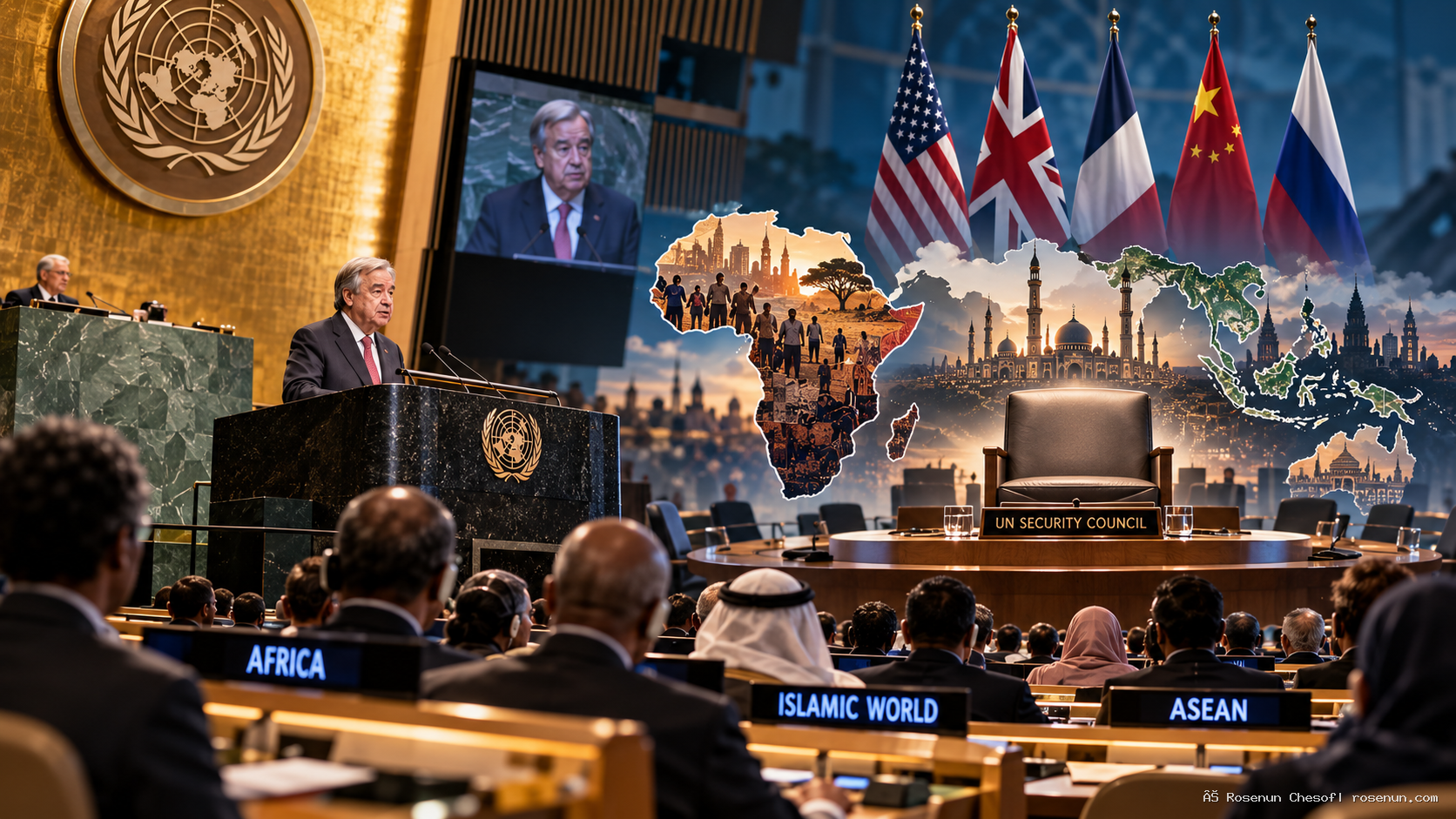
Several African leaders used the General Assembly stage to renew their demand for permanent seats on the Security Council. Kenyan President William Ruto put it bluntly: every nation is sovereign and equal under the UN charter, he said, but that equality ends at the doors of the Security Council. Ethiopian President Taye Atske Selassie asked how a world governed with a right conscience could justify denying 1.6 billion Africans equal representation.
Even Guterres himself joined the chorus, having previously said a 21st-century Security Council without permanent African seats is unjust and indefensible.
The Council's structure has stayed unchanged since 1945 — five permanent members hold veto power (the US, Russia, France, the UK, China), while Africa, with 54 member states, holds only three rotating non-permanent seats.
The Muslim world is also asking for a seat
The question of representation isn't limited to a single continent. The Organisation of Islamic Cooperation (OIC), with 57 member states, has repeatedly insisted that any proposal to reform the Security Council that fails to ensure adequate representation of the Muslim Ummah in any membership category will not be acceptable to the Islamic world, a statement delivered on the OIC's behalf by Pakistan's permanent representative at UN headquarters.
But that demand runs into resistance from the G4 (Brazil, Germany, India, Japan), which has rejected allocating Council seats on the basis of religion, insisting the accepted principle has always been regional representation, not religious representation. That divide shows how, while Africa can unite under a single continental banner, the Muslim world — spread across several continents — faces a structural obstacle entirely its own.
ASEAN: supportive of reform, but without a unified position
ASEAN hasn't demanded a permanent regional seat the way Africa or the OIC has, but it has backed reform in various bilateral settings. Malaysia has previously affirmed alongside Japan that the Security Council must reflect the geopolitical realities of the 21st century through expansion of both permanent and non-permanent categories, and more recently welcomed India's reform push during Prime Minister Modi's visit to Kuala Lumpur.
What ASEAN actually secured this year was far more modest — the Philippines regaining a non-permanent seat, restoring the region's representation on the Council for the first time since Vietnam's term ended in 2021. That's the gap between what Africa is demanding (a permanent seat with veto power) and what ASEAN has gained (a rotating two-year seat with no veto).
The empty Secretary-General's chair reflects the same problem
While the world debates the Security Council, the selection of the UN's tenth Secretary-General is unfolding in parallel. All eight nominated candidates come from Latin America, following the informal convention that this is the region's turn — not a single candidate from the Muslim world or Southeast Asia appears on the list.
The question still unanswered
Africa's challenge is uniting 54 countries behind one voice, then negotiating who actually holds that seat. The OIC's challenge is making a religion-based claim that clashes with the UN's own founding principle of regional representation. ASEAN's challenge is that the region hasn't yet seriously raised this question as a bloc at all.
All three groups belong to what's called the Global South — home to more than half the world's population, yet without a voice in the room where war and peace are decided. As Guterres departs and a new Secretary-General takes over, the question is how many more decades the power structure of 1945 will endure.