Switch lenses to the QS World University Rankings 2027, however, and the trajectory of Malaysian higher education appears even more striking:
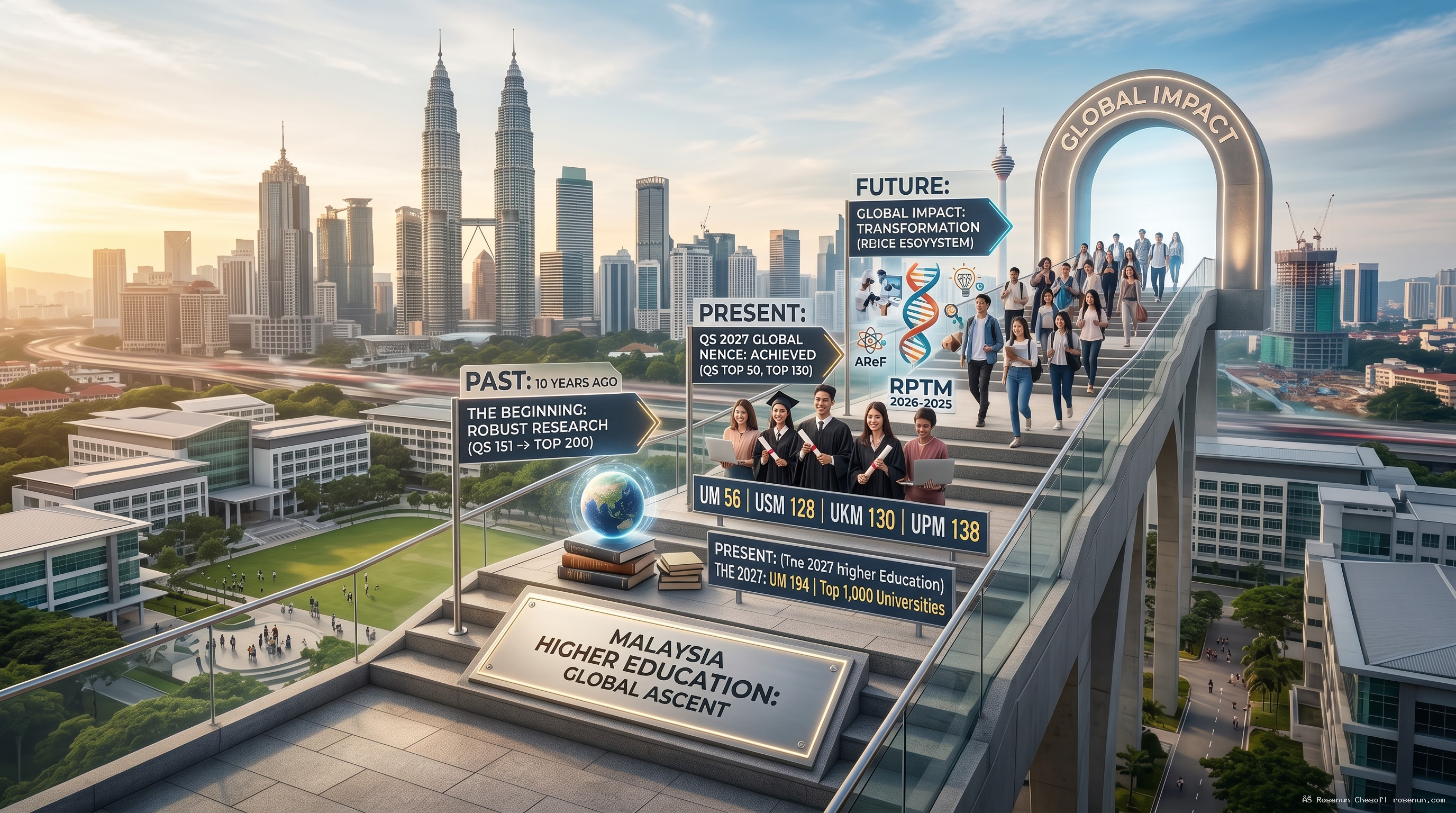
Universiti Malaya (UM) surged to 56th worldwide
Universiti Sains Malaysia (USM) followed at 128th
Universiti Kebangsaan Malaysia (UKM) climbed to 130th
Universiti Putra Malaysia (UPM) secured 138th
Direct comparisons between QS and THE are fraught; both league tables deploy markedly different methodologies, data weightings, and performance indicators.That UM sits comfortably at 56th in one system and 194th in another is neither a contradiction nor a flaw.
Yet, looking past the annual fluctuation of numbers reveals a far more compelling narrative: when viewed across a ten-year horizon, Malaysia’s academic landscape has undergone a tectonic shift.
A Decade Ago: League Tables Were Never the Starting Line (2015–2025)
Rewind ten years to the launch of the Malaysia Education Blueprint 2015–2025 (Higher Education). At the time, UM stood at 151st in the QS rankings, while its sister institutions trailed far behind: UKM at 259, UTM at 294, USM at 309, and UPM at 376. UM was the sole Malaysian institution within the global top 200.
A decade later, UM is knocking on the door of the world's top 50, flanked by USM, UKM, and UPM, which have collectively broken into the Top 150.
The essential inquiry is therefore not merely where Malaysian universities rank today, but rather, what did Malaysia actually do over the past decade to transform its university ecosystem?
The first revelation inside the 2015–2025 Blueprint is that policymakers did not begin by asking, “How do we game the rankings?” Malaysia entered 2015 already standing on solid foundational ground:
Between 2007 and 2012, scholarly publications from Malaysian institutions more than tripled.
Research citations expanded fourfold between 2005 and 2012.
The nation's five designated research universities account for roughly 70% of total national research output.
Public universities generated over RM1.25 billion (approx. $300 million USD / 9.8 billion THB) in research grants and commercial consultancy contracts.
Rather than constructing research universities from scratch, the federal government chose to consolidate, align, and scale what already worked. Crucially, it backed this ambition with fiscal muscle: during the formulation of the Blueprint, higher education expenditure accounted for approximately 7.7% of total government spending—an exceptionally high proportion among peer developing economies.
Yet funding was merely the fuel. The defining engine was a coherent national vision of institutional reform.
The Present Reality: The Harvest of the “10 Shifts”
The 2015–2025 Blueprint was anchored around a structural roadmap known as the 10 Shifts:
Four human-centric pillars: nurturing balanced, entrepreneurial graduates; cultivating academic talent excellence; transforming technical and vocational education (TVET); and embedding lifelong learning into society.
Six systemic enablers: institutional financial sustainability, empowered governance, a thriving innovation ecosystem, globalized online learning, agile service delivery, and, most prominently, global prominence.
Global prominence was the linchpin. Malaysia set out to establish itself as an international education hub—not simply by enrolling foreign fee-paying students, but by embedding Malaysian faculties into global knowledge networks through institutional twinnings, international research consortiums, and specialized Centres of Excellence.
Equally critical was the clarity and accountability of its milestones:
1 university in Asia’s Top 25.
2 universities in the Global Top 100.
4 universities in the Global Top 200.
Expand international student enrollment from 108,000 to 250,000.
Rather than drafting a static manifesto to be reviewed ten years later, the blueprint executed a phased Three-Wave strategy: establishing foundational momentum (Wave 1: 2015), accelerating structural improvements (Wave 2: 2016–2020), and fostering managerial autonomy alongside global excellence (Wave 3: 2021–2025).
The surging visibility of Malaysian institutions today is the harvest of that structural discipline. In this light, higher international rankings were never the core strategy; they were the inevitable byproduct of systematic capacity building.
The Decade Ahead: From Global Prominence to Global Impact (2026–2035)
As the inaugural ten-year roadmap drew to a close, Malaysian planners avoided the trap of policy inertia. The next phase was promptly codified under the Rancangan Pendidikan Tinggi Malaysia 2026–2035 (RPTM 2026–2035), or the Malaysia Higher Education Blueprint 2026–2035.
In this new decade, the guiding question has fundamentally evolved: moving away from “How visible are we?” towards “What real-world impact are we delivering?”
The emerging priorities for 2026–2035 are unequivocal:
Students are no longer evaluated solely on disciplinary acumen; they must command AI literacy, advanced analytical skills, humanistic empathy, entrepreneurial agility, and a transnational worldview.
Faculty and researchers are no longer measured primarily by publication volume but by tangible societal returns, collaborating through a Quintuple Helix model that unites government, industry, academia, civic communities, and ecological sustainability.
The strategic compass of RPTM 2026–2035 is captured in the acronym RDICE
The mandate is clear: scholarly insight must not gather dust in subscription journals or institutional repositories. It must translate into practical technologies, patent pipelines, spin-offs, and economic productivity.
To operationalize this paradigm shift, the Ministry introduced the Academic Research Fund (AReF) under its 2026–2028 Action Plan. AReF restructures research financing into an integrated pipeline, funding collaborative industry consortiums, bilateral international matching grants, the National Knowledge Infrastructure, and a newly minted Malaysian Nexus of Experts.
Beyond the Metrics: What Comes Next?
Viewed in isolation, the release of annual QS or THE league tables is little more than institutional horse racing.
Yet when contextualized across two decades of policy blueprints, a coherent long-term transformation emerges:
2015–2025: A decade dedicated to institutional modernization, capacity building, and claiming a seat at the global table (Global Prominence).
2026–2035: A decade aimed at converting prestige into measurable industrial and socio-economic transformation (Global Impact).
Over the coming decade, the most pertinent question for Malaysia will no longer be “Which rank will our universities reach?”
Rather, it will be:
For Malaysia, global rankings were never the ultimate destination—they were simply mile markers along the road of national development.
References
Ministry of Higher Education Malaysia (MOHE). (2015). Malaysia Education Blueprint 2015–2025 (Higher Education). Putrajaya: Ministry of Higher Education.
Ministry of Education Malaysia. (2015). Executive Summary: Executive Summary PPPM 2015–2025 (Higher Education). Universiti Malaya Documentation.
Ministry of Higher Education Malaysia (MOHE). (2025/2026). Rancangan Pendidikan Tinggi Malaysia 2026–2035 (RPTM 2026–2035) / Malaysia Higher Education Blueprint 2026–2035 & Action Plan 2026–2028. Putrajaya: Ministry of Higher Education.
Aquacquarelli Symonds (QS). QS World University Rankings
. Times Higher Education (THE). THE World University Rankings
.