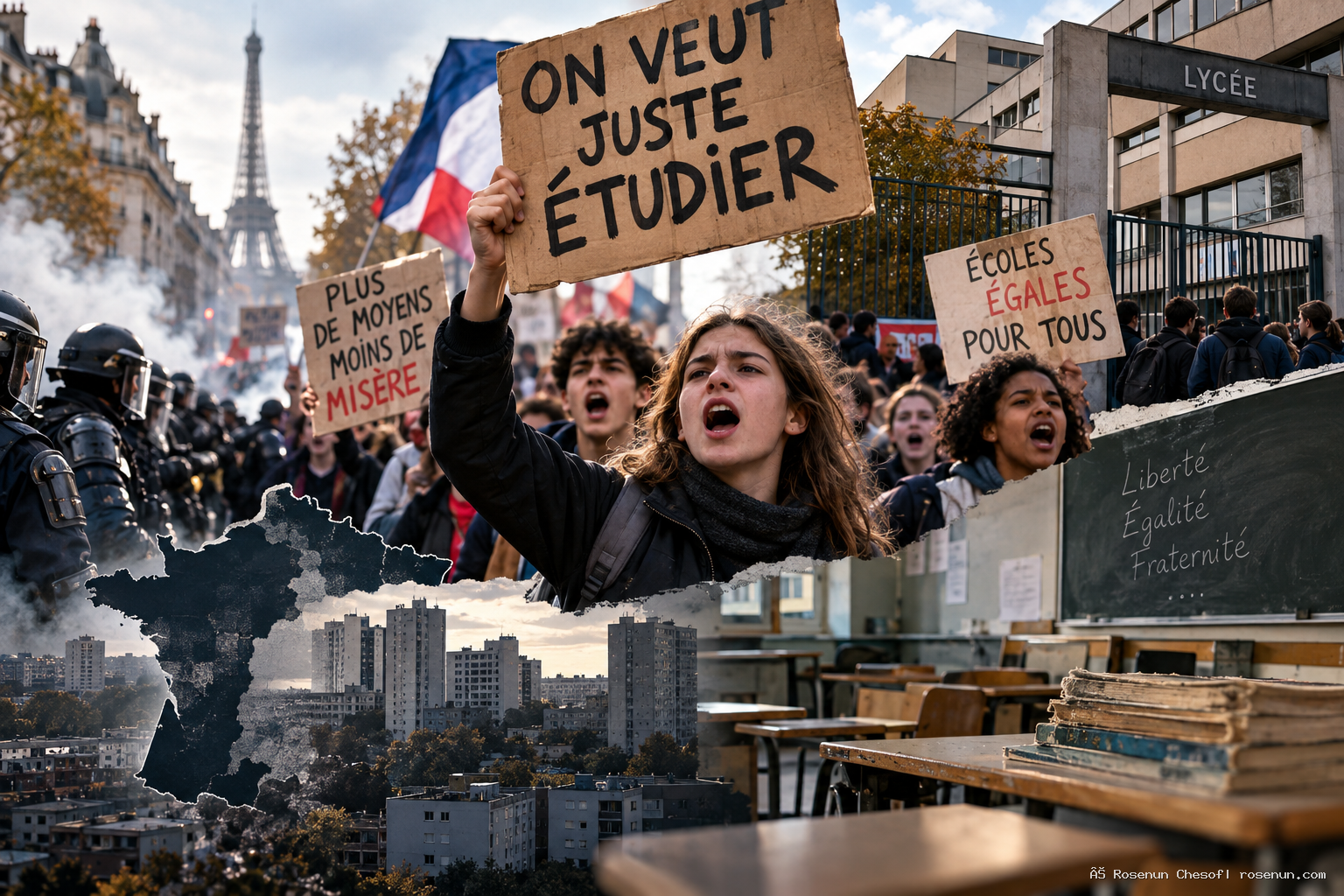
In late September 2026, students from high schools across the country began blocking campus entrances. Their demands were neither radical nor abstract: more teaching staff, prompt replacements for absent teachers, smaller class sizes, decent facilities, and schedules that do not exhaust adolescent minds.
What began in Île-de-France quickly cascaded into a nationwide movement. On September 29, the French Ministry of National Education reported that 338 high schools were affected by rallies or blockades (blocus). Within barely 48 hours, that figure had surpassed 1,000 secondary and higher education institutions, with university students joining the fray.
As tensions escalated, clashes with police, property damage, and arrests made daily headlines. The government responded by surging law enforcement presence and temporarily transitioning select schools to distance learning.
Yet focusing solely on scenes of burning bins and tear gas risks obscuring the pivotal question: Why do fifteen- and sixteen-year-olds feel that barricading their own school gates is the only language adults will hear?
From Créteil to Saint-Denis: A Simple Cry for “Schools That Work”
The earliest sparks were struck around mid-September at Lycée Gutenberg in Créteil, southeast of Paris, where students rallied over chronic staffing shortages. The momentum soon spread across the working-class suburbs of Paris and into the provinces.
Yet the undisputed symbol of the revolt became Lycée Paul-Éluard in Saint-Denis.
There, students and educators painted a bleak picture of everyday life: crumbling infrastructure, outdated equipment, classrooms crammed with up to 35 pupils, and weeks on end without substitute teachers. In an institution serving nearly 2,000 students, reports emerged that the school lacked even a single dedicated social worker.
The frustration resonated far beyond Saint-Denis. High schoolers elsewhere pointed to grueling timetables, rising cafeteria costs, and the suffocating pressure of Parcoursup—the national algorithmic admissions platform for higher education.
Stripped of rhetoric, their grievance was strikingly modest: they simply wanted schools where teaching and learning could actually take place.
An Unequal Republic: The Data Behind the Discontent
What lends this student revolt its weight is that the teenagers’ complaints are corroborated by decades of empirical research.
France boasts a robust public education apparatus and spends heavily on schooling. Yet reports from the Organisation for Economic Co-operation and Development (OECD) reveal a glaring paradox: while the average academic performance of French students hovers around the OECD median, the correlation between a family’s socioeconomic status and student achievement is among the steepest in the developed world.
The latest PISA benchmarks underscore this divide with startling clarity. In France, students in the top socioeconomic quartile outperform their peers in the bottom quartile by 100 score points in science—compared to an OECD average gap of 85 points.
In a country where égalité is inscribed on every city hall and school façade, a family's social background remains an extraordinarily stubborn predictor of a child’s educational destiny.
Beyond Poverty: The Multi-Layered Trap of School Segregation
The issue runs deeper than individual family poverty.
OECD findings demonstrate that in France, the socioeconomic composition of the school itself plays a decisive role in student outcomes. A disadvantaged child suffers not only from a lack of household resources but also from being funneled into schools where disadvantage is heavily concentrated. Inequality does not simply accumulate; it compounds.
According to the OECD, low-achieving students in France are more socially segregated from their peers than the OECD average. A similar divide exists along immigrant backgrounds. Rather than functioning as social elevators, French schools too often mirror, and in some cases actively reproduce, the structural divides of the society around them.
The Reality of the Banlieue
This context gives the French term banlieue its true weight.
Geographically denoting suburbs, in the French socio-political lexicon it signifies areas marked by low incomes, high immigrant populations, and working-class families. In places like Saint-Denis, located just north of central Paris, the intersection of geography, ethnicity, and class crystallizes in full view.
It came as no surprise when a hand-painted banner outside one barricaded school summed up the sentiment in four words:
“+ de moyens, − de misère”
(More resources, less misery)
Yet this is not a straightforward tale of state abandonment. France has operated a Priority Education network (REP/REP+) for decades to funnel supplementary funding to underprivileged areas. In 2022, nearly 1,090 establishments fell under this umbrella, encompassing roughly one-fifth of public school students, with priority education budgets reaching €2.3 billion in 2021–2022.
Even Lycée Paul-Éluard was not forgotten on paper: regional authorities in Île-de-France had earmarked it for a €43 million comprehensive overhaul, slated to break ground in summer 2026 as part of a massive renovation program across Seine-Saint-Denis.
The conundrum, therefore, cannot be reduced to “a lack of government funding.” The far more vexing question is: Why, despite decades of targeted policies and billions in spending, is the chasm between schools still so viscerally felt by teenagers in their day-to-day lives?
When Social Grievance Becomes a Security Concern
As the mobilization widened, its character fractured.
On October 1 in Haut-Rhin, eastern France, confrontations flared as projectiles and fireworks were directed at police lines, resulting in 35 arrests and injuries among law enforcement and demonstrators alike. Elsewhere, scattered incidents of property damage and physical confrontations with school administrators fueled anxieties.
The government found itself caught in a precarious dual mandate. On one hand, it bore an undeniable obligation to guarantee public safety, preserve order, and protect school premises. On the other hand, reducing the crisis to a law-and-order dispute risked erasing the foundational grievances that drove adolescents into the streets in the first place.
Recognizing the stakes, Education Minister Édouard Geffray convened talks with student unions, parent associations, and national student councils. Yet representatives maintained their core stance: until chronic understaffing, decaying classrooms, and structural pressures are addressed, the wound will remain unhealed.
A Broken Covenant in the Land of Égalité
Modern France built its republican identity on three sacred pillars:
Liberté, Égalité, Fraternité.
In this secular civic faith, the public school (l'école de la République) was meant to be the ultimate sanctuary—a place where every child, irrespective of pedigree or postal code, is afforded equal dignity and an unencumbered chance to thrive.
The OECD data, however, tells an uncompromising truth: that ideal remains unfulfilled.
This is why the high school revolt of 2026 touches a nerve far more profound than seasonal student unrest. These young citizens are calling into question the fundamental covenant of the state:
If the schoolhouse is supposed to level the playing field, why does a teenager's postal code still dictate the horizon of their future?
From the School Gates to the National Conscience
School blockades are not an educational policy, and street violence should never be romanticized.
Yet this mobilization has achieved one undeniable result: it has dragged the silent decay of the classroom into the harsh daylight of the public square.
The unreplaced teachers, the stifling rooms, the chronic delays, and the insidious sense that some neighborhoods are quietly written off—these were lived realities for students long before they were captured as statistics in an OECD dossier.
Ultimately, the most urgent question is not simply why French teenagers took to the streets.
It is why so many of them concluded that they had to walk out of the schoolhouse before the adult world would ever begin to listen to what was happening inside.