n late September 2026, the Financial Times reported that Chinese tech giant Tencent struck a five-year compute leasing deal with Oracle worth approximately $7 billion. The agreement grants Tencent access to around 100,000 advanced AI chips hosted in Oracle’s data centers across Southeast Asia, backed by a upfront payment of roughly 30%—marking Tencent’s largest overseas infrastructure lease to date.
Chinese media outlet ITHome corroborated the report, noting that Tencent intends to use this processing power to train AI models and develop AI agents. Major peers like ByteDance and Alibaba already rely on data center resources in Southeast Asia.
This milestone extends far beyond Tencent acquiring access to 100,000 GPUs. It opens up a broader geopolitical question: When advanced chips cannot easily enter mainland China, will Chinese firms shift their compute consumption closer to home instead?
If so, is Southeast Asia quietly evolving into an offshore compute zone for the US–China AI rivalry?
American Chips, Chinese Firms, Local Hardware
The AI race is no longer driven solely by algorithms. Large-scale models require vast computing power, making advanced GPUs and accelerators—primarily from Nvidia and other US manufacturers—the most critical assets in the modern tech economy.
Washington has aggressively sought to restrict Beijing's access to these technologies since 2022, expanding export controls to cover advanced computing chips, semiconductor manufacturing equipment, and High-Bandwidth Memory (HBM). Although US authorities eased restrictions slightly in January 2026—allowing select chips like Nvidia’s H200 and AMD’s MI325X to be exported to approved customers in China under case-by-case licenses—strict conditions on end-users, security audits, and export volumes remain intact.
For Chinese tech firms, the challenge is not merely whether they can purchase physical hardware, but how quickly and under what terms they can harness massive compute capacity.
Cloud computing changes the equation. Companies do not need to ship physical GPUs into China; they can rent compute capacity from overseas cloud providers and process workloads remotely. For Tencent, while the hardware may reside thousands of kilometers away from its Shenzhen headquarters, distance is irrelevant to software. What Tencent needs is not the physical silicon, but the compute—and that compute is flowing south.
Southeast Asia possesses the exact infrastructure needed to absorb this shift. Oracle operates multiple cloud regions across the region, including Singapore, Batam (Indonesia), and Kulai (Malaysia)—where it launched its second Malaysian region in February 2026. While reports have not disclosed which specific facilities host Tencent’s leased chips, the overarching trajectory is clear: Southeast Asia now boasts sufficient compute capacity to anchor the global strategies of Chinese tech giants.
The Compute Corridor: From Singapore to Johor and Batam
While Singapore long served as the region’s primary data center hub, land, water, and power constraints led to a moratorium on new projects between 2019 and 2022. Even after lifting the freeze under strict sustainability criteria, investment capital naturally spilled into neighboring territories.
Malaysia emerged as a major beneficiary, particularly the state of Johor. According to 2026 data from DC Byte reported by Malay Mail, Malaysia accounts for over half of all data center capacity currently under construction across five major Southeast Asian nations (Malaysia, Indonesia, Thailand, the Philippines, and Vietnam).
Recognizing this shift, the Malaysian government is pivoting from simply attracting infrastructure investments to driving higher-value economic returns. In September 2026, the Malaysian Investment Development Authority (MIDA) signaled that the next phase of industry growth must tie data infrastructure directly to AI adoption, local innovation, skilled talent development, and high-value employment.
Simultaneously, Indonesia’s Batam island—located just across the strait from Singapore—is experiencing a 22% annual growth rate in its data center market, bolstered by multi-billion-dollar investments in AI-ready data centers.
When viewed together, Singapore, Johor, and Batam operate less like isolated national markets and more like a unified compute corridor. Fiber cables, power grids, cloud regions, and data centers interconnect across the Malacca Strait. What flows through this vital maritime artery is no longer just oil and container cargo, but raw processing power.
Moving Beyond Export Controls to Remote Access Controls
The chip war has not stopped hardware deployment; it has fundamentally altered its geography.
Washington's initial objective was to restrict China's access to advanced AI technology that could enhance its military or strategic capabilities. Yet in a cloud-first world, controlling where hardware is physically installed does not equate to controlling who runs workloads on it.
Recognizing this loophole, the US Bureau of Industry and Security (BIS) has broadened its scope. Regulatory frameworks now extend past physical chip shipments to encompass Infrastructure-as-a-Service (IaaS) and remote end-user compliance, mandating disclosures when foreign entities access advanced compute resources remotely. The battleground is shifting from "Where are the chips shipped?" to "Who is utilizing the compute, and from where?"
As a result, ASEAN finds itself at the intersection of this technology divide. The region hosts major American cloud providers, semiconductor firms, and hyperscalers, while simultaneously maintaining deep trade, investment, and technology ties with China.
Malaysia offers a clear illustration of this balancing act. In July 2025, the government required Strategic Trade Permits for the export, transit, and transshipment of high-performance US-origin AI chips to close potential regulatory loopholes. This followed broader regional scrutiny over transshipment risks, including investigations into Nvidia-equipped servers. By mid-2026, Malaysian customs seized 72 servers containing advanced AI chips valued at RM52.9 million at the KLIA Free Commercial Zone after uncovering plans to re-export them within Asia.
Commercial Cloud Leasing vs. Smuggling
It is critical to distinguish legitimate commercial arrangements from illicit trade. Deals like Tencent’s lease with Oracle should not be mislabeled as "smuggling" or "sanction evasion."
As Chinese tech media ITHome pointed out, leasing compute power through international cloud operators operates within existing legal frameworks, which explicitly accommodate remote access and Infrastructure-as-a-Service provisions.
This dynamic is far more consequential than clandestine GPU smuggling. It proves that AI geography can be effectively redesigned through the cloud. The hardware remains inside facilities owned and operated by American corporations, while Chinese firms lease the underlying capacity to advance their AI capabilities.
This does not mean Beijing is abandoning its drive for native hardware self-reliance. China continues to push domestic alternatives like Huawei’s Ascend chips and localized software stacks. Leasing ASEAN-based compute serves a dual-track strategy: securing high-end compute in the short term to keep pace with global AI models while building a fully independent domestic supply chain for the long term.
Strategic Opportunity or Mere Infrastructure Host?
The rapid influx of data center investments brings tens of billions of dollars into Southeast Asia, spurring grid upgrades, fiber deployment, construction, and tax revenues.
However, hosting thousands of GPUs does not automatically transform a nation into an AI powerhouse. If the hardware belongs to foreign vendors, the cloud platforms are managed by overseas multinationals, the models are trained by external firms, and the compute power is leased by foreign clients, the host country risks absorbing only the resource-heavy burdens—land usage, massive electricity consumption, and water cooling—without retaining high-value intellectual capital.
Regional policymakers are taking note. Malaysia's updated evaluation framework for data center proposals prioritizes project sustainability and direct economic value creation, favoring facilities tied to AI capability building over basic storage infrastructure.
The core challenge for ASEAN is clear: The true competition is not over who hosts the most data centers, but who can convert local compute infrastructure into native technological capability.
A New AI Geography
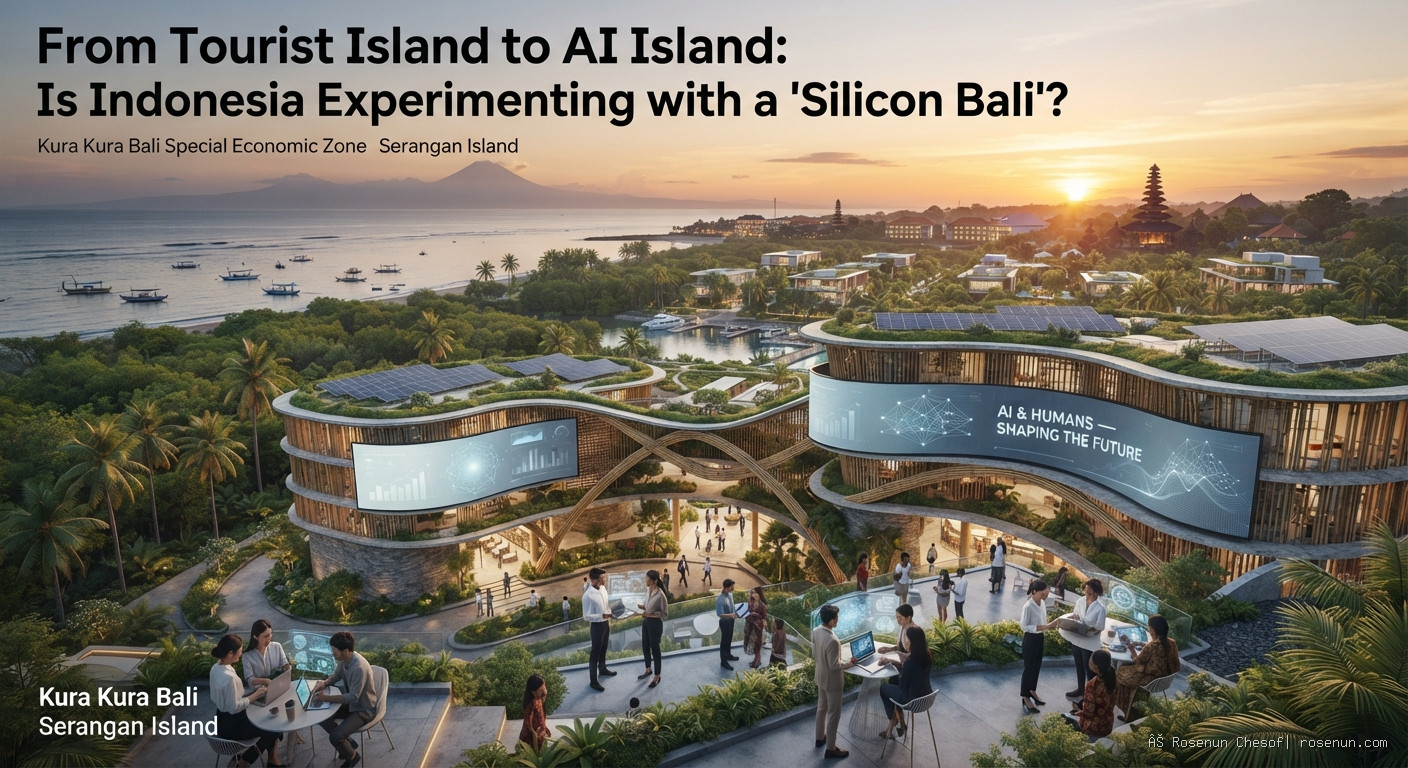
From Indonesia collaborating with international institutions like Tsinghua University to build AI research ecosystems in Bali to Chinese giants leasing massive compute capacity from US providers across regional hubs, Southeast Asia is emerging as a central arena for the global AI economy.
This shift is not occurring because ASEAN develops the most advanced frontier models or manufactures cutting-edge GPUs. Rather, the region offers the foundational assets the AI economy demands: available land, energy infrastructure, subsea fiber networks, semiconductor supply chains, expanding consumer markets, and a strategically neutral geopolitical location.
The Tencent–Oracle agreement signals a structural realignment. Rather than neatly decoupling the tech world, export controls are giving rise to a hybrid AI geography. The chips may be designed in the United States, and the end-user may be a Chinese corporation, but the actual computation takes place in Southeast Asia.
The ultimate question for ASEAN is no longer how many data centers it can build, but whether it can leverage this compute footprint to foster its own enduring AI ecosystem.