What Is the Makkah Pact?
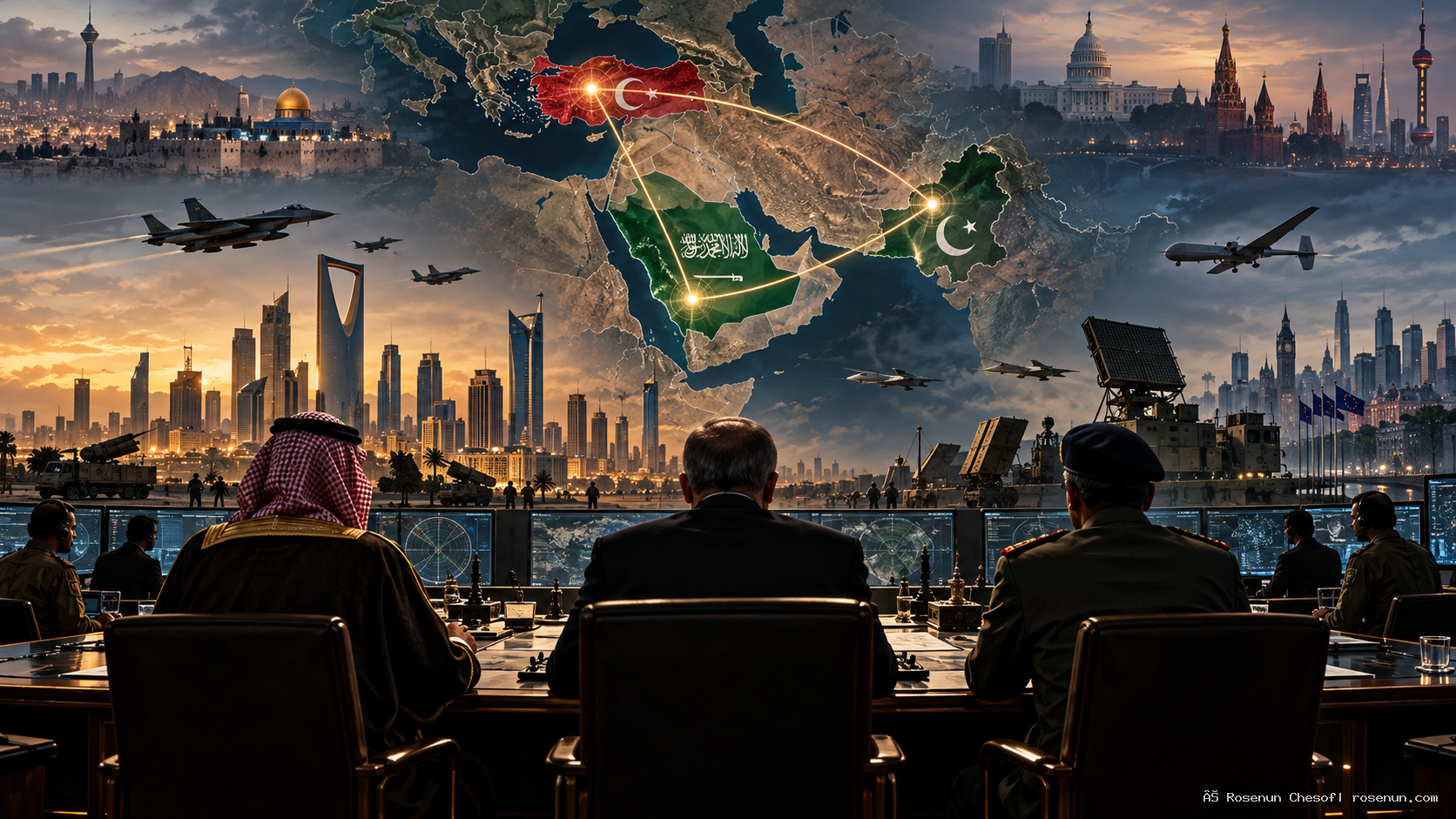
On 7 August 2026, Saudi Crown Prince Mohammed bin Salman, Turkish President Recep Tayyip Erdoğan, and Pakistani Prime Minister Shehbaz Sharif signed the Makkah Joint Defence Agreement in the holy city. Its core clause—stipulating that an armed attack on one member state is considered an attack on all three—drew immediate comparisons to NATO’s Article 5.
Each member brings a distinct strategic asset to the alliance. Saudi Arabia provides vast financial resources and energy reserves. Turkey brings a rapidly growing defense industry alongside its established NATO membership. Pakistan offers its status as the world's only nuclear-armed, Muslim-majority state, though nothing announced thus far extends its nuclear umbrella to the other two nations.
The pact did not emerge from a vacuum. Pakistan and Saudi Arabia had already signed a bilateral defense agreement in 2025, with approximately 8,000 Pakistani troops—supported by combat aircraft—stationed in the kingdom since April 2026. What the Makkah agreement adds is Turkey’s inclusion and a formal standing infrastructure: a joint political defence committee that held its inaugural meeting in Istanbul on 31 August, headed by Secretary-General and retired Pakistani Lieutenant General Nauman Mahmood.
The Backdrop: The Iran War
The pact can only be understood against the backdrop of the conflict that preceded it. On 28 February 2026, the United States and Israel launched joint strikes against Iran amidst ongoing nuclear negotiations. The opening salvo resulted in the death of Supreme Leader Ali Khamenei, after which his son Mojtaba assumed leadership.
Iran retaliated against Israel, US military bases, and neighbouring Gulf states—striking targets in Riyadh and Saudi Arabia's Eastern Province—while shutting down the strategic Strait of Hormuz. An 8 April ceasefire quickly collapsed, subsequent talks in Islamabad stalled, and a memorandum signed on 17 June unravelled by July. By early October, the conflict had entered its eighth month with no truce in sight. While Washington continues to demand a substantial reduction in Iran's uranium enrichment, Tehran maintains that the Strait of Hormuz will remain closed until its own conditions are fulfilled.
For Riyadh, the core takeaway was stark: while the United States initiated the military action, the Gulf states bore the direct fallout. Analysts at Harvard’s Belfer Center point to growing post-war skepticism toward Washington as a primary driver for both Saudi Arabia and Turkey.
Washington, for its part, has not publicly objected to the agreement. On August 16, Donald Trump praised the pact, calling it a "BIG, BOLD, IMPORTANT FIRST STEP", reflecting a stance that self-reliant allies ease America's regional burden. However, strategic friction remains regarding the Houthis. Trump noted that the US maintains contact with the group, which reportedly agreed to refrain from attacking American forces. According to The New York Times, Trump initially considered ordering strikes on Houthi targets at the Saudi Crown Prince's urging but ultimately cancelled them. The Financial Times reported that while Riyadh requested expanded military support, Washington responded primarily with intelligence sharing and a reaffirmation of Saudi Arabia’s right to self-defense.
This reflects a fundamental strategic mismatch: Washington views the Houthis as a secondary issue relative to Iran, whereas Riyadh perceives them as an immediate threat targeting its airports, oil refineries, and holy cities. This divergence explains why Saudi Arabia is seeking external security guarantees without severing ties with the United States.
The Houthi Test
The Houthis resumed maritime attacks in the Red Sea the same day the US struck Iran, subsequently declaring a naval blockade against Saudi Arabia on 20 July. Barely a month after its signing, the pact faced an immediate operational challenge: direct strikes on a member state’s urban centres, transport hubs, and holy sites.
Sources: Al Jazeera, 11 Sep · Reuters via Financial Express · EEAS · Al Jazeera, 5 Oct · Al Jazeera, 9 Oct · Reuters, 8 Oct · Pakistan MOFA, 9 Oct
Three main takeaways emerge from these developments:
Response Time: It took the allied nations nearly four weeks after the first major strike to coordinate a joint response.
Deterrence Limits: The formal activation of the alliance did not deter further aggression, as the deadliest civilian attack occurred two days later.
Operational Scope: Member states maintain a strict boundary between mutual territorial defense and participating in active external warfare. Additionally, Turkey faces domestic legal procedural hurdles, as parliamentary approval is required to ratify the pact and authorise overseas troop deployments.
Concurrently, Pakistan is pursuing a secondary diplomatic track. Field Marshal Asim Munir has visited Tehran four times since April, with Islamabad reportedly passing a Saudi warning advising Iran to curb Houthi operations—though Pakistani officials described these reports as unsubstantiated. Pakistan remains the sole member capable of balancing this dual role: providing military deterrence for Riyadh while keeping diplomatic channels open with Tehran.
Measuring Effectiveness
Deterrence generally operates through two mechanisms:
Deterrence by Punishment: Threatening severe military retaliation to discourage an enemy from launching an attack.
Deterrence by Denial: Rendering enemy attacks ineffective, such as through advanced air-defense interceptions.
Given that alliance members have ruled out offensive military action inside Yemen, deterrence by punishment carries limited weight. Consequently, the success of the pact must be measured by deterrence by denial: whether it effectively mitigates damage to Saudi Arabia.
Key indicators to monitor over the coming weeks include:
Attack Intensity: The frequency and severity of strikes targeting Saudi infrastructure before versus after the 5 October activation.
Defense Capabilities: Air-defense interceptor rates, specifically confirming whether Pakistani or Turkish systems are operationally integrated.
Turkish Deployment: The timeline of Turkish parliamentary ratification and subsequent force deployments.
Diplomatic Channels: Whether the Islamabad–Tehran axis successfully encourages Houthi restraint.
Protection of Holy Sites: Whether attacks near Mecca and Medina cease, preserving the symbolic core of the alliance.
Political Resolution: Whether formal negotiations materialize, as Iran has expressed openness to dialogue while coalition statements remain silent on the matter.
A critical caveat remains regarding attribution. Because Houthi military actions are heavily influenced by the broader US–Iran conflict, any reduction in attacks may stem from bilateral US–Iran developments or internal Yemeni dynamics, rather than the deterrent effect of the Makkah pact itself.
Geopolitical Stances
While no foreign power has formally opposed the agreement, international actors view the pact through their respective strategic interests:
The alliance's fundamental structural vulnerability lies in mismatched priorities: Saudi Arabia focuses primarily on threats from Iran and the Houthis, Turkey prioritizes issues concerning Israel, and Pakistan must account for its border with Iran alongside its posture toward India.
Conclusion
The Makkah Pact represents neither an explicit break with the United States nor the creation of a unified anti-Iran military bloc. Rather, it reflects middle powers hedging their security options at a time when the Iran war has demonstrated that reliance on a single superpower guarantor carries inherent strategic risks.
The conflict in Yemen highlights both the significance and the boundaries of this alliance. While the three nations can coordinate defense policies and deploy ground forces, collective defense commitments stop firmly at the Saudi border, and hostilities persist.
Ultimately, the long-term impact of the Makkah Pact will be determined not by official communiqués from Riyadh, but by concrete security metrics over the coming months and the trajectory of broader US–Iran diplomatic negotiations. The overarching question remains whether the Middle East has entered an era where no single external power can act as the sole guarantor of regional stability.
Sources
The Makkah Pact represents neither an explicit break with the United States nor the creation of a unified anti-Iran military bloc. Rather, it reflects middle powers hedging their security options at a time when the Iran war has demonstrated that reliance on a single superpower guarantor carries inherent strategic risks.
The conflict in Yemen highlights both the significance and the boundaries of this alliance. While the three nations can coordinate defense policies and deploy ground forces, collective defense commitments stop firmly at the Saudi border, and hostilities persist.
Ultimately, the long-term impact of the Makkah Pact will be determined not by official communiqués from Riyadh, but by concrete security metrics over the coming months and the trajectory of broader US–Iran diplomatic negotiations. The overarching question remains whether the Middle East has entered an era where no single external power can act as the sole guarantor of regional stability.
- Joint statement of the Makkah Summit for Joint Defence – Saudi Press Agency
- IISS – Pakistan, Saudi Arabia and Türkiye: a new defence pact
- Belfer Center – Experts react to the Mecca Joint Defense Agreement
- Wikipedia – 2026 Iran war
- Al Jazeera – US sets new demands for Iran deal (7 Oct)
- Al Jazeera – Iran says Hormuz to remain closed (4 Oct)
- Dawn – Trump welcomes defence pact (17 Aug)
- ABC News – Houthi attacks give Iran leverage (21 Sep)
- Arab News – How Houthi attacks on Saudi Arabia raise the stakes
- Al Jazeera – Why Pakistan is talking to Iran (11 Sep)
- Al Jazeera – Mecca alliance activates deterrence (5 Oct)
- Al Jazeera – What the deterrence activation means (6 Oct)
- Al Jazeera – Riyadh airport attack kills three (9 Oct)
- ANTARA – Iran does not see the Makkah pact as a threat (2 Sep)
- EEAS – Saudi Arabia/Yemen statement by the spokesperson (17 Sep)
- The Wire – India examining implications, says MEA (11 Aug)
- Arab Center DC – How smaller GCC states are navigating the agreement
- Chatham House – Should Egypt join the Mecca Pact?
- Times of Israel – Mecca pact isn't meant to challenge Israel (12 Aug)
- South China Morning Post – China waits in the wings (10 Aug)
- Financial Times (6 Oct) · Reuters (8 Oct) · Pakistan MOFA (9 Oct) · Axios (7 Oct)