In most classrooms, conversation between teachers and students is part of how learning happens. Children ask questions, push back, share opinions and talk about what is going on in their lives. In some classrooms in Gaza, however, those conversations may soon be recorded and analysed by artificial intelligence.
On October 9, 2026, the Associated Press reported on plans by Gaza Children Village, a US-based charity running education programmes in the Gaza Strip, to use AI to analyse classroom conversations and flag language deemed hateful, inciting or antisemitic.
The project’s founder says the technology will help teachers stay true to a curriculum built around peace and tolerance. But for human rights advocates, educators and some aid groups, the question is not only how accurately AI can detect such language. It is also who gets to define hatred and what happens to the recordings once they exist.
Those concerns carry particular weight in Gaza, where education is hard to separate from the experience of war, the erosion of identity and the collective memory of Palestinians.
From rebuilding schools to monitoring speech
Gaza Children Village was founded by Dr David Hasan, a Palestinian-American neurosurgeon and academic who travelled to Gaza to provide medical help during the war.
The organisation runs a network of schools called Academies of Hope, which offer meals, health care and psychological support alongside classes for children affected by the conflict.
Hasan says he wants to help break the cycle of violence between Palestinians and Israelis through an education that exposes children to different perspectives.
The schools largely follow the Palestinian Authority curriculum, but with changes to material that Hasan believes promote violence or hostility toward Israelis and Jews.
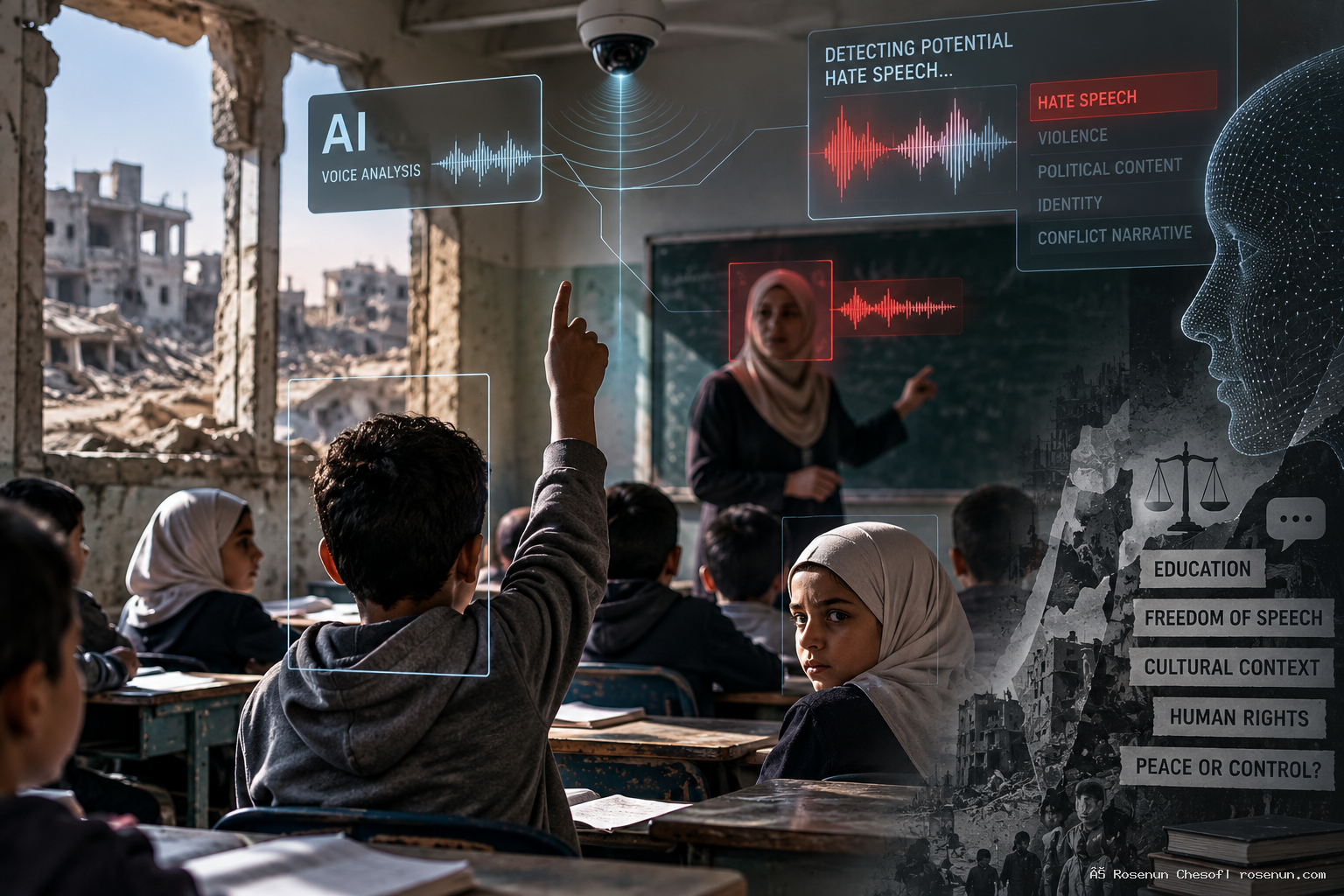
Under the proposed AI system, classroom conversations would be recorded and analysed. If the system detects language that meets its criteria, it would send an alert to Hasan, who would then contact the teacher to ask about the context.
Hasan says audio would be kept for 72 hours, that the system has already been tested, and that he plans to expand it to dozens of classrooms.
As of the October 9 report, however, it remained unclear when the system would actually go live, what kinds of words or statements it would flag, and whether teachers, students and parents had been told they were being recorded.
These details matter. Monitoring the quality of teaching is a normal part of running a school, but continuously recording classroom speech and having AI assess its content raises a different order of questions about rights and privacy.
Doubts from inside the organisation
The criticism has not come only from outsiders.
Bishara Bahbah, a Palestinian-American political activist and a board member of Gaza Children Village, told the AP he had not been informed of the monitoring plan and that it had never been brought before the board.
Bahbah drew a line between using cameras to evaluate how teachers and students perform and using technology to restrict the free exchange of ideas, which he said should not happen.
With so few functioning schools left in Gaza, he argued, the urgent priority should be getting more children back into classrooms.
An official at an aid organisation that works with Gaza Children Village, who spoke on condition of anonymity out of concern for the group’s operations in Gaza, warned that AI speech monitoring could lead to problems that are hard to contain and might force the organisation to reconsider the partnership.
Taken together, these reactions suggest that agreeing on the goal of promoting peace does not mean everyone accepts the same means of getting there.
Palestinian voices: who owns education?
Ines Abdel Razek, co-director of the Palestine Institute for Public Diplomacy, worried that the charity’s approach could strip Palestinians of the power to decide what their next generation should learn.
She argued that rebuilding Gaza’s education system should mean supporting Palestinian institutions and UNRWA, which have long experience running schools in the territory.
Her point goes to the heart of a broader debate about post-war reconstruction: how much say should foreign organisations have over the direction of education in the communities they help?
Funding, school buildings, supplies and staff may be desperately needed. But deciding how children learn history, which words are used to describe the conflict, and how freely they may speak about political events touches on a community’s identity and its right to shape its own future.
At the same time, countering racial and religious hatred is a legitimate and important educational goal. Fostering understanding between Palestinians and Israelis need not conflict with Palestinians’ right to determine their own education.
The challenge is to design a process that serves both aims without turning educational support into the imposition of ideas from outside.
The Palestinian official view
Mohammad AbuAlrob, a Palestinian spokesperson, told the AP that the Palestinian Authority curriculum is designed to promote tolerance and justice.
He acknowledged there was not enough information about Gaza Children Village’s revised curriculum to judge its content directly but said placing surveillance systems inside classrooms crossed an important line.
His position widens the debate from a question of school management to one about the relationship between foreign organisations and Palestinian education authorities.
When a foreign-funded group operates in an area where governance is in crisis, the key questions become who should approve the curriculum, set the standards for data collection, and oversee how children are treated.
The project details made public so far offer no clear answers.
Teachers in Gaza: educators in the middle of a war
Amid the debate over AI, one crucial set of voices is largely missing: the teachers who would have to work under the system.
The AP reported that it contacted six current and former Academies of Hope teachers, all of whom declined to comment. It is therefore impossible to say whether they support or oppose the plan.
One staff member said some teachers and employees worried about being questioned by Hamas over the curriculum or felt uneasy working for an organisation backed by Israeli aid groups.
This shows that teaching in a conflict zone involves more than classroom challenges. It also means navigating safety risks and pressure from multiple centres of power.
In a statement marking World Teachers’ Day on October 4, 2026, the Palestinian Ministry of Education and Higher Education said large numbers of teachers had been killed, injured or detained since the war began, and paid tribute to those still teaching in tents and shelters.
In that context, any system that records and evaluates speech must be weighed against the added burden or risk it could place on teachers, especially if they do not know what the criteria are or who can access the data.
War memory versus hate detection
One of the hardest problems is how an AI system would tell the difference between expressing hatred and describing loss.
A child might talk about a family member killed in an airstrike. Another might express anger at the actions of an army. A teacher might lead a discussion of a historical event whose interpretation is contested.
None of these is necessarily incitement. But a system that reads words or language patterns without context could easily misjudge their meaning.
Conversely, language that dehumanises an ethnic or religious group or encourages violence against civilians is something schools should take seriously.
So the question is not whether classrooms should tolerate hate speech. It is who should do the judging, and by what standards they will distinguish prejudice from political criticism, historical learning and the expression of wartime pain.
Amjad Iraqi, a senior analyst on Israel and the Palestinian territories at the International Crisis Group, told the AP that the use of technology and data for surveillance during the war has instilled deep fear among Palestinians.
There is no evidence that Gaza Children Village intends to share audio recordings with any other party. But trust in a surveillance system cannot rest on assurances of good intentions alone. It requires data protections that can actually be verified.
Many children still have no classroom at all.
The AI debate is unfolding against a severe education crisis.
UNICEF reported in May 2026 that around 700,000 children in Gaza aged 4 to 17 had missed nearly three consecutive school years of formal education. Almost all school buildings have been damaged, and about 420,000 children still have no access to in-person learning.
Beyond the destroyed buildings, there are shortages of supplies, staff and safe spaces, along with the danger of unexploded ordnance.
UNICEF and Palestinian education authorities are working to expand temporary learning spaces so children can return to reading, writing and spending time with classmates and teachers.
That raises the question of priorities in rebuilding education.
For supporters of Hasan’s project, a curriculum that promotes peaceful coexistence may be part of long-term recovery. For those worried about surveillance, what matters just as much is creating safe spaces where children can learn and speak without fear.
Both goals may be achievable together, but only with transparency, community participation and adequate safeguards for rights.
Who should shape the future of education in Gaza?
The Gaza Children Village case does not prove that AI has no place in education, nor that adapting a curriculum to promote peace is inherently wrong.
What it does show is that deploying technology in a conflict zone involves far more than asking whether the system works.
AI might help review content, support teacher training or identify certain kinds of problems. But deciding whether a statement is hate speech or an expression of historical experience demands a deep understanding of linguistic, cultural and social context.
Education, moreover, is not simply the transfer of information. It is where children learn to ask questions, reason, and understand the world from many perspectives.
If technology leaves teachers and students weighing every word because they cannot be sure how a machine will interpret it, classrooms may lose something essential about learning freely, however good the developers’ intentions.
In the end, the most important question may not be whether AI is capable of detecting hate speech.
It may be this: how does a peace built on learning and mutual understanding differ from a silence born of the fear of being watched?
In Gaza, where so many children are trying to find their way back to school after war, that question matters deeply for the future of Palestinian education and society.
https://www.unicef.org/sop/reports/unicef-state-palestine-humanitarian-situation-update-education
https://www.unesco.org/en/gaza/education
https://gazatlm.gov.ps/en/report/94