1. Thailand Signals That Myanmar Should Not Be Left Isolated
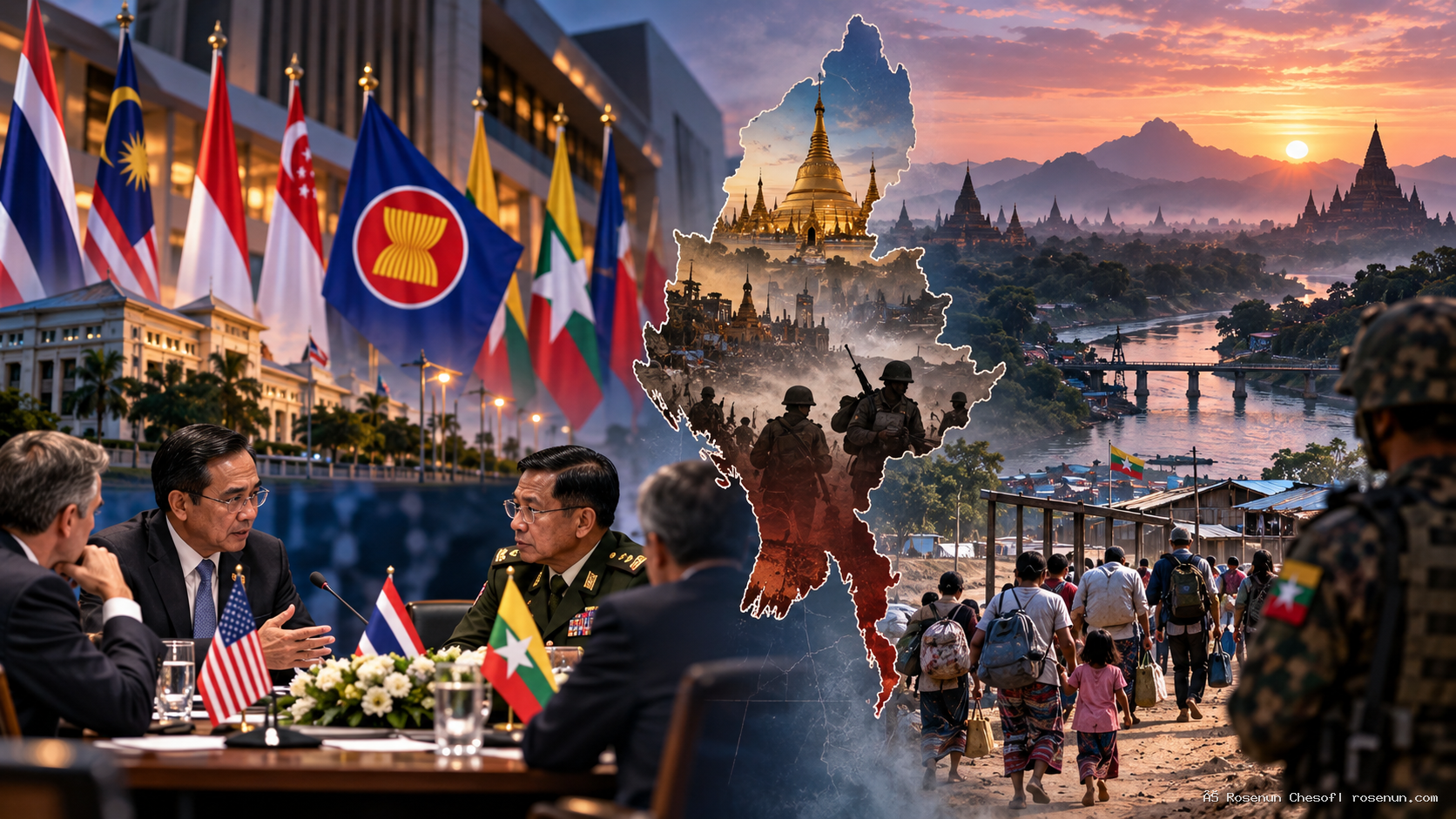
A potentially significant shift in Southeast Asian diplomacy emerged on 23 October 2026, when Thailand's Deputy Prime Minister and Foreign Minister, Sihasak Phuangketkeow, told Reuters that Bangkok welcomed renewed engagement between the United States and Myanmar.
His remarks followed reports that US representatives had held a second round of talks with Myanmar's military-backed government within a month, with the latest meeting taking place in Tokyo approximately two weeks earlier.
Sihasak argued that Myanmar should not be left isolated or become another arena for competition among major powers. At the same time, he emphasised that diplomatic engagement should not be confused with political endorsement. The objective, he suggested, should be a peaceful resolution of the conflict and reconciliation with opposition forces.
The distinction is important.
Since the military seized power in February 2021, Myanmar has experienced an escalating internal conflict, political repression, a deepening humanitarian crisis and growing diplomatic isolation.
ASEAN has struggled to respond effectively to a crisis involving one of its own members. Its efforts have been constrained by divisions among member states, the principle of non-interference and the limited influence it can exert over Myanmar's military leadership.
Yet more than five years after the coup, diplomatic pressure and restrictions on Myanmar's participation in regional meetings have failed to produce a sustainable political settlement.
The question facing ASEAN may therefore be change.
Rather than asking whether Myanmar's military-backed government should be engaged at all, regional governments are increasingly confronting a more difficult issue: what form of engagement might improve conditions inside the country?
2. From Isolation to Dialogue: Is ASEAN Changing Its Approach?
Following the 2021 military takeover, ASEAN restricted Myanmar's political representation at high-level meetings while attempting to implement its Five-Point Consensus.
Adopted in April 2021, the agreement called for an immediate cessation of violence, constructive dialogue among all parties, the appointment of an ASEAN special envoy, humanitarian assistance and a visit by the envoy to meet the parties concerned.
The framework was intended to provide a regional pathway towards de-escalation and political dialogue.
In practice, however, implementation has remained deeply problematic.
ASEAN has few effective enforcement mechanisms, while its member states have different security concerns, economic interests and political approaches towards Myanmar.
For countries sharing borders with Myanmar, particularly Thailand, the conflict has immediate consequences.
Refugee movements, border trade disruptions, security threats and transnational criminal networks are not distant diplomatic issues. They directly affect communities, businesses and government agencies along the border.
Other ASEAN members may place greater emphasis on the organisation's credibility, democratic principles or its longstanding commitment to non-interference.
Reconciling these priorities has proved difficult.
In his October remarks, Sihasak suggested that some changes were becoming visible in ASEAN's approach, pointing to visits by Myanmar's military leader, Min Aung Hlaing, to Laos, Cambodia, Vietnam, Thailand and Malaysia.
He also anticipated substantial discussion of Myanmar's future at the ASEAN summit scheduled for November in Manila.
However, there was no confirmation that ASEAN would restore Myanmar's full political participation at the highest level.
That distinction should not be overlooked.
Expanding diplomatic contacts does not necessarily mean restoring political legitimacy.
ASEAN could maintain communication with Myanmar's authorities to facilitate humanitarian assistance, negotiate ceasefires or encourage political dialogue while continuing to restrict their participation in leaders' meetings.
Such an approach would preserve channels of communication without automatically granting the political recognition that Myanmar's military leadership may seek.
The danger arises when engagement becomes normalisation without conditions.
If diplomatic relations are restored without measurable progress towards reducing violence or establishing an inclusive political process, ASEAN risks undermining the very principles it has spent years defending.
The challenge is therefore not simply whether to reopen dialogue, but how to ensure that dialogue produces meaningful results.
3. Why Is Washington Talking to Myanmar Again?
The reported resumption of contact between Washington and Myanmar's military-backed authorities adds another dimension to the diplomatic picture.
For several years, the United States has relied heavily on sanctions and diplomatic pressure to pressure Myanmar's military leadership.
Meanwhile, Myanmar has maintained relations with countries willing to continue engagement, notably China and Russia.
The country's strategic location helps explain why developments there attract international attention.
Myanmar lies between China, India and mainland Southeast Asia, with access to the Indian Ocean through the Bay of Bengal and the Andaman Sea.
For China, Myanmar is important for border security, trade and infrastructure connectivity.
For India, developments in Myanmar affect security along its northeastern frontier and efforts to strengthen economic links with Southeast Asia.
For the United States, Myanmar presents overlapping concerns involving regional stability, human rights and strategic competition in the Indo-Pacific.
Against this background, renewed American engagement could reflect a reassessment of whether diplomatic isolation alone can influence developments inside Myanmar.
Maintaining some form of communication may provide opportunities to exchange information, convey expectations and explore possible avenues for de-escalation.
However, it would be premature to conclude that Washington's primary objective is to counter Chinese influence.
Diplomatic contacts can serve several purposes simultaneously, and the existence of talks does not establish the strategic intentions behind them.
What matters is whether the United States links further engagement to concrete improvements in Myanmar's political and humanitarian situation.
There is also a question about ASEAN's role.
If major powers increasingly engage Myanmar through direct bilateral channels, the regional organisation may face pressure to reconsider its own strategy.
That could weaken ASEAN's collective influence if member states pursue competing approaches.
Alternatively, greater international engagement could create additional diplomatic opportunities if the parties coordinate their efforts around reducing violence and encouraging inclusive dialogue.
Much will depend on whether external powers treat Myanmar primarily as a strategic asset or as a country whose population urgently needs a political settlement.
4. Malaysia and the Human Cost of Renewed Engagement
The changing diplomatic atmosphere is not confined to Thailand.
Earlier in October, Min Aung Hlaing visited Malaysia for discussions with Prime Minister Anwar Ibrahim.
The visit came amid concerns over plans to repatriate approximately 5,000 Myanmar nationals from Malaysia in stages.
According to reporting by the Associated Press, the proposed returns prompted warnings from the United Nations refugee agency and human rights organisations about the risks individuals could face upon returning to a country still experiencing armed conflict.
These concerns included possible persecution and military conscription.
Malaysia's government presented the initiative as part of its diplomatic efforts while maintaining that Myanmar had responsibilities towards its own citizens.
Human rights groups questioned whether those being returned could be adequately protected.
The controversy illustrates why diplomatic engagement cannot be evaluated solely through meetings between governments.
For neighbouring states, communication with Myanmar's authorities may be necessary to address migration, border security and humanitarian challenges.
For people who have fled the conflict, however, closer cooperation between governments may raise fears that their safety will be subordinated to political or administrative priorities.
This is where the distinction between diplomatic progress and humanitarian progress becomes particularly important.
The government may regard the resumption of bilateral relations as a diplomatic achievement. But if that development results in vulnerable individuals being returned to unsafe conditions, the broader consequences may be far less positive.
Any repatriation process must take account of the protection needs of those involved, including the principle of non-refoulement, which prohibits returning people to places where they face certain forms of serious harm.
The issue is not simply whether Myanmar's authorities agree to receive returning nationals.
The question is whether individuals can return safely, voluntarily and with adequate protection.
If ASEAN intends to pursue a more active diplomatic approach, humanitarian safeguards must remain central to the process.
Otherwise, renewed engagement could produce agreements between governments without improving conditions for the people most affected by the conflict.
5. Can There Be Peace Without Opposition?
The most difficult question surrounding Myanmar's diplomatic future concerns the structure of the conflict itself.
Myanmar's crisis is not a conventional dispute between a government and a single opposition party.
The country is home to numerous ethnic armed organisations, resistance forces that emerged following the 2021 coup, and political networks with different objectives and territorial interests.
Some groups have longstanding grievances involving autonomy, ethnic identity and the distribution of political power.
Others emerged in direct opposition to military rule.
Their relationships with one another are complex, and their positions cannot be reduced to a single political agenda.
Consequently, an agreement reached exclusively with Myanmar's military-backed government would not necessarily produce peace across the country.
In some areas, territorial control and political authority differ substantially from the arrangements formally recognised by the central government.
This makes any sustainable settlement dependent on the participation of a much broader range of actors.
Renewed diplomatic contact with the authorities may provide a starting point, but it cannot substitute for an inclusive political process.
Progress would need to be measured against practical developments: reductions in violence, humanitarian access, protection of civilians and credible opportunities for dialogue among the parties to the conflict.
At the same time, refusing all contact with Myanmar's authorities may make some of these objectives more difficult to achieve.
The challenge is to establish a form of engagement that encourages progress without turning diplomatic access into an unconditional political reward.
ASEAN could consider linking different levels of engagement to clearly defined and verifiable outcomes.
Humanitarian coordination, for example, could continue without automatically restoring Myanmar's full political representation at regional summits.
A broader political normalisation process, by contrast, could be tied to demonstrable improvements in security conditions and inclusive dialogue.
Such an approach would allow ASEAN to remain engaged while preserving the credibility of its commitments.
It would also provide a clearer basis for assessing whether diplomatic initiatives are producing results or merely creating the appearance of progress.
The distinction matters because Myanmar's conflict cannot be resolved through international recognition alone.
Any durable settlement will ultimately require political arrangements that address the interests and security concerns of the country's diverse communities.
Conclusion: Will an Open Door Lead to Peace or Legitimacy?
The diplomatic developments of October 2026 suggest that the regional approach towards Myanmar may be entering another phase.
The United States has reportedly resumed discussions with Myanmar's military-backed authorities. Thailand has welcomed that engagement. Myanmar's military leaders have visited several ASEAN countries while the organisation prepares for further discussions at its November summit.
Taken together, these developments indicate a growing willingness to reconsider the limits of diplomatic isolation.
But they do not establish that Myanmar's war is approaching an end.
Nor do they mean that ASEAN has decided to restore full political recognition to Myanmar's military-backed government.
Diplomatic engagement can create opportunities for negotiation, humanitarian cooperation and conflict reduction.
It can also create risks if relations are normalised before meaningful improvements occur on the ground.
For ASEAN, this is a test of its ability to respond to a prolonged crisis within its own region.
If renewed engagement helps reduce violence, expand humanitarian access and establish a more inclusive political process, it could demonstrate that diplomacy remains an effective instrument even under difficult circumstances.
But if meetings resume while civilians continue to face insecurity and displacement, diplomatic activity may amount to little more than a change in appearances.
The real measure of success should not be the number of official visits, meetings or statements.
The focus should be on whether the lives of people in Myanmar become safer and whether the prospects for a lasting political settlement will improve.
1. Reuters. (2026, October 23). Thailand welcomes US-Myanmar engagement, expects ASEAN talks on country's future.
https://www.reuters.com/world/asia-pacific/thailand-welcomes-us-myanmar-engagement-expects-asean-talks-countrys-future-2026-10-23/
2. The Nation Thailand. (2026, October 24). Thailand backs US-Myanmar talks before November ASEAN summit:
https://www.nationthailand.com/news/asean/40072668?
3. Associated Press. (2026, October). Myanmar military leader arrives in Malaysia as repatriations draw criticism.
https://apnews.com/article/min-aung-hlaing-malaysia-anwar-rohingya-34a65fe203c37131d33965c680699082
4. Associated Press. (2026, October 24). Myanmar's detained leader Suu Kyi traded health concerns with her son in their first call in 5 years. https://apnews.com/article/myanmar-suu-kyi-kim-aris-phone-call-00c4a716b57888c75e1a3015fb7028e6
The question, then, is not simply whether ASEAN should reopen the door to Myanmar. It is who will benefit when that door opens: a population desperate for peace, or a government seeking renewed international legitimacy?