October 25, 2004: The Day Everything Changed
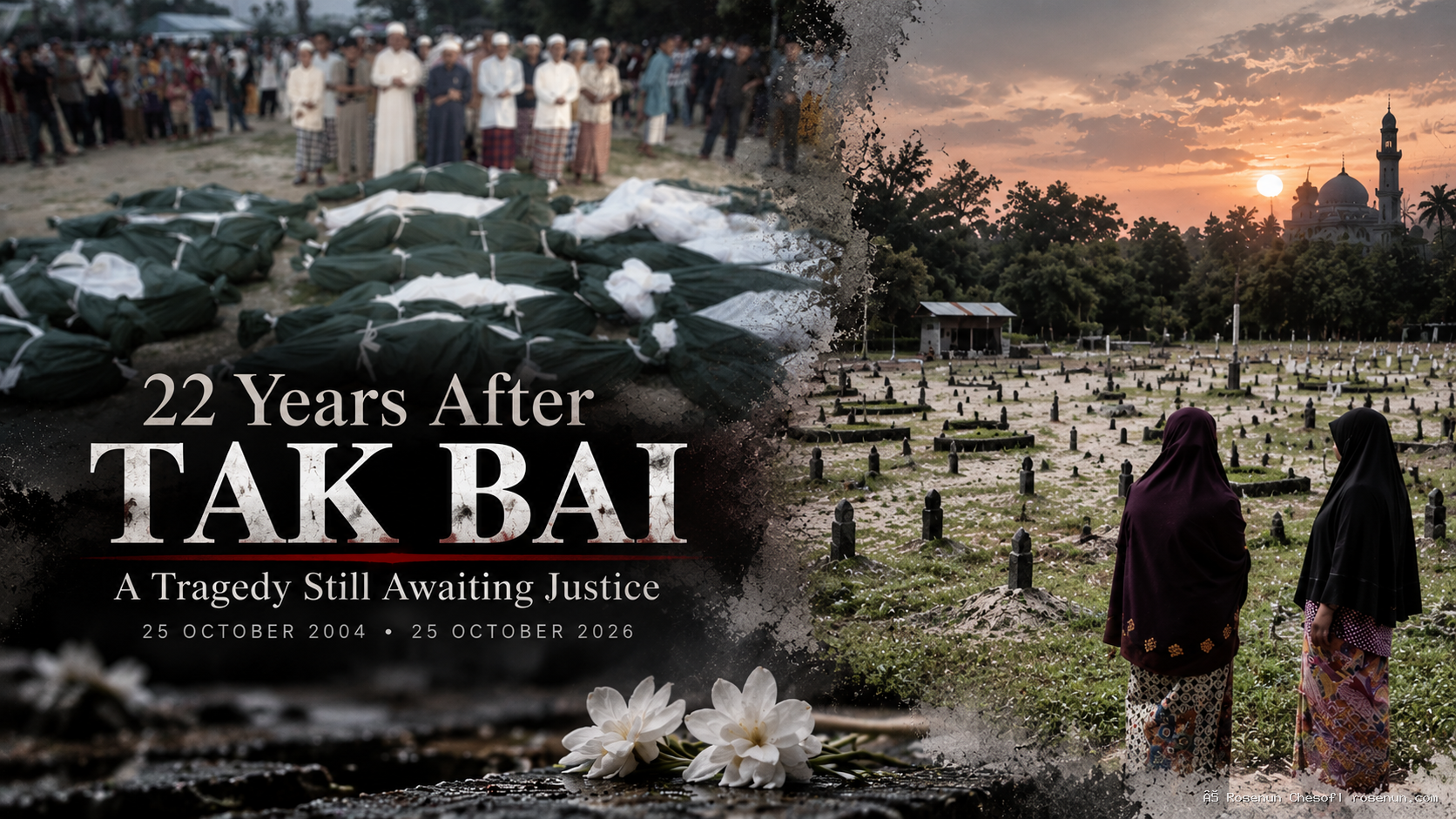
On the morning of October 25, 2004, a large crowd gathered outside the Tak Bai Police Station in Narathiwat province, near Thailand's border with Malaysia.
The protesters were demanding the release of six village security volunteers who had been detained on suspicion of handing over government-issued weapons to insurgents.
Many of those gathered were Malay Muslims, members of communities whose language, culture, religion and historical identity have long shaped Thailand's southern border provinces.
The protest took place against a backdrop of growing insecurity. Earlier that year, violence had intensified across the southern provinces, deepening tensions between local communities and the Thai authorities.
As the demonstration continued, confrontations developed between protesters and security personnel. The authorities eventually moved in to disperse the crowd, using water cannons, tear gas, and live ammunition.
Seven protesters were shot dead at the scene.
What followed would make Tak Bai one of the most devastating incidents in the modern history of Thailand's southern border region.
Approximately 1,300 people were detained. Many were ordered to remove their shirts, had their hands tied behind their backs, and were made to lie face down on the ground.
They were subsequently loaded onto military trucks for transportation to Ingkhayutthaborihan Military Camp in neighbouring Pattani province, approximately 150 kilometres away.
The detainees were packed tightly into the vehicles, with some forced to lie on top of others in several layers.
By the time the trucks reached their destination, 78 detainees had died from suffocation and compression during the journey.
Together with the seven people killed during the dispersal, the death toll reached 85.
Yet behind that number were 85 individual lives: sons, fathers, husbands, brothers, and members of communities whose families would never see them return home.
When Death Occurred in State Custody
One of the most disturbing aspects of the Tak Bai tragedy was not simply the number of deaths, but the circumstances in which most of them occurred.
The majority of those who died were not killed during the confrontation between protesters and security forces.
They died after being detained while under the control of the authorities.
This distinction is fundamental.
Once individuals are taken into custody, the state assumes responsibility for their safety and well-being, regardless of the allegations against them.
Detention does not remove a person's right to life, dignity, or humane treatment.
These principles lie at the heart of international human rights standards and the rule of law.
In December 2004, a government-appointed fact-finding commission concluded that the methods used to disperse the demonstration were inappropriate and inconsistent with internationally accepted practices. The report also identified serious failures in the supervision and management of the detainees' transportation.
The findings pointed to problems extending beyond an isolated operational mistake. They raised questions about decision-making, command responsibility, and the treatment of people placed under state control.
Nevertheless, establishing that serious failures occurred is not the same as determining individual criminal responsibility.
That distinction would shape the struggle for justice over the next two decades.
A Long Road Through the Justice System
In the years following Tak Bai, investigations, judicial enquiries, and compensation programmes were undertaken.
On May 29, 2009, the Songkhla Provincial Court issued its findings in an inquest into the deaths of 78 detainees transported in military trucks.
The court determined that the victims had died from suffocation during transportation.
However, the inquest did not establish the criminal responsibility of specific individuals.
In 2013, the Supreme Court upheld the findings.
For the families of the deceased, an official explanation of how their loved ones died was only part of the answer.
They continued to ask who had authorised the transportation arrangements, who had been responsible for supervising the operation, and why a process that resulted in so many deaths had not led to criminal accountability.
Successive Thai governments have introduced compensation measures for victims and their families.
Such assistance was important in addressing the immediate and long-term hardship caused by the tragedy.
But financial compensation and criminal accountability serve different purposes.
Compensation can acknowledge suffering and provide material support. It cannot, by itself, establish who was responsible for a death or ensure that unlawful conduct is punished.
Justice also requires the pursuit of truth, effective investigation, accountability where wrongdoing is proven, and safeguards against recurrence.
For many families, those questions remain unresolved.
Twenty Years Later, the Clock Ran Out
The twentieth anniversary of Tak Bai in 2024 became a defining moment in the long campaign for accountability.
In April 2024, 48, the victims and relatives brought a criminal case before the Narathiwat Provincial Court against officials allegedly involved in the incident.
On August 23, 2024, the court ruled that there were sufficient grounds to proceed against seven former military, police, and administrative officials in connection with the dispersal and transportation of detainees.
In September, the Office of the Attorney General separately decided to prosecute eight suspects in a related case concerning the deaths during transportation.
Across the two proceedings, 14 individuals were implicated, as one defendant appeared in both cases.
These developments offered a renewed possibility that the events of October 2004 might finally be examined through criminal proceedings.
But time was running out.
Although arrest warrants were issued and legal proceedings were initiated, none of the defendants was brought before the court in time for the cases to proceed to trial before the statutory limitation period expired.
On October 25, 2024, twenty years after the tragedy, the limitation period expired.
Three days later, the Narathiwat Provincial Court formally dismissed the private prosecution.
The cases had reached their legal endpoint without a trial determining the defendants' guilt or innocence.
This distinction matters.
The expiration of a limitation period is not equivalent to a judicial finding that the accused committed no wrongdoing.
It means that the legal system can no longer pursue the relevant criminal proceedings because the time permitted by law has elapsed.
For the families who had waited two decades, the passage of time had become another obstacle to obtaining a judicial determination.
The tragedy is no longer only about what happened in 2004.
It was also about what had, and had not, happened in the twenty years that followed.
Tak Bai and the Question of Trust
The Tak Bai tragedy occurred in a region with a complex history of relations between the state and local communities.
Thailand's southern border provinces are home to diverse populations, including Malay Muslim communities whose language, religious traditions, and cultural identity are deeply rooted in the region's history.
Relations between these communities and the Thai state have long been influenced by questions of governance, education, language policy, security, and recognition of cultural identity.
Against this historical background, Tak Bai came to represent more than a single episode of protest and repression.
For many, it became a symbol of the unequal relationship between state power and the rights of ordinary citizens.
When the authorities detain an individual, they are responsible for protecting that person's life.
When deaths occur in custody, an independent, transparent, and effective investigation is essential not only for the victims but also for public confidence in the institutions of the state.
Trust cannot be restored through compensation alone.
It depends on whether citizens believe that the law protects everyone equally and that those exercising public authority can be held accountable for their actions.
When a tragedy involving numerous deaths does not result in a completed criminal trial, that failure can deepen existing mistrust.
The consequences may extend far beyond the immediate victims, shaping how subsequent generations understand the relationship between their communities and the state.
Yet acknowledging these grievances should never be interpreted as justifying violence against anyone.
Justice and peace must be pursued together, with the protection of human life and dignity at their centre.
Remembering Is Not the Same as Refusing to Move Forward
Every October 25, Tak Bai returns to the collective memory of families, communities, human rights advocates, and those concerned about the future of Thailand's southern border provinces.
For some, it may be remembered as an episode in Thailand's political history.
For those who lost loved ones, however, October 25, 2004, is not merely a date in a historical record.
It is the day their families changed forever.
Remembering such an event does not mean remaining trapped in the past.
Nor does demanding accountability mean rejecting reconciliation.
On the contrary, confronting painful history may be essential to building a future in which similar tragedies are less likely to occur.
A society does not have to forget its past in order to move forward.
It must instead be willing to acknowledge what happened, examine the decisions that led to suffering, and learn from the consequences.
Moving beyond pain does not mean pretending that the pain never existed.
And looking towards the future should not require those who suffered to surrender their memories.
For younger generations, the significance of Tak Bai lies not only in understanding a tragedy that occurred before many of them were born.
It also lies in recognising why human rights, accountability, and the responsible exercise of state power matter in any society.
Historical memory, when approached with honesty and compassion, need not deepen divisions.
It can become a foundation for understanding, reform, and the prevention of future injustice.
Twenty-Two Years On, What Has Thailand Learned?
October 25, 2026, marks twenty-two years since the Tak Bai tragedy and two years since the criminal proceedings came to an end because of the statute of limitations.
Many essential facts have been documented: the number of people who died, the conditions under which detainees were transported, and the serious shortcomings identified by official investigations.
Yet the question of individual criminal responsibility was never resolved through a completed trial.
The lessons of Tak Bai therefore extend beyond the conduct of security personnel on a single day in October 2004.
They also concern the effectiveness of criminal investigations, the timeliness of prosecutions, command responsibility, and whether limitation periods are appropriate in cases involving serious human rights violations.
Above all, Tak Bai reminds us that the exercise of state power must always be accompanied by accountability.
Lasting security cannot be built where citizens lack confidence that their lives and rights will be protected.
Nor can meaningful peace depend solely on the silence of those who have suffered.
Twenty-two years have passed. Nothing can undo the deaths of October 25, 2004, or restore the years that families have spent waiting for answers.
But the passage of time does not make the tragedy irrelevant.
Society can still decide what lessons to draw from it, what institutional safeguards to strengthen, and what kind of future to build for the next generation.
Moving forward does not mean forgetting. It means carrying the memory of what happened into a future where others will not have to endure the same suffering.
And perhaps that is the most enduring responsibility left by Tak Bai: not merely to remember the 85 lives lost, but to ensure that their loss continues to matter.
References
Human Rights Watch. (2024, October 28). Thailand: 20 Years of Injustice for Tak Bai Massacre Victims. https://www.hrw.org/news/2024/10/28/thailand-20-years-injustice-tak-bai-massacre-victims
International Commission of Jurists. (2024, October 26). Thailand: As statute of limitations expires in Tak Bai massacre, justice remains elusive. https://www.icj.org/thailand-as-statute-of-limitations-expires-in-tak-bai-massacre-justice-remains-elusive/
International Commission of Jurists. (2024, August 23). Thailand: A historic step towards justice in the Tak Bai incident. https://www.icj.org/thailand-a-historic-step-towards-justice-in-the-tak-bai-incident/
Amnesty International. (2024, August 23). Thailand: Court decision on Tak Bai protest lawsuit a crucial first step towards justice. https://www.amnesty.org/en/latest/news/2024/08/thailand-court-decision-on-tak-bai-protest-lawsuit-a-crucial-first-step-towards-justice/
Associated Press. (2024, October 28). A Thai court drops a case over the deaths of Muslim protesters in 2004. https://apnews.com/article/71d33f914f2ae9788c3e4213f996cc71
International Commission of Jurists. (2025, October). Thailand: One year on, still no statute of limitations reform in Tak Bai massacre case. https://www.icj.org/thailand-one-year-on-still-no-statute-of-limitations-reform-in-tak-bai-massacre-case/